
CARF readiness is an operating system, not a survey-week document project. CARF accreditation consulting can help behavioral health organizations turn preparation into a structured process, so policies, records, staff practices, and operational systems work together rather than being assembled at the last minute.
The challenge is rarely a lack of effort. It is knowing what work comes first, how requirements apply across programs, and how to keep documentation aligned with the way the organization operates. A clear, organization-specific plan helps leaders prioritize gaps and build consistent practices without reducing readiness to a paperwork exercise.
This guide explains how consulting can structure that work, from gap analysis and documentation preparation to mock surveys and coordination with licensing, staffing, and facility operations. It also covers how to sustain survey readiness and use ongoing improvement practices to strengthen operations beyond accreditation preparation.
Key Takeaways
- Separate CARF accreditation requirements from consulting support so your organization retains ownership while using structured preparation guidance.
- Use CARF accreditation consulting to organize readiness work into clear stages, from defining scope and assessing gaps to preparing and reviewing evidence.
- Match advisory support to your needs, whether you’re prioritizing a gap analysis, documentation preparation, mock survey, or ongoing readiness.
- Build recurring responsibilities and review routines into daily operations so readiness does not become a last-minute documentation exercise.
- Coordinate accreditation planning with state licensing, facility structure, staffing, and operational systems to create a more consistent readiness plan.
What CARF Accreditation Consulting Does for Behavioral Health Organizations
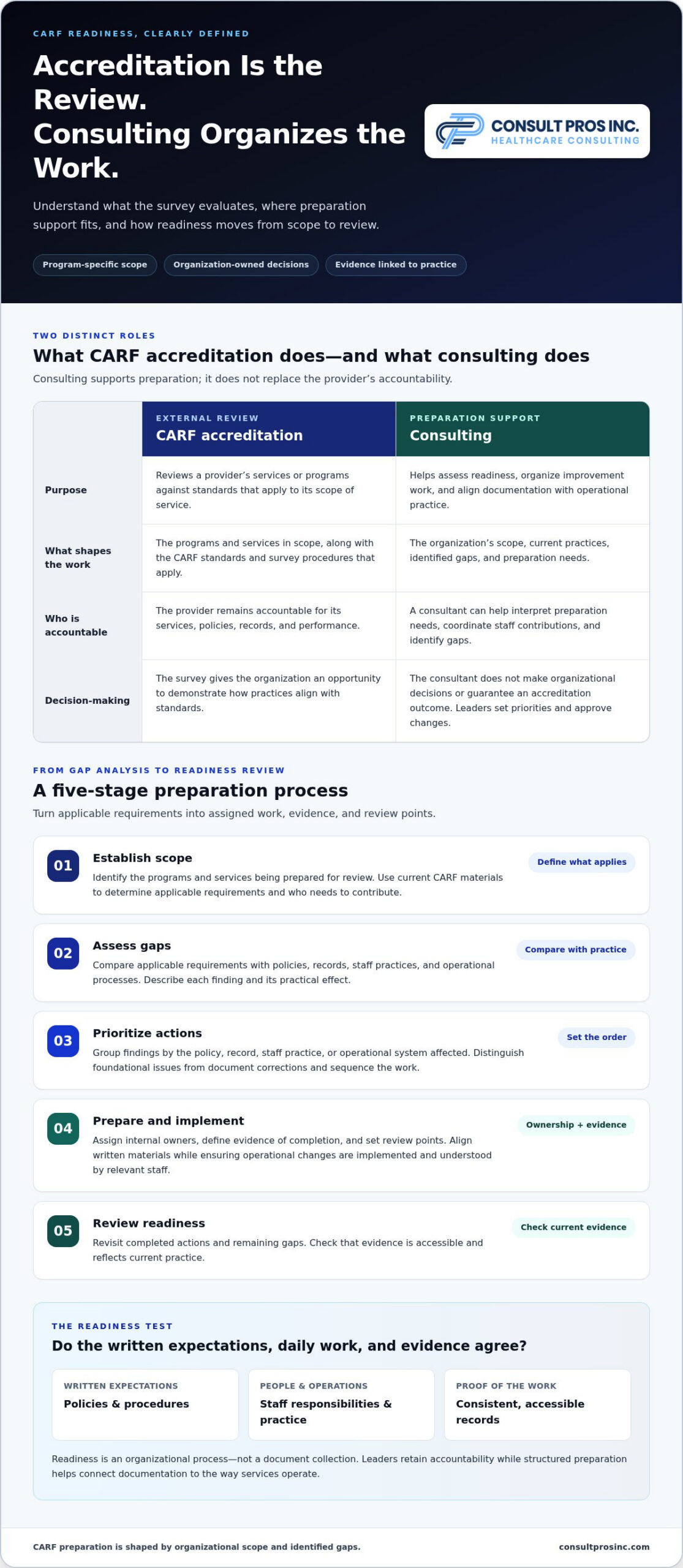
CARF accreditation is an external review of a provider’s services or programs against the standards that apply to the organization’s scope of service. The survey process gives the organization an opportunity to demonstrate how its practices align with those standards. CARF accredits programs and services across several areas, including behavioral health; its CARF accreditation overview provides general background on the organization and its work.
Consulting is different. CARF accreditation consulting is structured preparation support that helps an organization assess readiness, organize improvement work, and align documentation with operational practice. A consultant can help leaders interpret preparation needs, coordinate staff contributions, and identify gaps, but cannot make organizational decisions or guarantee an accreditation outcome. The provider remains accountable for its services, policies, records, and performance.
That distinction matters because CARF requirements depend on the programs and services in scope. There is no single preparation checklist for every behavioral health organization. Leaders need to define the intended scope and use current CARF materials to identify applicable standards and survey procedures. Consulting can make the work more systematic, while decisions about how the organization operates remain with its leadership.
Where consulting fits in the accreditation journey
Preparation for an initial survey often starts with establishing a foundation: clarifying scope, assigning responsibilities, and organizing evidence of how services operate. Renewal readiness builds on existing practices and addresses areas that need continued attention. Ongoing improvement extends beyond either survey milestone, helping leaders maintain review routines and respond to operational changes. At each stage, an adviser can organize tasks and surface unresolved issues, while leaders set priorities and approve organizational changes.
Why readiness is broader than policy documentation
Written procedures are only one part of readiness. A policy needs to connect to clear staff responsibilities, consistent records, and the work performed in practice. For example, a procedure may explain how a process should work, while staff need to understand their roles and records need to show how the process is carried out. If those elements do not match, teams may have to reconcile documents and practices under survey pressure. Readiness is an organizational process, not a document collection.
Disconnected systems can make routine preparation harder. A procedure may be stored separately from the records that demonstrate its use, while staff responsibilities remain unclear or vary across programs. Reviewing these connections helps leadership see where coordination is needed and where existing processes already support readiness. The goal is not to create paperwork for its own sake, but to make documented expectations, daily operations, and evidence coherent.
Consulting provides structure and an outside perspective; the organization supplies operational knowledge and accountability. This partnership can help behavioral health leaders treat accreditation as part of sound governance and continuous improvement, rather than as a temporary effort to assemble files for a survey.
How CARF Accreditation Consulting Moves from Gap Analysis to Survey Readiness
A useful preparation process turns applicable requirements into assigned work, evidence, and review points. The sequence should reflect the organization’s programs, relevant CARF standards, and existing practices rather than rely on a universal checklist. Consult Pros Inc supports this work through gap analysis, documentation preparation, and mock surveys. Priorities and timing are shaped by the organization’s scope and identified gaps.
- Establish scope. Identify the programs and services being prepared for review, then use current CARF materials to determine which requirements apply. Clear scope keeps the assessment relevant and helps leaders identify who needs to contribute.
- Assess gaps. Compare applicable requirements with existing policies, records, staff practices, and operational processes. Describe each finding clearly, including its practical effect, such as a written procedure that does not match how staff carry out the process.
- Prioritize actions. Group findings by the policy, record, staff practice, or operational system affected. Leaders can distinguish foundational issues from document corrections, then sequence work around organizational responsibilities and available resources.
- Prepare and implement. Assign internal owners to corrective actions, define what evidence will show completion, and set review points. Documentation preparation can clarify or align written materials; operational changes need to be implemented and understood by the relevant staff.
- Review readiness. Revisit completed actions and remaining gaps, checking that evidence is accessible and reflects current practice. This creates a working view of readiness, not a promise of a particular survey determination.
Turn assessment findings into an owned work plan
A finding becomes manageable when it has an accountable owner, a defined completion record, and a planned check-in. For example, if staff practices differ from a written procedure, the action might include reviewing the procedure, communicating clarified responsibilities, and checking whether later records reflect the intended process. Leaders can monitor progress with a status review that records open actions, evidence received, and decisions still required. This creates oversight without suggesting every provider follows the same CARF checklist.
The sequence also needs to fit the organization’s circumstances. A provider with established processes may focus on reconciling records and addressing targeted gaps. An organization changing its operations may need to coordinate foundational work before reviewing evidence. Federal behavioral health resources from SAMHSA offer broader context for the field, while the applicable CARF standards remain the reference point for accreditation preparation.
Use mock surveys and documentation review purposefully
A mock survey is a readiness exercise that simulates aspects of survey review. It can assess whether staff can explain relevant practices and locate supporting evidence, then identify preparation needs. It does not predict or guarantee an accreditation outcome. Documentation review complements the exercise by comparing written procedures with records and reported practices. If materials conflict, address the operational cause rather than simply polishing the wording, so revised documents accurately reflect responsibilities and established processes.
For organizations structuring this work across programs and operations, CARF accreditation consulting support from Consult Pros Inc can connect assessment findings with documentation preparation and readiness review. The aim is a repeatable process that keeps actions visible and supports improvement beyond the immediate survey preparation period.
How to Scope CARF Accreditation Consulting for Your Organization
A useful consulting scope starts with the organization’s actual readiness needs, not a preset package. For CARF accreditation consulting, consider which programs are in scope, how consistently procedures are followed, what internal staff can manage, and what an assessment has already identified. The right combination of advisory work can then focus effort where it will help leaders make informed decisions and keep preparation aligned with operations.
Use this comparison to frame the work. Options can be combined or adjusted as findings develop; they are not a universal sequence or ranking.
| Readiness need | Suitable advisory work | Useful focus |
|---|---|---|
| Requirements or gaps are unclear | Focused gap analysis | Assess applicable requirements and organize prioritized findings for leadership review. |
| Policies and actual practices appear inconsistent | Documentation preparation and review | Identify where written procedures, records, and operational practices need alignment. |
| Staff need practice explaining procedures or locating evidence | Mock survey and staff preparation | Rehearse evidence retrieval and identify areas where staff need clearer guidance. |
| Readiness needs to continue beyond a single review | Ongoing readiness assistance | Support recurring reviews of open actions, records, and operational changes. |
Match consulting support to the readiness gap
Choose a starting point based on what is creating friction. If leaders cannot determine which requirements apply or where gaps exist, a structured assessment can produce prioritized findings. If procedures differ across teams or do not reflect daily work, pair documentation review with operational alignment. When staff need practice navigating readiness activities, a mock survey can help them retrieve evidence and describe established processes. Let findings guide the work rather than assumptions.
Scope also depends on internal capacity. An organization with assigned owners and established review routines may need focused advisory input. A team with competing operational demands may benefit from more coordination across preparation tasks. The number and nature of programs in scope, existing documentation, and identified gaps all affect priorities. Review the scope as work progresses so newly surfaced issues can be addressed without losing sight of agreed responsibilities.
Define roles, deliverables, and decision points
Set expectations at the outset. A consultant can support assessment, review materials, organize findings, and facilitate readiness exercises. Organizational leaders retain authority over policies, staffing, operational decisions, and corrective actions. Practical deliverables might include a gap summary, an action plan with internal owners, or reviewed documentation. Define who approves revisions, how often progress is reviewed, and how unresolved or cross-functional issues reach leadership.
These agreements turn an advisory engagement into a manageable working structure. For each action, specify the person responsible, the evidence that will demonstrate completion, and the review point for confirming progress. If an action affects staffing, facility setup, or another operational system, identify the relevant decision-makers early. Consult Pros coordinates CARF accreditation preparation with its broader advisory work, helping organizations structure support around their scope, capacity, and readiness findings.
How to Build a CARF Readiness Plan Around Daily Operations
A sustainable readiness plan assigns accreditation work to the people and routines that support the organization’s operations. Rather than treating preparation as a separate project, leaders can connect each priority to a responsible role, the records that demonstrate the work, and a recurring review point. This makes emerging gaps more visible and helps staff understand how everyday responsibilities contribute to organizational readiness.
Accreditation planning and state licensing are distinct processes, each with its own requirements and decision points. They may still need coordinated sequencing. For example, a change in services or facility operations could affect licensing tasks as well as the procedures or records reviewed during accreditation preparation. Leaders can map the workstreams separately, then identify dependencies so decisions, staffing, and operational changes are addressed in a coordinated way. A behavioral health facility setup guide can also inform foundational planning when operational systems are still being established.
Assign internal ownership and staff preparation
Assign clear internal owners for policies, records, training, and corrective actions. Different leaders may hold these responsibilities, but handoffs should be explicit. Policy revisions need to reach affected staff, and records should be maintained by the people closest to the work. CARF accreditation consulting can help organize this coordination, while organizational leaders retain responsibility for decisions and implementation.
Connect orientation and ongoing training to role-specific procedures. Staff need to understand the expectations relevant to their work, where supporting records are maintained, and how to raise an issue when actual practice no longer matches written guidance. Use a consistent communication process for revised procedures and action items rather than relying on informal messages that may not reach everyone. Training records and review notes can help leaders track whether communication and follow-up occurred.
Make readiness a repeatable management practice
Set a recurring review cadence that fits the organization’s operations. At each review, leaders can check open actions, confirm that supporting documentation is current, and surface unresolved issues that need a decision or additional coordination. Keep the record practical: note the action, owner, status, evidence reviewed, and next step. This provides an operational view of readiness without creating a second documentation system.
Changes in programs, staffing, or operational processes may affect procedures, training needs, or records. Build a simple change review into existing management routines so relevant materials are considered when operations change. Continuous improvement means examining how processes work, identifying areas for refinement, and following through. Accreditation should not be presented as a guarantee of quality outcomes.
Consult Pros can help structure accreditation preparation alongside licensing, facility setup, staffing, and operational planning. Plan your CARF readiness support around the organization’s responsibilities and day-to-day systems.
How Consult Pros Supports CARF Accreditation Consulting and Operational Readiness
Consult Pros advises behavioral healthcare organizations on CARF accreditation preparation through gap analysis, mock surveys, and documentation preparation. These services help leaders understand readiness needs, organize supporting work, and review how written materials relate to operations. The scope is shaped around the organization’s programs, priorities, and existing systems. CARF accreditation consulting provides advisory structure, while decisions, implementation, and accountability remain with organizational leadership.
Preparation can also intersect with foundational operational work. Facility setup, staffing, and state licensing each involve distinct planning and responsibilities, but changes in one area may affect how another workstream is sequenced. Coordinating these efforts helps leaders identify dependencies, assign internal owners, and avoid treating accreditation as an isolated documentation project. Licensing and accreditation remain separate processes, and neither substitutes for the other.
Coordinate accreditation work with organizational foundations
Facility planning and operational setup establish processes that may later need to be reflected in procedures, staff responsibilities, and records. Consult Pros helps leaders consider these connections as they structure accreditation preparation. State licensing work can be coordinated alongside accreditation planning so related decisions and tasks are visible, while the distinct requirements of each process remain clear.
Staffing and onboarding matter, too. Consistent role expectations help staff understand how their responsibilities connect to written procedures and operational records. Coordinating these foundations can support a more coherent preparation plan, especially when an organization is establishing or adjusting its operations.
Set practical next steps with an advisory partner
A productive first discussion begins with the organization’s program scope, goals, current readiness concerns, and capacity to manage internal work. Leaders and an adviser can then identify whether the immediate need is assessment, documentation support, a mock survey, or coordination across broader operational priorities. Clear responsibilities and review points make the engagement useful without shifting organizational accountability to the adviser.
To prepare, outline which programs are being considered, what work is already underway, and where uncertainty or operational changes may affect readiness. This gives the discussion a practical starting point and helps align advisory support with actual priorities.
- Assessment needs: Identify where current readiness is unclear or requires structured review.
- Priorities: Note key concerns across documentation, staffing, facility setup, and licensing.
- Responsibilities: Clarify who can make decisions, carry out actions, and review progress internally.
- Sequencing: Surface dependencies between accreditation preparation and other organizational work.
With these foundations in view, Consult Pros can structure coordinated advisory support around the organization’s needs, without promising a particular survey outcome or timeline. Discuss your organization’s CARF readiness priorities with Consult Pros to define a practical starting point.
Set Your Next Readiness Priority
A practical next step is to identify the decision that would most improve clarity for your organization. That may mean agreeing on which programs are in scope, assigning an internal lead, or deciding how accreditation planning should fit alongside other operational priorities. Starting with one defined question gives leadership a useful basis for setting direction and allocating responsibility.
CARF accreditation consulting is most useful when it supports an organization-specific plan that leaders can carry forward, rather than a temporary push to prepare for a survey. Consult Pros works with behavioral health organizations to structure accreditation preparation and related operational planning around their needs and priorities.
Discuss your CARF accreditation readiness with Consult Pros to identify a clear starting point for your organization’s next phase of preparation. With a defined direction and appropriate advisory support, your team can build readiness into the way the organization operates.
Frequently Asked Questions
What does CARF accreditation consulting include?
CARF accreditation consulting can include a readiness assessment, gap analysis, documentation preparation, mock surveys, and support organizing corrective actions. The right scope depends on the organization’s services, existing systems, and assessment findings. Leaders may first need a clearer view of open gaps before deciding whether document review or survey practice should follow. Consult Pros provides gap analysis, mock surveys, and documentation preparation; organizational leaders remain responsible for decisions and implementation.
Is CARF accreditation required for behavioral health providers?
No universal requirement applies to every behavioral health provider. Whether accreditation matters depends on the organization’s service line, contracts, and applicable jurisdiction. Verify any stated requirement against current laws, payer terms, contracts, and relevant CARF materials. Keep accreditation separate from state licensure: satisfying one process should not be assumed to satisfy the other. A provider assessing a new service, for example, should review applicable licensing and contract requirements as distinct questions.
How long does CARF accreditation preparation take?
There is no reliable universal preparation timeline because the work depends on scope, current practices, staffing, documentation, and assessment findings. A provider with well-maintained records may have different priorities from one that needs to clarify responsibilities or align procedures. Build a project schedule after defining the programs in scope and reviewing current requirements, then set milestones for decisions, assigned actions, and readiness reviews. Verify application or survey scheduling details against current CARF guidance.
What is a CARF mock survey?
A CARF mock survey is a preparation exercise, not the official survey or a prediction of its decision. It can test whether staff know where relevant evidence is kept and can explain how a procedure is carried out. For instance, a practice review may reveal that a record exists but staff are unsure how to retrieve it. Assign findings for follow-up and verify that the underlying issue is addressed; the exercise cannot guarantee accreditation.
Does CARF accreditation guarantee payer contracts or reimbursement?
No. Accreditation does not guarantee payer contracts, network participation, reimbursement, or business performance. Payers make decisions under their own criteria and agreements, while accreditation is a separate review process. Treat each payer’s current requirements as a distinct workstream, and assess contracting independently rather than assuming accreditation replaces it. Consult Pros advises on both accreditation and in-network contracting, but neither service guarantees a payer decision or reimbursement.
Can a new behavioral health facility prepare for CARF accreditation before opening?
Yes, leaders can plan accreditation-related work during facility development, but planning does not establish eligibility or a survey date. Requirements depend on the services involved and current CARF materials. Early coordination can help teams consider how operational design, staffing plans, policies, and records need to develop together. Treat accreditation preparation, licensing, and facility readiness as connected but distinct workstreams, then verify applicable requirements and sequencing before relying on assumptions about a future survey.