
A polished policy binder won’t prepare an organization for a CARF survey if daily practice tells a different story. To prepare for CARF accreditation, leaders need to connect the standards with how staff deliver services, document their work, and use evidence to improve operations.
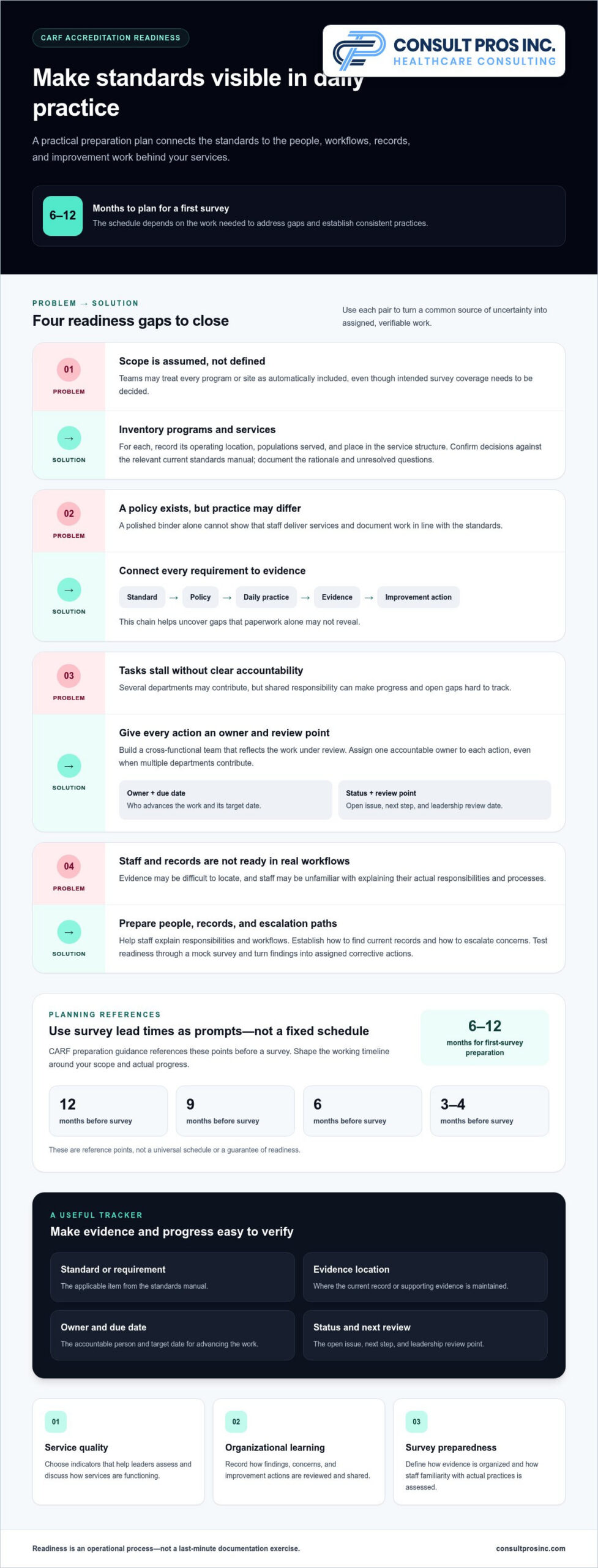
It’s understandable to be unsure where to begin, how much time to allow, or whether records reflect what happens across programs. For a first survey, organizations should plan for a preparation period of 6 to 12 months, with the schedule shaped by the work needed to address gaps and establish consistent practices. Readiness is an operational process, not a last-minute documentation exercise.
This guide lays out a sequenced approach, from reviewing applicable standards and assigning accountable owners to strengthening documentation, preparing staff, and testing readiness through a mock survey. It also explains how leadership oversight and regular performance reviews can keep policies, practice, and evidence aligned. The goal is a clear preparation plan that supports confident staff and continuous improvement, without treating accreditation as a guaranteed outcome.
Key Takeaways
- Define which programs and services are in scope so readiness work aligns with the organization’s intended survey coverage.
- Use the applicable standards manual and a documented self-evaluation to organize priorities, owners, and milestones.
- Connect each applicable standard to a policy, daily practice, supporting evidence, and an improvement action to uncover gaps beyond the paperwork.
- Prepare staff to explain their responsibilities and workflows, and establish a clear process for locating current records and escalating concerns.
- Turn readiness findings into assigned corrective actions and recurring reviews, using gap analysis, mock surveys, or documentation support where useful.
Prepare for CARF Accreditation by Defining Your Scope and Readiness Goals
Before assigning tasks or revising documents, leadership needs a shared understanding of which programs and services the organization intends to include in its CARF accreditation scope. Accreditation involves an external review of applicable service and business practices against relevant CARF standards. Scope is therefore more than a program list: it defines which operations the preparation effort must examine. For general background on CARF’s mission and the types of services it accredits, see the CARF Wikipedia article. Use the applicable CARF standards manual to guide operational decisions.
How to establish the right CARF accreditation scope
Start with an inventory for leadership review. For each program and service, record its operating location, the populations served, and how it fits into the organization’s service structure. This gives leaders a practical basis for deciding which activities are intended to fall within the accreditation scope, rather than assuming every service or site is automatically included.
Once the intended scope is set, identify the applicable CARF standards manual and check program-specific requirements against the current edition. Requirements can vary by service, so confirm scope decisions against the standards relevant to those services. Document the decision, its rationale, and any unresolved questions. This creates a defined starting point for the self-evaluation and the work that follows.
How accreditation preparation fits into facility planning
Operational design and accreditation planning inform one another. Program structure, staffing responsibilities, recordkeeping processes, and oversight practices shape daily operations. Reviewing standards can also reveal where those arrangements need clearer definition. Organizations still developing their operating model can connect accreditation planning with behavioral health facility setup so foundational decisions support an organized, evidence-based operation.
Keep accreditation readiness distinct from state licensing and other regulatory obligations. CARF preparation does not replace those requirements, and a licensing review does not substitute for evaluating practices against CARF standards. Track each obligation through its own responsible owner and evidence, coordinating work where processes overlap. This prevents teams from treating one approval or review as proof of readiness for another.
With the scope defined, set measurable readiness goals that support service quality, organizational learning, and survey preparation without treating accreditation as a guaranteed outcome. For each goal, name an accountable owner, specify the evidence that will demonstrate progress, and set a review point. Leaders might track whether staff can explain key workflows, required records are maintained consistently, or identified gaps have documented corrective actions. Establishing a baseline makes progress visible and helps leadership focus on unresolved risks.
- Service quality: Choose indicators that help leaders assess and discuss how services are functioning.
- Organizational learning: Record how findings, concerns, and improvement actions are reviewed and shared.
- Survey preparedness: Define how evidence will be organized and how staff familiarity with actual practices will be assessed.
With scope and goals documented, the organization can prepare for CARF accreditation through sequenced work tied to real operations, rather than a broad checklist disconnected from its programs.
Build a CARF Accreditation Preparation Timeline With Owners and Milestones
A useful preparation timeline connects each milestone to a responsible person and verifiable evidence. Start with the applicable CARF standards manual and a documented self-evaluation, then work backward from the intended survey window. CARF’s published preparation guidance offers reference points, including 12, 9, 6, and 3 to 4 months before a survey. Treat these as planning prompts, not a universal schedule or a guarantee of readiness. The official CARF accreditation guide can help leaders understand the process, while the organization’s scope and actual progress should determine its working plan.
What to organize during the early preparation phase
Use the initial phase to confirm the intended program scope, identify the current standards manual, and establish leadership oversight. Form a cross-functional preparation team that reflects the work under review, including people who understand operations, records, staffing, and quality processes. Assign one accountable owner to each action, even when several departments contribute.
Create a standards-to-evidence tracker and record initial gaps rather than waiting for every detail to be resolved. A practical tracker can include:
- Standard or requirement: The applicable item from the manual.
- Owner and due date: The person responsible for advancing the work and the target date.
- Evidence location: Where the current record or other supporting evidence is maintained.
- Status and review point: The open issue, next step, and date leadership will review progress.
This structure makes stalled work visible. For example, one owner might update a policy while another confirms that the related procedure is followed and documented in practice.
How to manage progress as the survey approaches
Schedule leadership reviews to examine unresolved gaps, evidence readiness, overdue actions, and decisions that need escalation. Set a cadence that fits the organization’s timeline and workload. As survey activities draw nearer, check whether evidence is current and easy to locate, not just whether a task is marked complete.
Prepare staff using approved policies and actual workflows. Ask relevant leaders to confirm that team members understand their responsibilities, know where procedures apply, and can describe how concerns are escalated. Rehearsing a script is less useful than resolving differences between written procedures and daily practice.
Reassess the plan when scope, staffing, or operating conditions change. Adding a program to the intended scope, losing a key owner, or revising a workflow can affect task dependencies and evidence. Update owners, dates, and leadership review points, and document the reason for each adjustment. Organizations can also use CARF readiness support, including gap analysis, mock surveys, and documentation preparation, to structure the work and strengthen the project plan.
Test CARF Readiness by Connecting Standards, Practice, and Evidence
A complete policy binder does not, by itself, show that an organization is ready for review. A policy may be current and approved while staff follow a different process, records remain incomplete, or leaders do not use available information to guide improvement. A useful readiness review traces each applicable standard through written direction, daily operations, and evidence, then records what the organization will do when those elements do not align.
Use the current, applicable CARF standards manual as your reference. Don’t assume a familiar practice is a specific CARF requirement. Confirm the language and relevance of each standard before evaluating conformance. A simple tracker can make the connection clear:
- Applicable standard: Identify the relevant standard from the manual.
- Written policy: Note the policy or procedure that addresses the topic, or record that one is absent.
- Daily practice: Describe how the process is carried out and who is responsible.
- Evidence: Identify records, staff explanations, observations, or quality information that support the description.
- Improvement action: Document the gap, next step, accountable owner, and follow-up point.
For example, if an applicable standard relates to responding to a reported concern, compare the written procedure with staff descriptions of escalation, records of follow-up, and leadership review of recurring themes. This is an illustrative method, not a claim about a particular CARF requirement. The manual determines which standards apply.
How to conduct a useful CARF standards gap analysis
For each applicable standard, record the evidence available, what it demonstrates, and any unresolved questions. Distinguish among an absent policy, a policy that staff do not consistently implement, and a process that may occur but is not reliably documented. These are different gaps and require different responses. Prioritize actions by significance, assign an owner, and sequence work around dependencies. For example, clarify a procedure before training staff on it.
How to show that policies work in daily operations
Test alignment using more than one source. Compare the written procedure with staff explanations, relevant operational records, direct observations of the workflow, and quality-improvement information where available. Interviews can show whether responsibilities are understood; records can show whether steps are documented; observations can reveal differences between the stated process and actual practice.
Review findings with the people responsible for the work, then document decisions and follow-up actions. If information points to a recurring issue, leaders can assign a corrective action and later assess whether it addressed the cause. Keep the review record with the relevant evidence so improvement is traceable, not confined to informal discussion.
Readiness improves when evidence reflects ordinary operations, not a temporary performance created for survey day. As you prepare for CARF accreditation, treat discrepancies as signals to strengthen procedures, clarify responsibilities, or improve documentation. The objective is a dependable connection between what the organization says it does and what staff can demonstrate in practice.
Prepare CARF Staff, Records, and Survey-Day Workflows
Staff readiness is not about memorizing polished responses. Team members should be able to describe their responsibilities, explain how routine work is carried out, and identify how concerns reach the appropriate leader. In behavioral health settings, workflows may involve several roles and records. Clear preparation helps staff participate accurately and shows leaders where procedures need clarification.
How to prepare staff without turning training into a script
Explain the purpose of the external review, how staff may participate, and why clear, accurate answers matter. Review role-specific procedures through examples from normal work, such as handling a routine handoff or routing an operational concern. Encourage staff to answer from their experience, avoid guessing, and identify the appropriate person or process when a question falls outside their role.
Use brief scenario-based practice to uncover inconsistencies, not to rehearse fixed wording. Ask staff in different roles to describe how the same type of concern moves from initial identification to leadership follow-up. Differences may show that responsibilities or escalation steps are unclear. Invite staff to raise those issues and route them to accountable leaders for review rather than asking employees to conceal uncertainty.
How to organize records and survey-day responsibilities
Assign a coordinator to manage requests, route them to the right internal contacts, and maintain consistent communication. Organize current, relevant evidence with a clear index or retrieval method, while preserving applicable privacy and access controls. Staff should know how to locate records they are authorized to access. The coordinator should track what has been requested, who is responding, and whether follow-up is needed.
- Coordinator: Logs requests and directs them to the responsible staff member.
- Record owner: Retrieves relevant, current evidence and follows established access procedures.
- Leadership contact: Receives observations or issues that require a decision or corrective action.
After interviews or review activities, document observations and improvement opportunities for leadership follow-up. Keep notes factual: record the workflow or record examined, the concern identified, and the next step. Don’t treat every observation as a confirmed deficiency.
A limited mock review can test whether staff can explain real workflows and whether authorized team members can retrieve relevant evidence. Use the findings to improve preparation and clarify gaps. A mock review is a readiness check, not a substitute for consistent daily practice or ongoing compliance.
Consult Pros Inc. provides structured support with staff preparation, mock surveys, and documentation readiness to help organizations strengthen their preparation.
Sustain CARF Readiness With a Structured Improvement Plan
A readiness review creates value when findings lead to accountable action and follow-up, rather than remaining in a report or tracker. Turn each gap into a corrective action that identifies the issue, assigns an owner, sets a practical due date, and defines what evidence will show progress. Regular leadership reviews keep unresolved work visible and help the organization adjust priorities as operations evolve.
Build the improvement plan around the organization’s scope and operating realities. A documentation issue may call for clearer record practices, while an unclear workflow may require staff input and leadership decisions before procedures are revised. Connect each response to existing oversight and quality-improvement routines so readiness work strengthens ongoing operations instead of becoming a separate, short-term project.
When outside CARF preparation support can help
Structured support can help when internal capacity is limited, action ownership remains unclear, or similar gaps keep appearing in reviews. An advisory partner can work with leaders and operating teams to clarify priorities and organize the work while internal leaders retain accountability. Support can include gap analysis, mock surveys, and documentation preparation tailored to the organization’s readiness needs.
Consult Pros Inc. advises behavioral healthcare organizations on CARF preparation by helping structure these activities around their needs. A gap analysis organizes findings for action, a mock survey helps assess readiness, and documentation preparation supports a clearer evidence structure. These activities inform planning; they don’t guarantee a particular survey outcome.
How to move from initial review to a managed readiness plan
Consolidate the work into one action plan that links the intended scope to priority gaps, accountable owners, evidence, and leadership review milestones. Make dependencies visible so teams can complete foundational work before related tasks. For example, if a procedure needs clarification, assign that decision before scheduling staff orientation on the revised process.
For each action, record its status, next step, evidence of completion, and the person responsible for reviewing whether the change is working. Schedule recurring reviews within existing management or improvement meetings, and revise the plan when findings, staffing, or operations change. This creates a practical record of decisions and progress and helps leaders distinguish completed tasks from improvements that still need monitoring.
- Finding: State the operational or documentation gap clearly.
- Action: Identify the change needed and any prerequisite decisions.
- Accountability: Assign an owner, due date, and leadership reviewer.
- Follow-up: Define what evidence will demonstrate progress and when it will be reviewed again.
A plan is most useful when it remains active after the initial assessment. As you prepare for CARF accreditation, a consistent review cycle can help the organization maintain alignment between documented practices and daily operations. To discuss a CARF readiness plan shaped around your organization’s needs, discuss CARF accreditation preparation with Consult Pros Inc.
Turn Readiness Work Into Your Next Operational Priority
Move from preparation activity to sustained ownership by making improvement actions part of regular oversight. Review whether changes hold in daily operations, and adjust priorities as the organization evolves. This helps ensure the effort to prepare for CARF accreditation contributes to organizational learning beyond the survey itself.
When internal capacity is stretched or findings need a clearer path to resolution, advisory support can help leaders structure the work. Consult Pros Inc. supports behavioral healthcare founders and operators nationally with CARF preparation, including gap analysis, mock surveys, and documentation preparation. The starting point depends on the organization’s current needs and priorities.
Explore a structured CARF readiness plan with Consult Pros Inc. A clear next step can turn uncertainty into focused, manageable progress grounded in your organization’s operations and continuous-improvement goals.
Frequently Asked Questions
Is CARF accreditation required for behavioral health treatment centers?
CARF accreditation isn’t universally required for every behavioral health treatment center. Whether it is expected can depend on the organization’s circumstances, contracts, and relevant stakeholder expectations. State licensing and other applicable obligations are separate matters, not substitutes for accreditation. Start by identifying which requirements apply to each program and stakeholder, then verify current expectations before deciding whether and how to establish an accreditation plan.
How long does it take to prepare for CARF accreditation?
There’s no fixed preparation period that fits every organization. CARF says preparation may take a year or more, while the work required depends on program scope, existing systems, and unresolved gaps. To prepare for CARF accreditation realistically, begin with a self-evaluation and map the work needed before choosing a target survey window. Accountable owners and regular progress reviews help leaders adjust the schedule as readiness becomes clearer.
What happens if a behavioral health organization is not ready for its CARF survey?
If readiness concerns remain, define each issue, compare it with the current standards applicable to the programs, and determine next steps through CARF’s official process. A gap doesn’t automatically carry the same consequence in every situation, so don’t assume a particular survey result. Escalate material concerns promptly, document corrective actions, and assign clear responsibility for follow-up. If survey timing may be affected, use CARF’s current guidance to inform decisions.
Can a new treatment center prepare for CARF accreditation before it opens?
Yes. Planning can begin during facility development by clarifying intended programs, drafting operating procedures, defining staffing workflows, and establishing systems for maintaining records. This early work can help leaders identify operational dependencies before launch. However, applicable standards and readiness considerations depend on the programs and services involved, and planning alone doesn’t establish survey readiness. Use the relevant CARF materials and process expectations as operations take shape.
What documents should an organization organize before a CARF survey?
Document needs depend on the applicable standards manual, program scope, and the organization’s operations, so a universal checklist may miss relevant evidence or include material that doesn’t apply. Build a standards-to-evidence tracker to identify relevant policies, operational records, and improvement documentation. Note where each item is maintained and who can retrieve it. Verify specific expectations against current CARF materials, and protect confidential information through appropriate access controls.
Does CARF accreditation replace state licensing for a treatment center?
No. CARF accreditation and state licensing are distinct processes, and one should not be treated as a substitute for the other. Licensing obligations depend on the organization and its services, so maintain separate plans while coordinating related operational work. This helps prevent accreditation milestones from obscuring licensing responsibilities. A state licensing planning guide can support that separate workstream alongside CARF preparation, with applicable requirements verified for the organization’s programs.