
A behavioral health facility may need CLIA certification based on the testing it performs, not on whether it operates a large laboratory. Under 42 CFR 493, facilities testing human specimens for diagnostic or treatment purposes must hold an appropriate certificate; the right type depends on test complexity. CLIA certification for behavioral health therefore starts with identifying each test and how it will be performed.
It’s easy to assume a small onsite testing area has fewer compliance obligations, but the tests performed determine the required certificate and quality controls. A waived test, for example, does not make every test the facility performs waived.
This article explains which behavioral health facilities need CLIA certification, how certificate types correspond to test complexity, and what laboratory setup, staff preparation, and quality checks involve. It also explains how the federal CLIA program fits into the wider regulatory picture, so you can understand operational requirements before testing begins.
Key Takeaways
- Determine whether your facility’s testing of human specimens for diagnosis or treatment requires a CLIA certificate before testing begins.
- Match the certificate to the complexity of each test, and follow the manufacturer’s instructions when performing waived tests.
- Build quality checks into laboratory procedures, staff competency, test documentation, and result records.
- Understand how the federal CLIA program and state requirements shape certification, oversight, and ongoing laboratory operations.
Who Needs a CLIA Certificate?
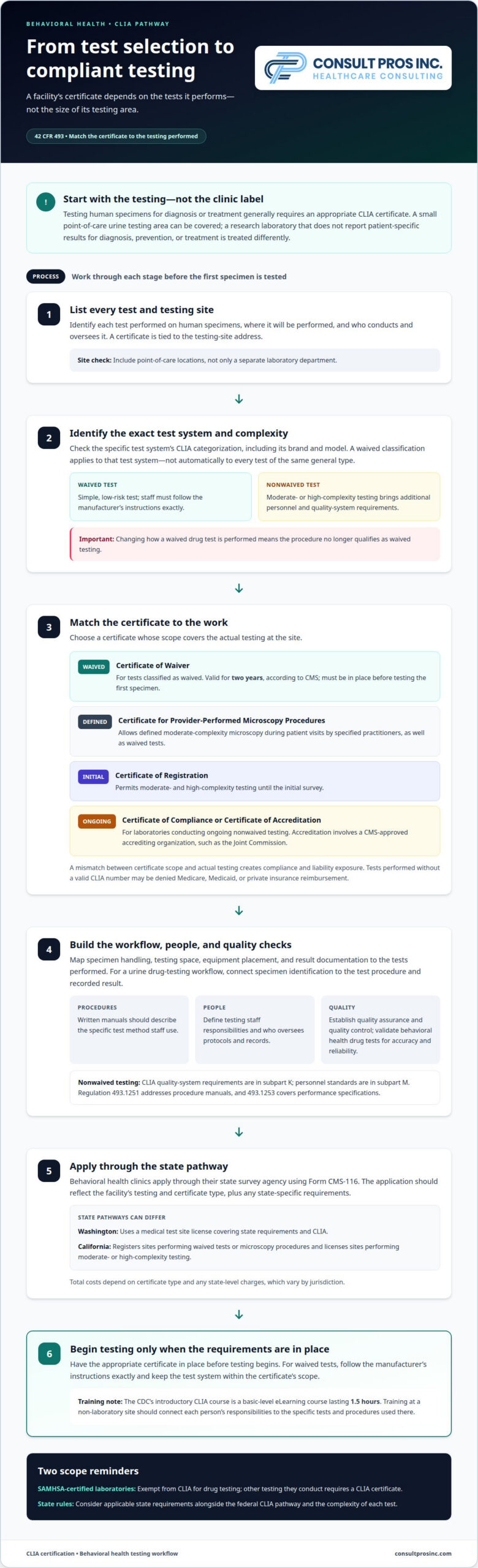
Under 42 CFR 493, a U.S. facility testing human specimens for diagnosis or treatment needs an appropriate CLIA certificate. This can include a behavioral health clinic using urine tests at the point of care, even without a separate laboratory department. CLIA certification for behavioral health drug-testing sites depends on the tests performed and their complexity, not the facility’s size. A research laboratory that doesn’t report patient-specific results for diagnosis, prevention, or treatment is treated differently.
For behavioral health providers, CLIA certification means the testing site must meet the requirements tied to its certificate, including applicable quality standards. A facility performing waived testing must have its Certificate of Waiver in place before testing its first specimen. SAMHSA-certified laboratories are exempt from CLIA for drug testing, but other testing they conduct requires a CLIA certificate.
Clinic leaders should define who performs each test and who oversees the testing process. Testing staff handle specimen and test procedures, while the person overseeing testing maintains the laboratory’s applicable protocols and records. At a point-of-care site, identify the test location and assigned personnel before testing begins, because a certificate is tied to the testing-site address.
For nonwaived testing, CLIA regulations include quality-system requirements in subpart K and personnel standards in subpart M. Laboratories performing moderate- or high-complexity tests can use a Certificate of Accreditation. Quality procedures, staff qualifications, and documentation must match the tests performed, rather than relying on the clinic’s broader clinical policies.
Training applies to people who conduct clinical laboratory testing and those who oversee it. The CDC’s introductory CLIA course is a basic-level eLearning course lasting 1.5 hours. At a non-laboratory site, training should connect each person’s responsibilities to the specific tests and procedures used there.
Behavioral health clinics apply through their state survey agency using Form CMS-116, according to the Centers for Medicare & Medicaid Services. The application should reflect the facility’s testing and certificate type. A Certificate of Waiver is valid for two years, according to the Centers for Medicare & Medicaid Services.
Total costs depend on the certificate type and any state-level charges, which vary by jurisdiction.
CLIA certificate types and test complexity
A Certificate of Waiver covers simple, low-risk tests classified as waived. The waiver applies to a specific test system, not every test of that general type. The brand and model matter, and staff must follow the manufacturer’s instructions exactly. If a behavioral health clinic changes how it performs a waived drug test, the procedure no longer qualifies as waived testing.
Other certificates apply as testing becomes more complex. A Certificate for Provider-Performed Microscopy Procedures allows defined moderate-complexity microscopy during patient visits by specified practitioners, as well as waived tests. A Certificate of Registration permits moderate- and high-complexity testing until the initial survey. Laboratories conducting ongoing nonwaived testing need a Certificate of Compliance or a Certificate of Accreditation.
Determine test complexity by identifying the exact test system and its CLIA categorization, then match the certificate to the testing performed at the laboratory. A Certificate of Accreditation involves a CMS-approved accrediting organization, such as the Joint Commission. A mismatch between the certificate’s scope and actual testing creates compliance and liability exposure. Tests performed without a valid CLIA number may be denied Medicare, Medicaid, or private insurance reimbursement.
State requirements can differ from federal CLIA rules. Washington uses a medical test site license covering state requirements and CLIA, while California registers sites performing waived tests or microscopy procedures and licenses sites performing moderate- or high-complexity testing. Clinics must account for the applicable state pathway as well as test complexity.
To obtain a Certificate of Waiver, first identify the waived test systems the clinic will use and ensure staff will follow each manufacturer’s instructions. Then submit Form CMS-116 through the state survey agency, including any state-specific application requirements, and have the certificate in place before testing begins. For clinics aligning certification with state requirements, state licensing and compliance planning can help structure the process.
Laboratory setup, training, and quality checks
A behavioral health laboratory needs a defined workflow before testing begins. Map specimen handling, testing space, equipment placement, and result documentation to the tests performed. For example, a urine drug-testing workflow should link specimen identification with the test procedure and recorded result. Equipment selection and staff roles should support that process, rather than being treated as separate administrative decisions.
For nonwaived testing, CLIA quality-system requirements appear in subpart K, while personnel standards appear in subpart M. Regulation 493.1251 addresses procedure manuals, and 493.1253 covers performance specifications. These standards make written procedures and documented test performance part of the laboratory’s operating structure. A manual should describe the specific test method staff use, not only general clinic policies.
Quality assurance and quality control serve distinct purposes in dependable testing. Laboratories pursuing certification should establish both programs, and behavioral health drug tests should be validated for accuracy and reliability. Quality-control practices are an important part of reliable nonwaived testing. Records must also support traceability, with retention requirements referenced in 42 CFR 493 subpart J, section 1105.
For waived tests, keep a record of each product’s name, manufacturer, specimen type, and listing in the FDA CLIA test categorization database. A waived-test log should capture the test date and time, tester, lot number, and expiration date. These details link each result to the test system and materials used.
Personnel training should align with assigned duties and the test methods in use. Competency requirements are referenced in 42 CFR 493 subpart M, section 1351. For initial Texas applications other than Certificates of Waiver, include documentation of Laboratory Director qualifications. Training can then reinforce procedure-specific practices, while a designated director oversees the laboratory’s technical framework and records.
CLIA regulatory program overview
The Clinical Laboratory Improvement Amendments were passed in 1988, according to U.S. Congress. Their implementing regulations appear in 42 CFR Part 493, establishing federal standards for clinical laboratory testing. The Centers for Medicare & Medicaid Services oversees the CLIA program, while state agencies support applications, surveys, and oversight. This structure means a behavioral health organization must consider both federal requirements and the procedures administered in its state.
CLIA oversight depends on the testing performed at each facility, not simply the organization’s clinical designation. Certificates are tied to testing-site addresses, so a move or an additional outpatient location can require an update or separate certificate. Laboratories performing moderate- or high-complexity testing under a Certificate of Compliance generally receive routine surveys about every two years. Surveys are unannounced, so keep procedures and documentation current between visits.
Accreditation is another oversight route for laboratories performing moderate- or high-complexity tests. A CMS-approved accrediting organization conducts surveys using CLIA-equivalent standards on an approximately biennial cycle. Medicare, Medicaid, and private insurers may deny reimbursement for tests performed without a valid CLIA number. The certificate and oversight pathway therefore affect more than regulatory records: they also shape how a facility can report and bill for testing.
State administration can change the practical pathway. Washington operates a medical test site licensing program that substitutes for federal CLIA, while New York is also identified as CLIA-exempt. Facilities should account for the applicable state framework when planning testing locations and documentation.
CLIA certificates generally require renewal every two years, and behavioral health programs should schedule renewal at least 90 days ahead. A Certificate of Waiver application for a treatment center typically takes 2 to 6 weeks to process, depending on state processing times. Allowing time for both renewal preparation and state processing helps prevent an avoidable gap in authorization.
Consult Pros: In-Network Contracting
Consult Pros Inc helps behavioral health operators coordinate in-network contracting with their facility’s broader operational structure. This can be a practical next step for programs preparing to serve patients through insurance networks while establishing their regulatory and organizational foundations.
State Licensing & Certification and Facility Setup & Operational Structuring support the groundwork for a facility’s launch and ongoing operations. TJC & CARF Accreditation can also support an organization’s broader readiness goals. These workstreams address different requirements, so coordinating them helps leaders plan responsibilities and documentation across the organization without treating accreditation, licensing, and payer contracting as interchangeable.
To align these operational priorities, contact Consult Pros Inc to discuss your facility’s needs.
Build a durable compliance foundation
The next decision is how to govern compliance as your program changes. Treat laboratory operations as part of the facility’s broader operating model, with clear ownership of test-menu changes, staffing, records, and site-level decisions. This structure helps leaders account for regulatory implications before introducing a new service or location, rather than retrofitting procedures after operations change. Keep leadership, clinical, and administrative decisions coordinated as the organization develops.
Consult Pros supports this operational work through CLIA Certification, State Licensing & Certification, Facility Setup & Operational Structuring, and In-Network Contracting. These services can help align regulatory responsibilities with facility planning and payer-readiness priorities, while keeping each workstream distinct.
To discuss a coordinated approach to CLIA certification for behavioral health, contact Consult Pros for CLIA support. With clear responsibilities and a deliberate operating plan, your team can move forward with greater clarity.
Frequently Asked Questions
Are Any Facilities Exempt from CLIA Regulations?
Yes. Some testing activities fall outside CLIA, and some states operate exempt programs. Research laboratories that test human specimens but do not report patient-specific results for diagnosis, prevention, or treatment do not need a CLIA certificate. Forensic testing conducted solely for legal or criminal purposes is also exempt. Washington and New York are identified as CLIA-exempt states, though Washington medical test sites follow state licensing requirements.
Which behavioral health services require CLIA certification or a CLIA waiver?
Behavioral health programs conducting urine drug testing generally need an appropriate CLIA certificate, including a Certificate of Waiver when their tests are classified as waived. The determining factor is the test performed, not whether the service is outpatient, residential, or part of treatment. SAMHSA-certified laboratories do not need CLIA certification for drug testing, but other testing they perform requires a certificate.
What behavioral health point-of-care tests are covered by CLIA?
CLIA coverage depends on the specific test system used at the point of care. Waived status applies to a particular system, so two products used for a similar purpose may have different classifications. Identify the manufacturer and model, then match the system to its CLIA categorization. Testing must follow the manufacturer’s instructions to remain within waived status.
What are the CLIA testing, quality control, and recordkeeping requirements for behavioral health clinics?
Requirements depend on the certificate and test complexity, so organize documentation around actual testing activity. Records should make it possible to link a reported patient result with its test system, staff member, and relevant quality checks. When adding a test, update procedures and training records together to maintain a clear link between authorized methods and daily practice.
What are the penalties and risks of conducting tests without the required CLIA certificate?
Testing without the required certificate creates regulatory exposure, and tests performed without a valid CLIA number may be denied Medicare, Medicaid, or private insurance reimbursement. A further operational risk arises when a clinic performs tests outside its certificate’s scope, such as using a method that no longer qualifies as waived. Keep the test menu, certificate, and procedures aligned to reduce these compliance risks.
How does CLIA certification compare with a CLIA waiver for behavioral health practices?
A Certificate of Waiver is a type of CLIA certificate, not an exemption from certification. It permits simple, low-risk tests classified as waived, while other certificates apply to different levels of testing complexity and oversight. For example, a clinic using only eligible waived test systems may fit the waiver pathway; adding a nonwaived test changes the certification requirements for that testing.