
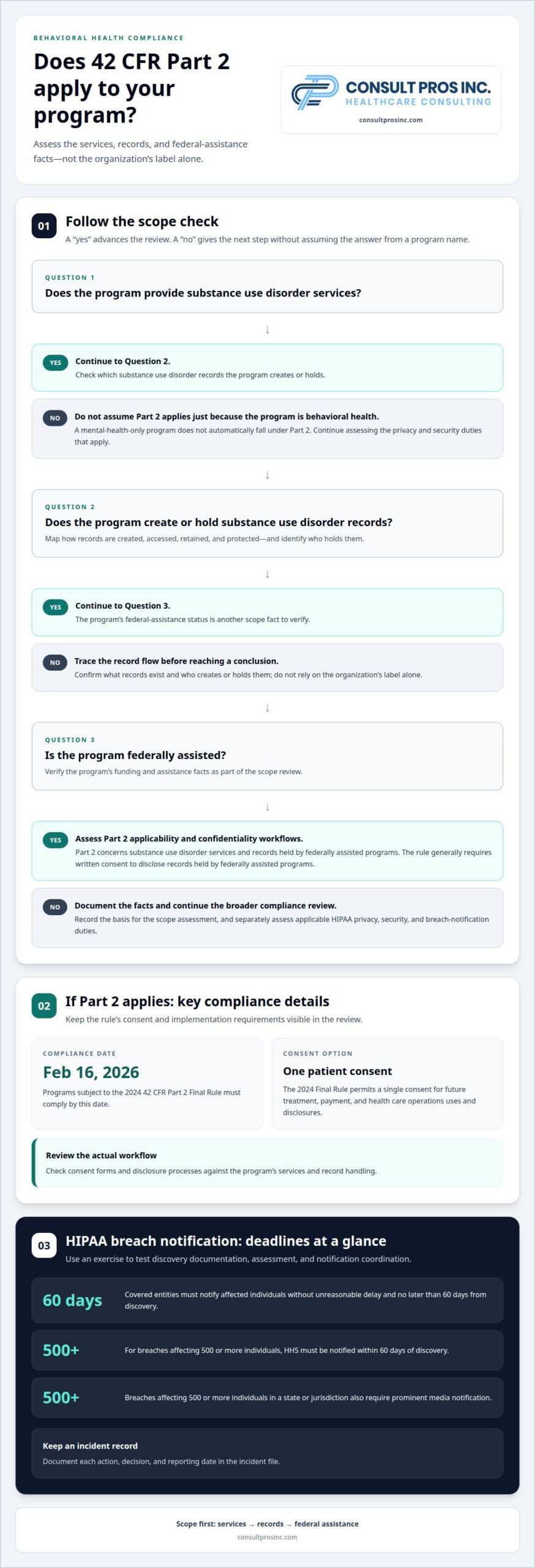
A mental-health-only program doesn’t automatically fall under 42 CFR Part 2: the rule concerns substance use disorder services and records held by federally assisted programs. A behavioral health compliance checklist helps you distinguish that question from broader privacy and security duties, then assess the safeguards and records your program needs.
Before building policies around a rule, first determine whether it applies to your services. Assess the care your program provides and the records it creates or holds, rather than relying on the organization’s label alone.
This guide walks through security safeguards, clinical documentation, HIPAA responsibilities, governance, and the factors that determine whether Part 2 applies. You’ll have a practical framework for identifying gaps, assigning follow-through, and structuring compliance as an ongoing operational discipline.
Key Takeaways
- Map how clinical records are created, accessed, retained, and protected, then align documentation practices with applicable requirements.
- Assess whether your program’s services and funding bring substance use disorder records under additional confidentiality rules.
- Assign clear owners for policies, staff training, incident escalation, and corrective actions so compliance work has documented follow-through.
- Review telehealth operations against the requirements that apply to your program, including relevant state rules and payer conditions.
Clinical documentation and individualized treatment plans
Start the annual review by sampling records across clinicians, service types, and treatment settings. A behavioral health compliance checklist should connect each chart’s assessment, treatment plan, progress notes, and claim, allowing reviewers to trace clinical decisions from intake through the billed service.
- Confirm each treatment plan identifies current symptoms, diagnosis, strategies, and goals. Compare the plan with the assessment and subsequent notes to ensure it reflects the individual’s needs, rather than a generic template.
- Test medical necessity by tracing the documented symptoms and functional needs to the service provided. For example, compare the treatment goal, session note, and billed service to see whether they describe a coherent course of care.
- Check that records tell a consistent clinical story across intake, progress notes, and discharge documentation. If an associate documents a changed diagnosis or treatment approach, look for the assessment and rationale supporting that change.
- Review a sample of 10 to 15 charts per clinician monthly in small to mid-sized practices. This recurring review can identify missing signatures, incomplete notes, and differences between documented services and submitted claims.
- Audit billing and coding against the record, including service type, duration, and provider documentation. Review claims from the last 30 to 90 days to identify recurring discrepancies and assign corrective steps to the responsible role.
- Separate clinical-record retention schedules from HIPAA documentation requirements. According to the U.S. Department of Health and Human Services, HIPAA documentation must be retained for 6 years from its creation or last effective date.
- Compare the retention schedule with applicable state requirements before records are destroyed. Adult clinical records are typically retained for 7-10 years, subject to state requirements; document the governing schedule and disposal process.
Close the audit by documenting each finding, its owner, and the evidence needed to resolve it. A follow-up review can show whether corrective actions improved record quality and alignment between clinical care and billing.
HIPAA Privacy, Security, and Breach Notification Rules
Review privacy, security, and incident workflows together, since a single disclosure can expose gaps across all three. HIPAA’s Privacy Rule is codified at 45 CFR Part 160 and Subparts A and E of Part 164; its Security Rule is codified at 45 CFR Part 164, Subpart C. The Breach Notification Rule is codified at 45 CFR §§ 164.400-414.
- Confirm staff know how to route access requests, suspected disclosures, and security incidents. Review the internal reporting path, decision owner, documentation fields, and escalation steps using a recent example.
- Check that the HIPAA risk analysis reflects current systems, access roles, and security safeguards. Review it at least annually, and document how identified risks lead to corrective actions.
- Inventory vendors handling protected health information and maintain applicable business associate agreements. Compare the vendor list with system access records, then investigate accounts or data flows that lack a clear operational owner.
- Review activity and access records when appropriate, including whether user permissions match staff responsibilities. Document the reason for access reviews and retain evidence of follow-up on unusual activity.
For substance use disorder records, assess whether 42 CFR Part 2 applies. The rule generally requires written consent to disclose records held by federally assisted programs. The U.S. Department of Health and Human Services states that programs subject to the 2024 42 CFR Part 2 Final Rule must comply by February 16, 2026. The 2024 Final Rule permits a single patient consent for future treatment, payment, and health care operations uses and disclosures. Review consent forms and disclosure workflows against the program’s services and record handling.
Use a breach-response exercise to test who documents discovery, assesses affected individuals, and coordinates notifications. Under HIPAA, covered entities must notify affected individuals without unreasonable delay and no later than 60 days from discovery, according to the U.S. Department of Health and Human Services. For breaches affecting 500 or more individuals, HHS must be notified within 60 days of discovery, according to the U.S. Department of Health and Human Services. Breaches affecting 500 or more individuals in a state or jurisdiction also require prominent media notification. Record each action, decision, and reporting date in the incident file.
Compliance policies, training, and governance
Compare approved policies with actual workflows, then document gaps, owners, and corrective actions. Train staff according to their roles, record completion, and assess whether employees can apply procedures in patient-facing situations. Organizations developing these systems may benefit from guidance from a healthcare compliance consultant for program and privacy support.
- Review each policy for a named approver, current version, accessible location, and review date. Compare mental health procedures with daily workflows, such as intake, patient handoffs, incident reporting, and record access. Flag missing or outdated steps for revision.
- Assign an owner to monitor requirements, receive audit findings, escalate problems, and verify remediation. A living risk register can track each issue’s significance, responsible person, due date, corrective action, completion evidence, and whether the change resolved the risk.
- Check training records for role-specific content, completion evidence, and refreshers suited to the employee’s responsibilities. For example, compare a supervisor’s incident-response training with the escalation tasks assigned in policy, rather than relying only on a general orientation record.
- For CCBHCs, provide training at orientation and annually thereafter on risk assessment, suicide and overdose prevention and response, and the roles of families and peer staff. Keep the curriculum, attendance, and completion records together for review.
- Review access controls alongside workforce changes. Compare current staff roles with system permissions, then document approval and removal steps when duties change or employment ends. Include relevant business associate access in the workflow review where applicable.
- Test staff understanding with realistic scenarios, such as a patient disclosure, a suspected privacy incident, or a missing approval. Record the response, identify misunderstanding, and assign targeted follow-up training instead of treating attendance as proof of competency.
Keep governance active between formal reviews by tracking policy updates, expirations, findings, and follow-up in one centralized system. Give leadership concise trend reports on recurring gaps, overdue actions, and completed remediation, so decisions address patterns rather than isolated audit notes.
What are the rules for telehealth behavioral health services, including state-specific requirements?
Telehealth requirements depend on the program’s location, the patient’s location, the service type, and the payer. During an annual audit, map each jurisdiction served and review its applicable licensing, consent, documentation, privacy, and emergency procedures. Record the governing source and the owner responsible for each requirement.
- Identify where clinicians and patients are located during telehealth encounters. Use that map to assess state licensing and certification requirements for each service relationship.
- Compare telehealth consent language with intake and clinical workflows. Confirm staff document the patient’s consent, service modality, and relevant encounter details in the record.
- Review payer-specific billing instructions for each telehealth service. Check whether required modifiers and place-of-service codes match the payer, setting, and modality.
- Test whether privacy safeguards work in actual practice. For example, review how staff confirm a private setting, protect video-session records, and report a suspected disclosure.
- Examine emergency-response procedures for remote sessions. Confirm staff know how to document a safety concern, escalate it internally, and follow the program’s approved response process.
- Compare virtual care policies with in-person workflows. Look for gaps in assessment, treatment planning, follow-up, record access, and responsibility for coordinating care.
Medicare behavioral health telehealth flexibilities, including audio-only visits and removed geographic restrictions, were extended through the end of 2025. Because that period has passed, an annual audit in 2026 should distinguish historical policy from current payer and program requirements. Keep the date and source for each policy decision in the compliance record.
For each finding, assign an owner, corrective action, and evidence of completion. If state-by-state licensing analysis reveals operational gaps, explore support for structuring state-aware operations as part of a broader compliance plan.
Consult Pros: In-Network Contracting
When audit findings point to payer participation or contracting needs, Consult Pros Inc supports behavioral health operators through In-Network Contracting. Reviewing documentation, governance, and telehealth workflows can clarify how contracting processes intersect with operational readiness. State Licensing & Certification can support organizations addressing state-level requirements.
For operators building or restructuring a program, Facility Setup & Operational Structuring and TJC & CARF Accreditation Support may also address broader readiness priorities. These services help establish organizational foundations and prepare for accreditation, but do not replace clinical judgment or day-to-day billing operations. Define the gaps identified in the audit, then determine which support best aligns with them.
Contact Consult Pros Inc to discuss how In-Network Contracting may fit your organization’s compliance priorities.
Turn audit findings into an operating plan
An audit is useful when its findings guide decisions after the review ends. Turn each unresolved issue into a defined priority, assign an accountable owner, and document the evidence that will show whether corrective action is working. This keeps leadership focused on sustained implementation, not just completing a report.
Treat your behavioral health compliance checklist as a working governance tool, and revisit it as services, staffing, and operational needs change. If identified gaps involve payer participation, state requirements, or facility structure, Consult Pros Inc offers In-Network Contracting, State Licensing & Certification, and Facility & Operations Consulting. These services can help operators align organizational foundations with their compliance priorities.
Contact Consult Pros Inc about compliance to discuss the operational support that fits your next steps. A clear, owned plan gives your team a practical path forward.
Frequently Asked Questions
Does 42 CFR Part 2 apply to my behavioral health program if I only treat mental health and not substance use?
Generally, a program that provides only mental health services does not fall under Part 2 solely because it is a behavioral health provider. The rule concerns substance use disorder records held by federally assisted programs. For a program offering both mental health and substance use services, assess which records relate to substance use disorder services and how they are maintained or disclosed.
How to Utilize the Behavioral Health Clinic’s Compliance Checklist?
Use the checklist as an audit tool, not just a policy inventory. Assign an owner to each item, examine supporting records or workflows, and determine whether the evidence shows the requirement is met in practice. For example, compare a staff member’s system access with their current role. Document gaps, corrective actions, and closure evidence so leadership can distinguish completed work from unresolved findings.
What should a behavioral health compliance checklist include?
Include review points for clinical records, privacy and security, incident response, staff training, policy approval, access permissions, and telehealth operations. Add fields for the applicable requirement, evidence reviewed, finding, owner, and follow-up status. For example, an access-control item should identify the system reviewed and whether permissions match the employee’s duties, not simply note that a policy exists.
What federal laws apply to behavioral health providers in the United States?
Relevant federal requirements can include HIPAA, 42 CFR Part 2, and the No Surprises Act, depending on the organization and services. HIPAA applies to covered entities and business associates; Part 2 concerns qualifying substance use disorder records. Under the No Surprises Act, providers must give self-pay or uninsured patients a written Good Faith Estimate before services begin.
How do HIPAA and 42 CFR Part 2 apply to behavioral health records?
HIPAA governs protected health information handled by covered entities and business associates, while Part 2 adds confidentiality protections for qualifying substance use disorder records. For applicable Part 2 records, written consent is generally required for disclosure. The 2024 Final Rule also permits a single patient consent for future treatment, payment, and health care operations uses and disclosures.
What licensing, credentialing, and scope-of-practice requirements apply to behavioral health staff?
Requirements depend on the staff member’s role, services, and state. Assess whether each person’s active license and scope of practice align with assigned duties, then document the review in personnel records. Also verify NPI taxonomy, scope of practice, and active enrollment in PECOS quarterly. Keep role descriptions and credential records consistent with scheduling and the services staff actually provide.