
A compliance program is only as dependable as the policies, oversight, and staff understanding behind it. A healthcare compliance consultant can help develop and implement that program, monitor regulatory needs, conduct audits and risk assessments, provide privacy support, and educate personnel. The work is structured around the organization’s operations and the requirements that apply to its facility and location.
Building this framework internally can be demanding, particularly when compliance responsibilities span policies, privacy practices, staff training, and ongoing oversight. This article explains what consulting support can cover, how outsourced privacy assistance fits into a compliance program, and what to consider when choosing a partner. It also outlines how regulatory support can help behavioral health organizations establish practical systems that staff can follow as operations develop.
Key Takeaways
- Build compliance programs around clear policies, oversight, and practical steps staff can follow.
- Use outsourced privacy support to help manage responsibilities alongside broader compliance work.
- Align regulatory planning with the organization’s facility type, location, and operational needs.
- Strengthen staff understanding through role-relevant training, and consider In-Network Contracting support as part of a broader operational plan.
Healthcare compliance program development and implementation
A healthcare compliance risk assessment begins by mapping operations, identifying areas of exposure, and reviewing policies, records, and controls. Prioritize the findings, assign owners, put corrective steps in place, and monitor progress through audits and follow-up reviews.
Compliance Program Assessment
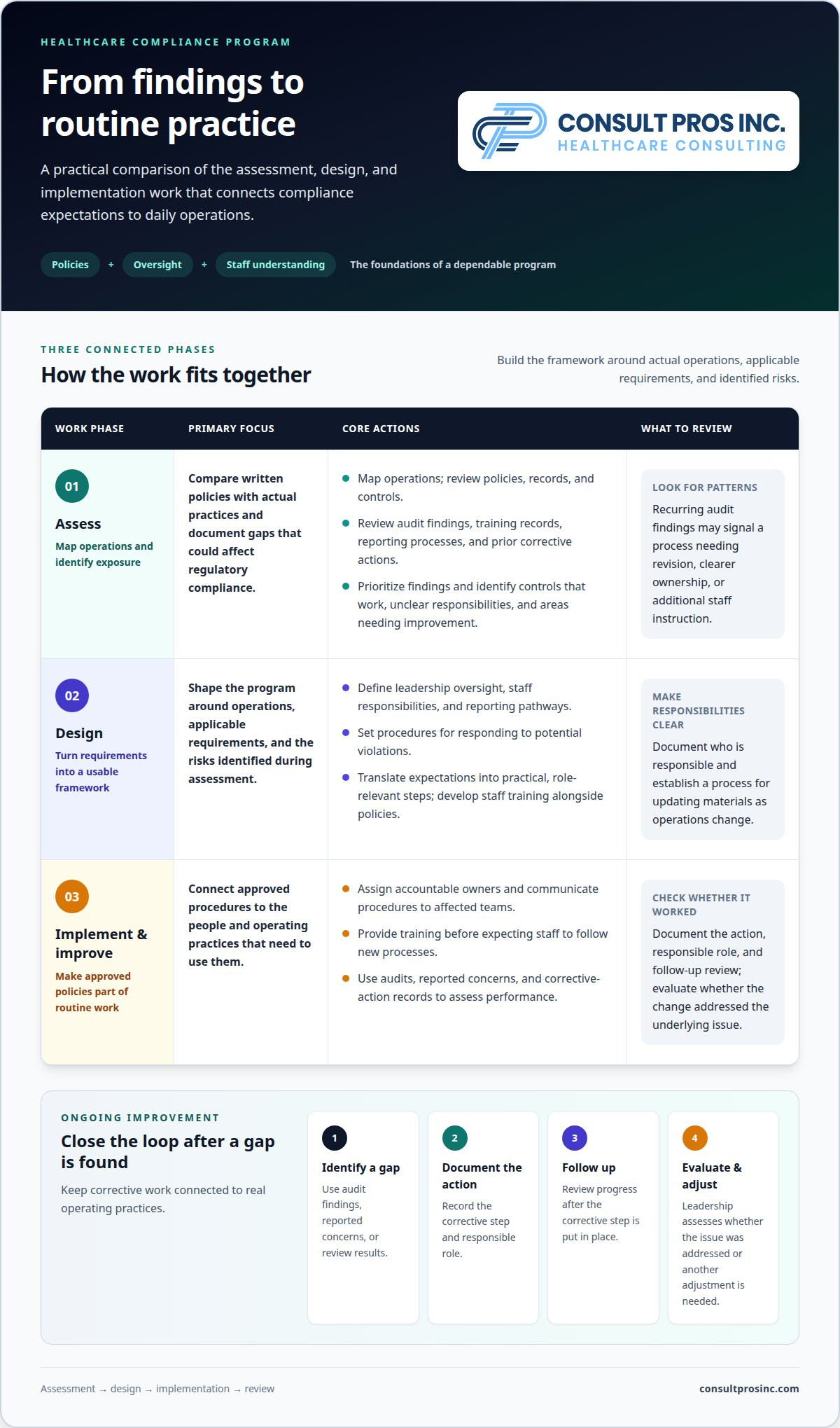
Start by comparing written policies with the organization’s actual practices, then document gaps that could affect regulatory compliance. Healthcare compliance officers oversee internal audits to assess whether practices meet legal and ethical requirements. Review audit findings, training records, reporting processes, and prior corrective actions to understand how the program functions beyond its written materials. An effectiveness assessment should identify which controls work, where responsibilities remain unclear, and what needs improvement. For example, recurring audit findings may point to a process that needs revision, clearer ownership, or additional staff instruction.
Compliance Program Design
Design the program around the organization’s operations, applicable requirements, and risks identified during assessment. Define leadership oversight, staff responsibilities, reporting pathways, and procedures for responding to potential violations. Policies should translate expectations into practical steps employees can apply to their roles. Develop staff training alongside the policies so employees learn how to follow them in practice. A healthcare compliance consultant can help organize these elements into a coherent framework, with documented responsibilities and a process for updating materials as operations change.
Program Implementation and Improvement
Implementation turns approved policies into routine work. Assign accountable owners, communicate procedures to affected teams, and provide training before expecting staff to follow new processes. Healthcare compliance officers develop policies and train employees to help their organizations operate compliantly. Establish a review cycle that uses audits, reported concerns, and corrective-action records to assess program performance. When an audit identifies a gap, document the action, responsible role, and follow-up review. Leadership can then evaluate whether the change addressed the underlying issue or whether the program needs another adjustment. This cycle supports ongoing improvement while keeping implementation connected to real operating practices.
Outsourced compliance and privacy support
Choose a healthcare compliance consultant by matching support to your practice’s risks. Evaluate healthcare knowledge, privacy experience, and clear role boundaries. Ask how support coordinates with leadership, clinical teams, and corporate processes, including interim coverage and reporting.
Privacy and Security Support
Map the information your organization handles, who can access it, and how staff use it. The U.S. Department of Health and Human Services states that healthcare organizations must follow HIPAA. Assess how policies, staff guidance, and escalation procedures address that obligation. Review written procedures for access, incident reporting, and staff responsibilities. A behavioral health facility may need to examine both clinical workflows and administrative records.
Privacy Program and Data Management
A privacy program should define how concerns are received, documented, reviewed, and routed. Set clear workflows and assign owners, with records showing how reports are handled. Clarify who maintains current policy versions and where staff can find them. Establish a process for sharing revisions with affected teams. This connects privacy practices to daily operations instead of leaving procedures in a file that staff may not use.
Some organizations need temporary leadership while recruiting or restructuring. Define whether an interim compliance or privacy officer will advise, coordinate, or manage specific work, and identify who retains internal decision-making authority. Clarify reporting lines, scope, handoff expectations, and coordination with clinical and administrative teams. Apply similar criteria to staffing support, including role fit, healthcare knowledge, onboarding needs, and continuity for existing programs. Clear distinctions help organizations assess support against specific compliance needs rather than a generic service description.
For organizations structuring broader compliance work, explore regulatory compliance programs that align policies, staffing, and operational responsibilities.
Regulatory support across health plans, providers, pharmacies, and investors
Regulatory responsibilities depend on the organization’s activities, location, and role in health care. The price depends on the case and is given after a quote request; cost factors include scope, facility type, locations, and requested support.
Federal and State Requirements
Assess both federal and state requirements against the organization’s actual processes. According to the U.S. Department of Health and Human Services, healthcare organizations must follow HIPAA. The U.S. Department of Health and Human Services Office of Inspector General identifies the Anti-Kickback Statute as a healthcare compliance law. Health plans, providers, and pharmacies should map relevant obligations to their own operations, then assign responsibility for tracking each requirement.
Regulatory Risk Assessment and Remediation
A risk assessment connects requirements to evidence from daily operations. Review policies, records, billing processes, and staff responsibilities, then prioritize gaps by their potential effect on compliance and operations. Healthcare organizations that fail to meet survey standards can face penalties, including loss of funding or operational licenses. Improper billing can lead to audits, financial penalties, and reputational damage. Document each remediation step, its owner, and the follow-up review.
Federal and State Regulatory Monitoring
Federal and state agencies conduct surveys of healthcare facilities to assess care and operational standards. Monitoring should translate regulatory developments into assigned review tasks, updated procedures, and staff communication. For example, when a requirement affecting operations changes, identify the relevant policy or process for review. Health plans, pharmacies, and investors also need monitoring tailored to their activities. A documented process helps leadership see what changed and how the organization responded.
Consultant Responsibilities
A healthcare regulatory compliance consultant may develop compliance plans, support regulatory applications and reports, and train personnel on their responsibilities. Responsibilities can also include monitoring regulations, conducting audits and risk assessments, and investigating and reporting violations. When comparing support, define the organization’s scope, affected teams, expected work products, and reporting path. This clarity helps leadership distinguish practical regulatory assistance from broad advice that lacks owners, timelines, or follow-through.
Education and training requirements
Healthcare compliance work combines regulatory knowledge with the ability to translate policies into daily practice. A healthcare compliance consultant should explain relevant experience, education, and training methods in terms of your organization’s operations, not credentials alone.
Education expectations vary by role and employer. Some employers require a bachelor’s degree in a related field, such as law, business administration, or healthcare management. A bachelor’s degree, preferably in biology or public health, is also suggested as a starting point for a healthcare compliance career. These are possible career pathways, not universal requirements for every consultant or organization.
The Health Care Compliance Association offers the Certified in Healthcare Compliance (CHC) credential, but it is not required for every healthcare compliance career. The Compliance Certification Board (CCB) administers the CHC exam, and eligibility requires the CCB-mandated level of relevant experience and education. When assessing a professional, consider how their education and work history relate to your organization’s patient, medical, and billing processes.
Staff education should turn policy into role-specific decisions. For example, train billing personnel on the procedures assigned to them and give clinical teams guidance relevant to their duties. An effective program identifies its audience, explains the applicable process, and gives staff a way to raise concerns. Track participation and use audit findings or recurring questions to identify where follow-up instruction may help.
A structured training approach defines learning needs, prepares materials, delivers instruction, documents completion, and reviews whether staff can apply what they learned. Seattle University School of Law’s healthcare compliance track covers the Affordable Care Act, illustrating how formal study can address specific health policy. For operational staff education, connect training to the organization’s own procedures and responsibilities.
Build practical staff education into healthcare compliance training that supports your organization’s programs and workforce.
Consult Pros: In-Network Contracting
Consult Pros Inc supports behavioral health organizations with In-Network Contracting, helping operators address payer-network participation as part of facility development. This support can fit organizations preparing to launch, structuring operations, or aligning contracting needs with broader operational plans.
When regulatory foundations are also being established, State Licensing & Certification, Facility Setup & Operational Structuring, and TJC & CARF Accreditation can support related readiness needs. Each service addresses distinct operational requirements, so organizations can focus on the areas relevant to their stage of development.
For support with in-network contracting and related facility planning, contact Consult Pros Inc or visit consultprosinc.com.
Set a Practical Direction for Your Next Stage
Turn compliance priorities into an operating plan with clear ownership, review points, and staff responsibilities. A healthcare compliance consultant can help leadership connect these systems to the organization’s next stage of development, rather than treating compliance as a separate administrative task.
For behavioral health operators, that next stage may involve aligning operational groundwork with In-Network Contracting, State Licensing & Certification, or Facility Setup & Operational Structuring. The right sequence depends on the organization’s immediate needs and where current processes need support. Defining a starting point helps focus discussions and determine which work should move forward first.
Contact Consult Pros about compliance support to discuss the operational priorities your organization is ready to address. Steady, well-structured progress can help create a clearer path forward.
Frequently Asked Questions
What does a compliance consultant do for healthcare organizations?
A healthcare compliance consultant helps leadership interpret applicable requirements, identify operational gaps, and organize follow-up. For a behavioral health operator preparing a new site, that could mean reviewing licensing preparation, policies, staff roles, and reporting workflows before launch. The consultant advises and structures compliance work; clinical decisions remain with clinical professionals, and executives retain organizational accountability.
What qualifications and certifications do healthcare compliance consultants need?
No single credential is required for every healthcare compliance career. Some employers require a bachelor’s degree in a related field, such as law, business administration, or healthcare management. The Health Care Compliance Association offers the Certified in Healthcare Compliance (CHC) credential, and the Compliance Certification Board administers its exam. Exam eligibility requires the board’s mandated relevant experience and education.
What healthcare regulations do compliance consultants help organizations follow, including HIPAA, OSHA, and the False Claims Act?
Consultants can help organizations identify which regulatory topics apply to their operations. According to the U.S. Department of Health and Human Services, healthcare organizations must follow HIPAA; the False Claims Act is also identified as a healthcare compliance law. For OSHA-related workplace safety, define whether that subject belongs in the consultant’s scope and how it connects with the organization’s own processes.
What services do healthcare compliance consultants provide, such as audits, risk assessments, and staff training?
Services can include audits, risk assessments, policy reviews, staff training, regulatory applications and reports, and support for investigating or reporting violations. To define the scope, name a specific operational concern, such as repeated documentation gaps, then identify the review, expected deliverable, and responsible internal owner. This makes it easier to determine whether the work addresses the issue or offers only general advice.
How can a healthcare organization hire an in-house compliance officer versus an outside consultant?
An in-house officer can maintain ongoing familiarity with internal teams and workflows, while an outside consultant can provide defined expertise or project support. Compare responsibilities that need continuous ownership with work that has a clear start and finish. For example, leadership may retain internal oversight while engaging external support for a licensing project or focused assessment.
How do healthcare compliance requirements vary by state and type of healthcare provider?
Requirements vary by facility type and location, so organizations must account for both federal and state rules. A behavioral health facility and a health plan have different operating models to assess, and facilities in different states may need separate licensing reviews. Map each site’s activities, location, and provider type, then assign owners to monitor the requirements that apply to each operation.