
An agency audit can expose weaknesses in the systems behind care, not just gaps in paperwork. A behavioral health consulting firm can help assess readiness, identify compliance concerns, and strengthen clinical, financial, and operational processes. For organizations preparing to launch, consultants can also support startup planning and the development of practical systems and procedures.
Audit preparation can be complex because requirements, documentation, staffing, and daily operations must work together. A structured assessment helps leaders see where processes align, which gaps need attention, and how to organize the work before an external review. This article explains how consultants support agency audits, quality assurance, startup planning, and assessments of clinical, financial, and operational functions, helping you determine what support fits your organization’s stage.
Key Takeaways
- Map audit preparation across documentation, quality assurance, and compliance processes to identify gaps and organize corrective work.
- Build a startup plan that connects licensing, facility structure, staffing, and operating procedures from the outset.
- Assess clinical, financial, and operational systems together to understand how they affect an agency’s readiness and stability.
- Use consultants to clarify responsibilities and coordinate complex projects, including ownership transitions and related operational changes.
Agency audits, quality assurance, and compliance
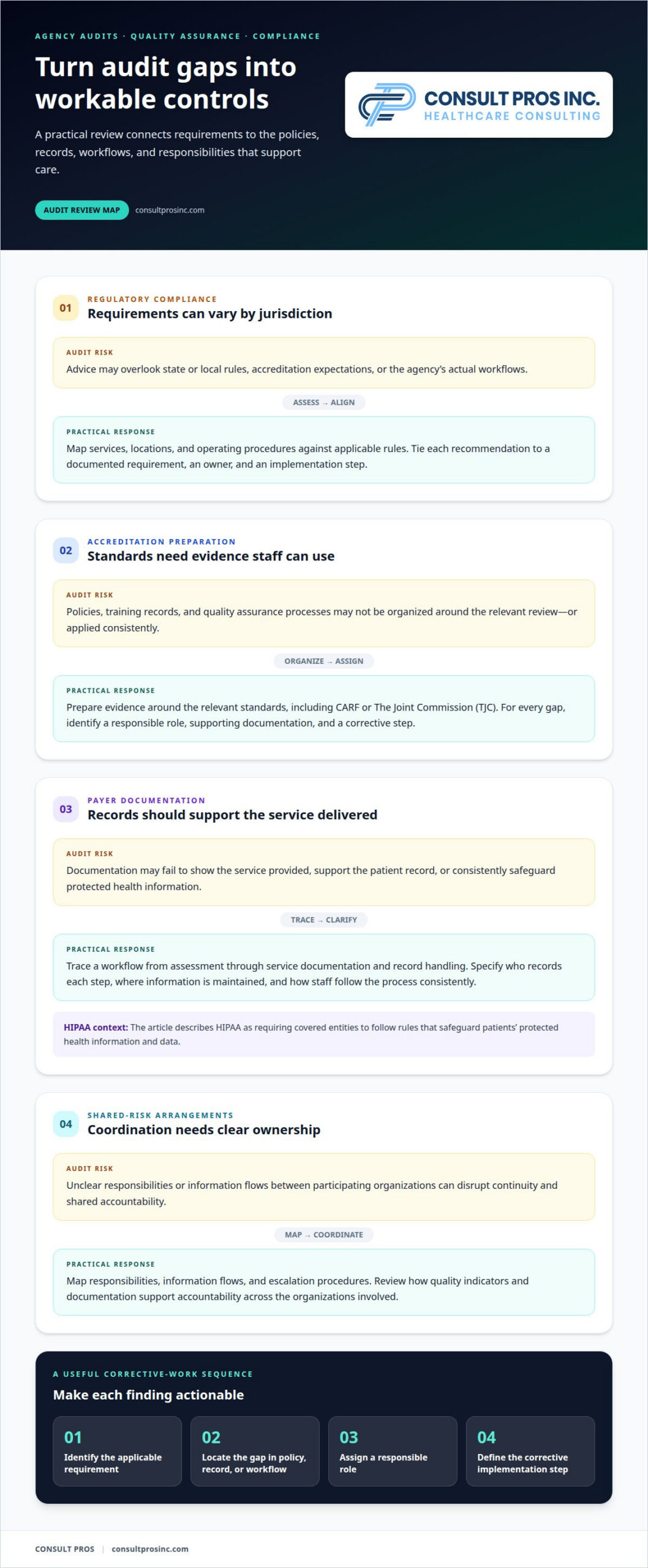
Hiring risks include advice that overlooks state and local laws, accreditation expectations, or the agency’s actual workflows. A careful assessment connects each recommendation to a documented requirement, assigns responsibility, and establishes a practical implementation step.
Regulatory Compliance Support
Behavioral health regulatory compliance involves requirements that can vary across state and local jurisdictions. A useful review begins by mapping the agency’s services, locations, and operating procedures against applicable rules. Consultants should identify which policies, records, and workflows need attention, then explain the reason for each recommendation. For example, a gap in an intake procedure should lead to a specific policy review and staff implementation plan, not a generic compliance checklist.
Accreditation Preparation
Accreditation preparation translates standards into evidence staff can apply consistently. CARF and The Joint Commission (TJC) are accreditation organizations for behavioral health programs. An assessment can organize policies, training records, and quality assurance processes around the relevant review. Check that each identified gap is tied to a responsible role, supporting documentation, and a corrective step. Consult Pros provides TJC & CARF Accreditation Support to help agencies prepare for these processes.
Payer Documentation Requirements
Payer compliance depends on documentation that supports the service delivered and the patient’s record. Baker Tilly describes HIPAA as requiring covered entities to follow rules that safeguard patients’ protected health information and data. A review can trace a sample workflow from assessment through service documentation and record handling. Look for recommendations that specify who records each step, where information is maintained, and how staff apply the process consistently.
For complex populations, risk-sharing arrangements require clear coordination across participating organizations. A consultant can map responsibilities, information flows, and escalation procedures, then identify where unclear ownership could disrupt continuity. During implementation, review how quality indicators and documentation support shared accountability. This makes procedures specific to the population served and the organizations involved.
Behavioral health agency startup and business planning
Startup planning turns a proposed service into a workable operating model. Begin by defining the population served, the services offered, and the communities reached. Then connect those decisions to facility requirements, staffing roles, referral pathways, and daily workflows. An outpatient program and a residential program, for example, need different operating structures. A behavioral health consulting firm can help founders sequence these decisions so facility development and operational planning stay aligned.
Strategic planning also guides established providers considering expansion, including Certified Community Behavioral Health Clinic (CCBHC) development. The plan should connect the organization’s mission, service capacity, partnerships, and implementation priorities. SAMHSA is a source of national frameworks that future-planning strategies for behavioral health programs can align with. Providers can use that alignment to structure goals, assign ownership, and identify which capabilities need development before a new program begins.
Financial planning links program design with the resources needed to sustain it. Map expected staffing, facility operations, technology, and administrative functions against anticipated revenue sources. Then model how changes in service volume, payer participation, or hiring timelines could affect cash flow. A growth plan should distinguish essential startup costs from later investments and show how leaders will monitor financial performance and adjust operations when assumptions change.
Long-term planning should establish a review cycle for goals, service demand, workforce capacity, and operational priorities. For an integrated program addressing mental health and substance use alongside primary care coordination, planning must account for partner roles and information flows. Define measures that show whether implementation is progressing, such as staffing readiness or referral completion, and assign responsibility for reviewing them. This gives leaders a practical basis for adapting the program as needs evolve.
To connect startup decisions with ongoing compliance processes, explore regulatory compliance programs as part of the planning approach. This support can help agencies coordinate policies and operational procedures with their intended services, growth plans, and implementation responsibilities.
Clinical, financial, and operational assessment
Clinical and operational assessments connect care processes with the resources that support them. Consultants review intake, assessment, treatment planning, referrals, and follow-up to identify workflow barriers. Repeated delays between referral and first appointment, for example, may signal capacity or coordination challenges. Addressing gaps can help providers deliver more consistent care and track outcomes using defined measures. A behavioral health consulting firm can also assess whether facility operations support the services offered.
A needs assessment clarifies which services fit the population and where gaps exist across the care continuum. It can map access points for mental health and substance use services, referral pathways, and transitions between levels of support. For a community with limited outpatient access, the assessment might examine referral demand, staffing capacity, and partner availability. This gives leaders a structured basis for deciding which services to develop and how to sequence implementation.
Provider assessment and monitoring examine whether clinical practices and operating processes remain aligned with program goals. Consultants can review training records, supervision workflows, service documentation, and quality measures, then identify where guidance or process changes may help. Financial review adds another lens by connecting staffing, service volume, payer mix, and operating expenses. Leaders can consider Medicaid participation alongside other payer arrangements when assessing sustainability and access.
Security review should consider how patient information moves through systems, roles, and facility workflows. Baker Tilly describes HIPAA as requiring covered entities to follow rules that safeguard patients’ protected health information and data. A risk assessment can map where information is created, accessed, stored, or shared, then identify safeguards and process weaknesses for review. The findings help leaders prioritize improvements across clinical systems and daily operations. Together, these assessments give decision-makers a clearer picture of needs, resource constraints, and practical opportunities to strengthen service delivery.
Behavioral health consultant roles
Behavioral health consultants help organizations translate a mission into workable structures, processes, and measures. Their role can span planning, compliance, facility operations, workforce systems, and program development. For example, a consultant supporting a new mental health center can connect service goals with staffing plans, operational responsibilities, and implementation priorities. The value lies in coordinating these workstreams rather than treating each decision as a separate project.
Which behavioral health consulting firms serve organizations across the United States? Look for firms focused on behavioral health agency development, compliance, accreditation, and operational structuring. The right fit depends on the organization’s needs, such as launching a program, preparing for review, or managing a change in ownership. Evaluate whether the consultant’s role matches the project and includes clear deliverables, assigned responsibilities, and usable implementation steps.
Consultants can also help leaders define how to assess progress. They translate an organization’s mission into measures tied to access, service coordination, workforce readiness, or program outcomes. For example, a center expanding mental health services could track referral completion and review barriers with its team. Those measures help leaders identify operational issues and decide where further development is needed.
Funding and organizational capacity must remain connected to the proposed work. A consultant can help map planned activities against staffing, facility requirements, administrative processes, and available resources. The National Council for Mental Wellbeing launched its Center for Workforce Solutions in 2023 in partnership with The College for Behavioral Health Leadership and HMA. That example illustrates how workforce planning can involve multiple organizations and defined areas of expertise.
Before engaging a consultant, clarify the project scope, decision-making roles, expected work products, and how recommendations will be implemented. For support with licensing requirements during agency development, explore state licensing and certification support.
Consult Pros: Change of Ownership Consulting
Consult Pros supports behavioral health organizations managing a change of ownership by structuring the transition’s operational and administrative work. This support is useful when new ownership must coordinate licensing, facility operations, or payer relationships alongside the transfer. Change of Ownership Consulting helps organize these connected priorities so responsibilities and next steps are clear.
Depending on the transition, related support may include State Licensing & Certification, Facility Setup & Operational Structuring, and In-Network Contracting. These workstreams help align the organization’s operating structure with its ownership transition and planned services. The right focus depends on the agency’s existing setup and the changes underway.
Contact Consult Pros to discuss Change of Ownership Consulting for your organization’s transition.
Set a Clear Path for Your Agency’s Next Stage
Turn your assessment into an operating priority: define the decision that needs attention first, identify who owns it, and establish how progress will be reviewed. A behavioral health consulting firm can help leadership connect strategic decisions with practical implementation, particularly when an agency is preparing for a transition or planning its next stage.
Consult Pros supports organizations with In-Network Contracting, State Licensing & Certification, and Facility Setup & Operational Structuring. A behavioral health consulting firm can help coordinate these priorities with an agency’s operating plans, whether it is managing a transition or building a stronger foundation. A focused discussion can clarify the next practical steps.
Move forward with a defined starting point and a partner for the work ahead. Contact Consult Pros to discuss your agency’s needs and identify a practical next step. A well-structured plan gives your team a clearer basis for building sustainable operations.
Frequently Asked Questions
What services does a behavioral health consulting firm provide?
A behavioral health consulting firm can support facility development, licensing, accreditation, staffing, and operational systems. Consult Pros Inc offers State Licensing & Certification, TJC & CARF Accreditation Support, and Accounting & Payroll Systems. For example, an organization preparing to open a facility may need coordinated guidance on setup and administration. The appropriate scope depends on the project and the systems the organization needs to establish or strengthen.
How much do behavioral health consulting firms charge?
Consulting fees depend on project scope and the services involved. Factors such as defined deliverables and the level of support shape the engagement. Accreditation preparation and facility startup, for instance, involve different work. A clear scope helps the organization understand which services and responsibilities are covered before work begins.
How do I choose a consulting firm?
Choose a behavioral health consulting firm whose capabilities align with the agency’s immediate objective. A startup may need licensing and operational guidance, while an existing organization may be preparing for a change of ownership. Clarify the expected deliverables, decision-making responsibilities, and how recommendations will be put into practice. These details help establish whether the engagement addresses the organization’s actual needs.
What regulations and compliance requirements affect behavioral health consulting?
Behavioral health compliance can involve state and local laws, as well as requirements connected to licensing and accreditation. Applicable considerations depend on the agency’s services, location, and facility model. CARF and JCAHO are involved in licensing or accreditation approval for behavioral health programs. For a service change, connect relevant requirements with operating procedures, documentation, and assigned responsibilities.
How do consulting firms support Medicaid and insurance reimbursement?
Consultants can support payer relationships through in-network contracting and help agencies structure operational processes around insurance participation. For example, an organization entering a payer network may need administrative workflows aligned with its service model. Contracting support is distinct from day-to-day medical billing or claims processing. Reimbursement also depends on payer arrangements and the organization’s processes for documenting and delivering services.
How can a behavioral health organization hire or work with a consulting firm?
Begin by defining the project, identifying decision-makers, and setting out the required deliverables. Organize relevant materials, such as current procedures, facility plans, or ownership-transition details, for a focused discussion. During the engagement, establish who will make decisions and how recommendations will be implemented. Clear responsibilities keep consulting work connected to operational priorities and support a coordinated working relationship.