
Better payer rates are negotiated, not assumed. Behavioral health in-network contracting can help a practice pursue stronger reimbursement terms, but results depend on the payer, service mix, geography, and existing agreements. Start by identifying which contracts and fee schedules warrant attention.
It’s understandable to focus on reimbursement rates, since even a small difference can affect operational planning. But rates are only one consideration. Network participation, credentialing, Medicaid plans, and managed care contract requirements also shape access and a practice’s ability to serve insured patients.
This article explains how payer negotiations work, what can influence contract terms, and how to assess network opportunities before committing resources. It also covers Medicaid and managed care contracts, practical participation steps, and when contracting support can help organize the process.
Key Takeaways
- Prioritize payer opportunities and assess reimbursement terms against your services, location, and current contracts before entering negotiations.
- Plan network participation around payer-specific credentialing and enrollment steps, since timelines vary by payer, state, and specialty.
- Review Medicaid and managed care requirements plan by plan, including how participation terms affect access to covered services.
- Align contracts, provider credentials, and operational readiness to reduce avoidable enrollment and reimbursement disruptions.
Can you help negotiate better payer contracts?
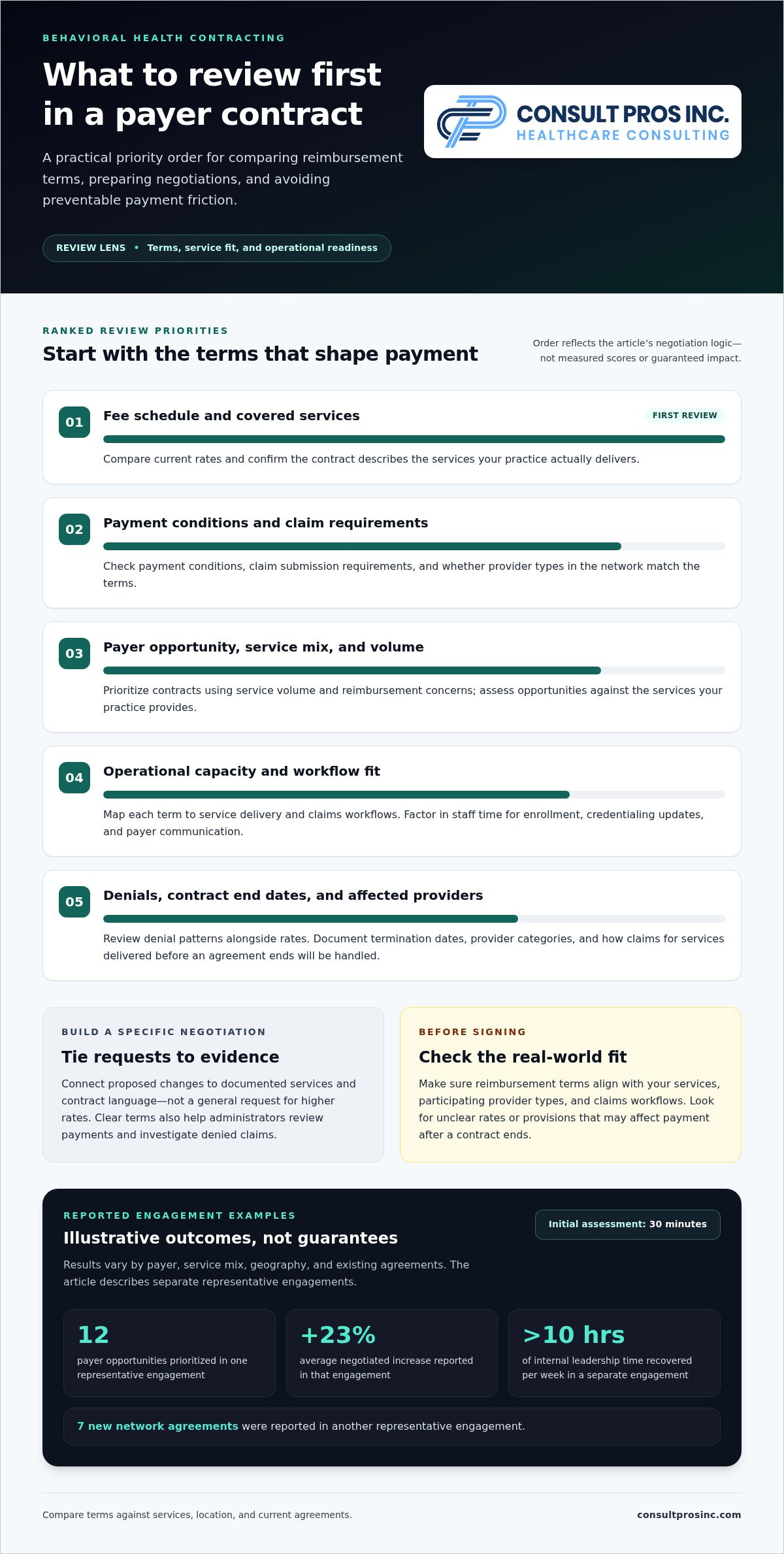
Yes. Effective negotiation examines payer opportunities, reimbursement terms, and contract language together. A representative engagement prioritized 12 payer opportunities and reported an average negotiated increase of +23%.
The practical objective is to align each agreement with the services delivered and reduce avoidable revenue friction. A separate representative engagement reported recovering more than 10 hours of internal leadership time per week.
Contract Negotiation and Reimbursement Optimization
Start by comparing current fee schedules, covered services, and payment conditions across payer agreements. Identify which contract terms affect revenue most, then prioritize negotiation opportunities based on service mix and operational capacity. A 30-minute contract opportunity review can help organize that initial assessment. Review claim denial patterns alongside rates, since unclear terms or mismatched service details can disrupt reimbursement.
For example, a practice can rank payer contracts by service volume and reimbursement concerns, then prepare specific requests for each negotiation. Tie proposed changes to documented services and contract language rather than making a general request for higher rates.
In-Network Reimbursement Terms
Review the fee schedule and the contract’s descriptions of covered services, payment conditions, and claim submission requirements. Confirm that negotiated terms reflect the services the practice provides and the provider types participating in the network. Clear language gives administrators a useful reference when reviewing payments or investigating denied claims.
Before signing, map each reimbursement term to the practice’s service and claims workflows. This can reveal gaps, such as unclear payment rates or provisions that affect reimbursement after a contract ends.
Contract end dates deserve separate attention. CareOregon’s revised behavioral health network and contracting policy takes effect July 31, 2025; according to CareOregon, beginning August 1, 2025, it will no longer reimburse claims submitted by non-contracted, unlicensed board registered associate providers who aren’t part of a group with a state Certificate of Approval. This example shows why practices should document termination dates, affected provider categories, and claims handling for services delivered before an agreement ends.
In-network participation and network development
Network participation can expand access to insured patients, but it requires deliberate planning. Compare each payer’s reach, participation terms, and administrative demands with your practice’s capacity.
State Rules and Network Adequacy
State-specific requirements can shape provider eligibility and network participation, so assess the rules where each practice operates. Review applicable licensing and certification requirements, then compare them with the payer’s network criteria. CareOregon’s policy changes illustrate why location matters: its revised behavioral health network and contracting policy took effect July 31, 2025. For state-level readiness, align licensing steps with the intended payer networks.
Joining Insurance Plans
To join a plan, identify the payer and network, prepare provider and practice details, and complete credentialing and enrollment requirements. Credentialing helps behavioral health providers join insurance networks, serve more patients, and bill payers correctly. Timelines vary by payer, state, and specialty: some enrollments take a few weeks, while others take several months. Track each application’s status and effective date before scheduling in-network services.
Participation can support access to insured patients, while private-pay care gives practices more direct control over payment arrangements. Out-of-network reimbursement depends on the member’s plan, so compare access and payment workflows before choosing a model.
Network Participation Risks and Costs
Joining networks carries administrative costs, including staff time for applications, credentialing updates, and payer communications. Reimbursement terms may also affect practice revenue, while incomplete enrollment can delay participation. Map the workload against expected patient access and operational capacity before committing. A representative engagement reported 7 new network agreements, illustrating how structured outreach can expand participation.
Network development also requires ongoing oversight. AmeriHealth New Jersey began directly contracting with behavioral health providers for its new network on January 1, 2023. After January 1, 2023, providers must be credentialed separately by AmeriHealth and Magellan to participate in both networks. Practices can organize licensing requirements through state licensing and certification support.
Medicaid and managed care organization contracting
Medicaid participation may involve a state program and managed care organizations that administer behavioral health benefits. Assess each target plan separately, since its network, provider criteria, covered services, and contract terms shape participation. Begin by identifying the relevant state Medicaid program and the MCOs serving your intended patient population. Then compare their provider requirements with your practice structure and service model.
Oregon illustrates how state policy and plan contracting can intersect. CareOregon began reimbursing unlicensed clinicians as non-contracted providers in 2020, supporting continuity during a change in behavioral health benefits management. Oregon legislation introduced rate increases for unlicensed, uncontracted behavioral health providers in 2022. These developments show why practices should distinguish plan reimbursement policies from state-level changes.
Provider status matters in these arrangements. Keep separate contracting records for licensed clinicians, registered associates, and group organizations, then match each category to the payer’s enrollment and contract pathway. CareOregon’s policy rationale described workforce departures and increased behavioral health service demand during the five years preceding its change. That context can help practices assess how network rules affect staffing and continuity planning.
Oregon’s regulatory direction also requires attention. The Oregon Health Authority has begun rulemaking to reverse the 2016 rule change affecting unlicensed clinicians. For practices operating there, track the rulemaking process alongside each MCO’s contract requirements. Keep state licensing documentation, provider rosters, and payer communications organized by effective status, so administrators can identify which clinicians fall within each network arrangement.
A practical review can use three columns: state program requirements, MCO participation terms, and practice readiness. Record each plan’s covered services, provider categories, reimbursement provisions, and application status. For example, a group considering several Medicaid MCOs can compare its staffing model with each network’s participation criteria. This structured review helps leaders identify contract gaps before expanding enrollment or changing service delivery.
Behavioral health insurance contracting
Behavioral health insurance contracting sets the terms for a practice to participate in a payer’s network and serve covered members. For practices, behavioral health in-network contracting also involves coordinating provider participation with the agreement’s service scope. The contract may outline participating providers, covered services, reimbursement arrangements, and administrative requirements. For example, a group practice should ensure its clinicians and service descriptions match the agreement. Treat the contract as an operational document, not just a rate schedule.
What are credentialing and contracting services?
Credentialing and contracting services help practices prepare provider information, coordinate payer applications, and manage agreement discussions. Credentialing confirms provider qualifications and participation eligibility; contracting addresses the terms governing network participation. Keep these related tasks distinct: maintain separate records for each clinician’s credentials and each payer’s contract status, then track outstanding requests and decisions.
What does in-network contracting mean for behavioral health providers?
In-network contracting means a provider or practice has an agreement to participate in a payer’s network under stated terms. It can affect which members a practice serves and how services are reimbursed. Before accepting appointments as in-network, confirm that the agreement covers the provider and service arrangement. A clinician’s individual participation should not be assumed from a group’s contract alone.
What documents and credentials are required for behavioral health credentialing?
Requirements vary by payer and provider type, but applications commonly request professional credentials, practice details, and information about services offered. Prepare consistent records for each clinician and organization, including current licensing information and contact details. For example, reconcile names and practice addresses across application forms before submission. A document tracker can show which items are ready, submitted, or awaiting payer review.
How long does behavioral health insurance credentialing and contracting take?
Timing varies by payer, state, and specialty: some enrollments take a few weeks, while others take several months. The sequence can also depend on whether an application is complete and whether the payer requests corrections or additional details. Track submission dates, outstanding items, and written status updates for every application. Account for the payer’s processing period in staffing and scheduling plans before relying on network participation.
How can behavioral health providers negotiate insurance reimbursement rates?
Prepare for a payer-specific negotiation by reviewing the current agreement, fee schedule, services provided, and reimbursement concerns. A sound behavioral health in-network contracting process uses these details to prioritize specific requests and support them with examples from the practice’s service mix and operating needs. Keep proposals focused and document payer responses. If a rate change isn’t available, examine other contract provisions affecting covered services, payment conditions, or administrative workload.
Consult Pros: In-Network Contracting
Consult Pros Inc supports behavioral health organizations in structuring payer participation and pursuing in-network agreements. Use its In-Network Contracting service when payer requirements, contract terms, or participation steps need coordinated attention.
Contracting also depends on organizational readiness. Consult Pros Inc can align payer participation work with State Licensing & Certification, Facility Setup & Operational Structuring, or TJC & CARF Accreditation Support when these priorities intersect. This helps operators address foundational requirements alongside network development.
For example, a new behavioral health facility preparing to enter payer networks may need licensing and operational structures in place as part of its readiness plan. An established practice may instead need focused help with contracting priorities and participation processes. The right starting point depends on the organization’s stage and contracting needs.
Contact Consult Pros Inc to discuss In-Network Contracting, or visit consultprosinc.com.
Build Your Next Contracting Step
The next step is to turn payer priorities into an organized work plan. Assign responsibility for tracking contract decisions, provider readiness, and follow-through so network participation stays connected to the practice’s operations. A disciplined approach to behavioral health in-network contracting helps leaders make these decisions deliberately rather than treating each payer application as an isolated task.
Consult Pros Inc supports this work through In-Network Contracting, State Licensing & Certification, and Facility Setup & Operational Structuring. These services help organizations address contracting alongside the operational foundations that support participation. The right starting point depends on whether your immediate priority is payer engagement, licensing readiness, or facility operations.
For a practical discussion about your organization’s contracting priorities, contact Consult Pros Inc about contracting. A clear plan can help your team move forward with greater focus and operational alignment.
Frequently Asked Questions
What Is Behavioral Health Insurance Contracting?
Behavioral health insurance contracting sets the terms for a practice to participate in a payer’s network and serve covered members. The agreement may outline participating providers, covered services, reimbursement arrangements, and administrative requirements. For example, a group practice should ensure its clinicians and service descriptions match the agreement’s scope. Treat the contract as an operational document, not just a rate schedule.
What are credentialing and contracting services?
Credentialing and contracting services help practices prepare provider information, coordinate payer applications, and manage agreement discussions. Credentialing confirms provider qualifications and participation eligibility; contracting addresses the terms governing network participation. Keep these related tasks distinct: maintain separate records for each clinician’s credentials and each payer’s contract status, then track outstanding requests and decisions centrally.
What does in-network contracting mean for behavioral health providers?
In-network contracting means a provider or practice has an agreement to participate in a payer’s network under stated terms. It can affect which members a practice serves and how services are reimbursed. Before accepting appointments as in-network, confirm that the agreement covers the provider and service arrangement. A clinician’s individual participation should not be assumed from a group’s contract alone.
What documents and credentials are required for behavioral health credentialing?
Requirements vary by payer and provider type, but applications commonly request professional credentials, practice details, and information about services offered. Prepare consistent records for each clinician and organization, including current licensing information and contact details. For example, reconcile names and practice addresses across application forms before submission. A document tracker can show which items are ready, submitted, or awaiting payer review.
How long does behavioral health insurance credentialing and contracting take?
Timing varies by payer, state, and specialty: some enrollments take a few weeks, while others take several months. The sequence can also depend on whether an application is complete and whether the payer requests corrections or additional details. Track submission dates, outstanding items, and written status updates for every application. Account for the payer’s processing period in staffing and scheduling plans before relying on network participation.
How can behavioral health providers negotiate insurance reimbursement rates?
Prepare for a payer-specific negotiation by reviewing the current agreement, fee schedule, services provided, and reimbursement concerns. Identify the terms that matter most, then support each requested change with clear examples from the practice’s service mix and operating needs. Keep proposals focused and document payer responses. If a rate change isn’t available, examine other contract provisions affecting covered services, payment conditions, or administrative workload.