
The certificate category, not just the laboratory’s name, determines its federal testing requirements. A CLIA Certificate is generally required before a U.S. clinical laboratory tests human specimens and reports patient-specific results. The Centers for Medicare & Medicaid Services (CMS) issues these certificates, which are valid for two years. CLIA certification consulting can help operators identify the applicable certificate and organize the steps to pursue it.
CLIA has five certificate types, and the right pathway depends on the tests performed. This guide explains what a CLIA Certificate covers, where federal requirements are set out, how laboratories apply, and how issuance and renewal work. It also clarifies what can affect consulting costs, separate from federal certificate fees, which vary by laboratory type and testing complexity. With the requirements in sequence, operators can plan the application and supporting laboratory structure more clearly.
Key Takeaways
- Identify the certificate type that matches the tests your laboratory performs before organizing its application and operational requirements.
- Planning the application process is one part of preparing for federal requirements.
- CLIA certificates are valid for two years, so build renewal planning into the laboratory’s compliance calendar.
- For moderate complexity testing, technical consultant qualifications depend on education, relevant experience, and the laboratory’s testing specialties.
- Federal certificate fees vary by laboratory type and testing complexity, while consulting program costs depend on the scope of support needed.
CLIA application information and submission
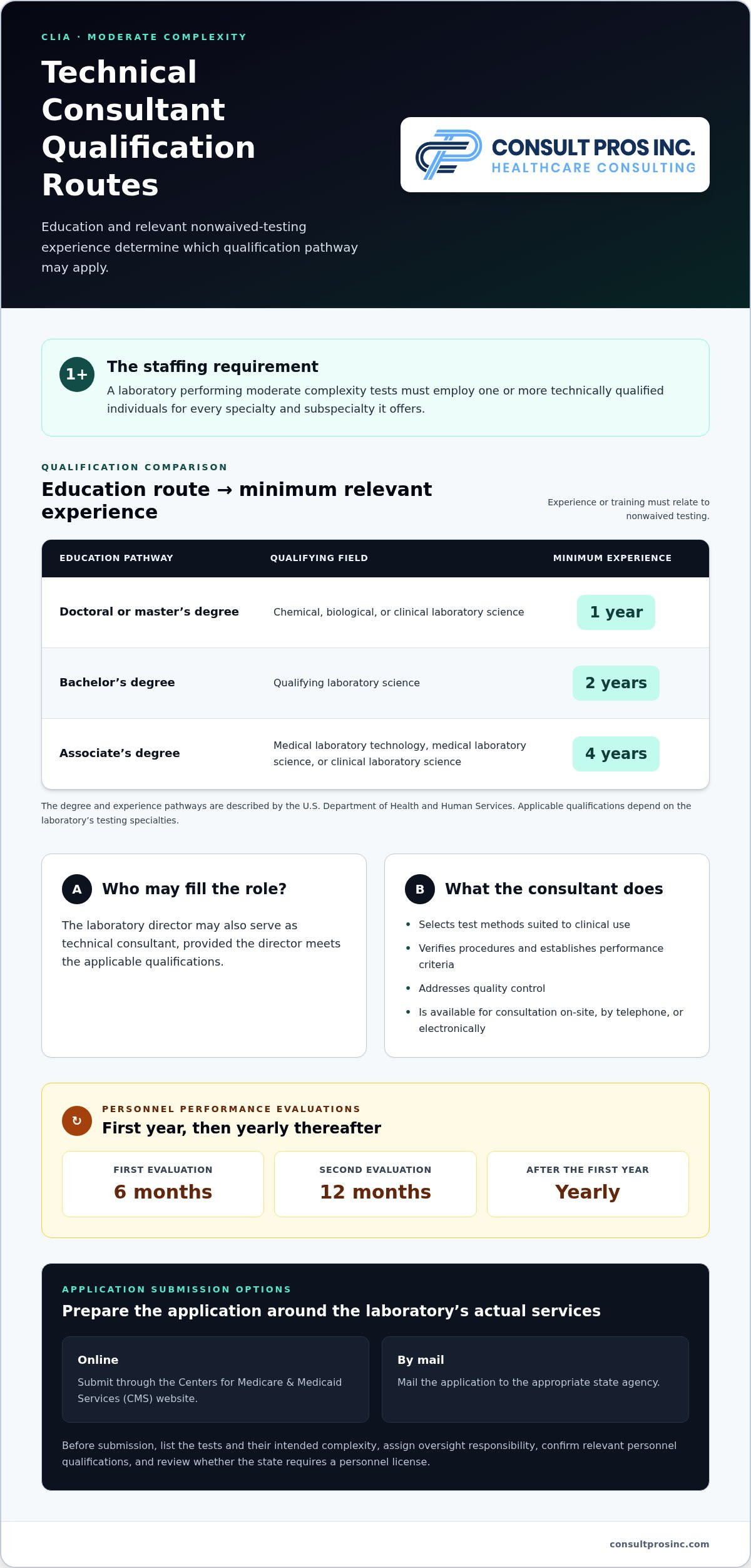
A CLIA application requests federal certification for a laboratory to test human specimens. Submission means sending the application through an accepted channel. In the United States, laboratories can apply online through the Centers for Medicare & Medicaid Services (CMS) website or mail the application to the appropriate state agency.
Before submitting, match the planned test menu to the intended testing complexity and certificate pathway. An addiction center, for example, should identify which tests it will perform in-house and which it will send to another laboratory. This inventory helps align the application with actual operations, rather than services that may change. Organize the laboratory’s ownership and operating details, location, responsible personnel, and applicable state license information so the application describes the facility being established.
A practical preparation sequence keeps the submission aligned with the proposed services:
- List each test the laboratory will perform and identify its intended complexity.
- Assign responsibility for laboratory oversight and confirm relevant personnel qualifications.
- Review whether the state where the laboratory is located requires a personnel license.
- Choose online submission through CMS or mail submission to the appropriate state agency.
For moderate complexity testing, technical consultant qualifications depend on education and relevant nonwaived-testing experience. According to the U.S. Department of Health and Human Services, a person with a doctoral or master’s degree in a chemical, biological, or clinical laboratory science may qualify with at least 1 year of relevant training or experience. A person with a bachelor’s degree in a qualifying laboratory science may qualify with at least 2 years, while an associate’s degree in medical laboratory technology, medical laboratory science, or clinical laboratory science may require at least 4 years of relevant laboratory training or experience. The director may also serve as technical consultant if they meet the applicable qualifications.
When choosing a CLIA consulting firm, compare its experience with your laboratory’s testing complexity, application preparation, and state licensing coordination. Define responsibilities in advance, including who will organize submission materials and support operational readiness.
Application preparation should also connect staffing to the laboratory’s work. A technical consultant selects test methods suited to the laboratory’s clinical use, verifies testing procedures, establishes performance criteria, and addresses quality control. The consultant must also be available for consultation on-site, by telephone, or electronically. Clarify these responsibilities before submitting, especially when an addiction center is developing laboratory operations alongside other services.
For an ownership transition, align application work with the change in control and the laboratory’s current operations. A change of ownership can involve distinct administrative steps, so plan for continuity of personnel, testing services, and facility information rather than treating the submission as a routine update.
CLIA certificate purpose and federal requirements
CLIA establishes federal requirements for clinical laboratory testing in the United States. Its certificate type and operational standards depend on the laboratory’s tests, complexity, and services.
CLIA Certificate Types
A CLIA certificate identifies the federal certification pathway for a laboratory’s testing services. There are five types: a Certificate of Waiver covers simple, low-risk tests; a Certificate for Provider-performed Microscopy covers certain microscopic tests; and a Certificate of Compliance applies to moderately complex or high complexity testing. A Certificate of Accreditation is for laboratories accredited by a CMS-approved accrediting organization. Match the pathway to the tests actually performed.
For addiction centers, the practical distinction is whether testing is waived, includes qualifying microscopy, or falls within moderate or high complexity. Some laboratories applying for a Certificate of Compliance or Certificate of Accreditation may need an on-site inspection. The certificate category therefore affects both applicable requirements and the oversight process.
Personnel and Director Qualifications
Personnel qualifications are the education, training, and experience required for laboratory roles under the applicable testing complexity. A U.S. laboratory performing moderate complexity tests must employ one or more technically qualified individuals for every specialty and subspecialty offered. According to the U.S. Department of Health and Human Services, a doctoral or master’s degree in a qualifying laboratory science may meet technical consultant requirements with at least 1 year of relevant nonwaived-testing training or experience.
A qualifying bachelor’s degree pathway requires at least 2 years of relevant experience or training, while an associate’s degree pathway requires at least 4 years. The director may also serve as technical consultant if they meet the applicable qualifications. Testing personnel performance must be evaluated at six months and twelve months during the first year of employment, then yearly thereafter.
Inspection, Quality Assurance, and Proficiency Testing
Inspection, quality assurance, and proficiency testing are oversight processes for assessing laboratory operations and testing reliability. Some laboratories applying for a Certificate of Compliance or Certificate of Accreditation may need an on-site inspection. A technical consultant must enroll the laboratory in an approved proficiency testing program suited to its services and establish a quality control program.
The consultant also selects methods suited to clinical use, verifies procedures, and sets performance criteria for accuracy and precision. Quality control establishes acceptable analytical performance levels and ensures they are maintained during testing. When an instrument or test method changes, personnel must be reevaluated before patient results are reported. Documenting these processes helps identify operational gaps before they affect testing procedures.
State Licensing and CLIA Requirements
State laboratory licensing is a separate jurisdictional requirement that may apply alongside federal CLIA certification. A technical consultant must hold a current license from the state where the laboratory is located if that state requires one. Map the laboratory’s location and personnel roles against applicable state licensing rules, then coordinate those requirements with federal certification.
State requirements can affect staffing and readiness, not just application paperwork. For example, a laboratory’s technical consultant may need both the appropriate qualifications and a state license. Planning for state licensing and certification support can help align the state and federal workstreams.
Common mistakes include choosing a certificate that does not match the test menu, overlooking personnel qualifications, or failing to maintain quality control and proficiency testing processes. These gaps can create compliance risks and disrupt laboratory operations. Address them with a documented review of services, roles, and procedures.
Certificate issuance and renewal
A CLIA certificate is the federal authorization associated with a laboratory’s testing services and certificate category. CLIA certificates for U.S. laboratories are valid for two years, making renewal a recurring compliance responsibility, not a one-time setup task.
Certificate issuance
Issuance is the administrative process through which a laboratory receives its CLIA certificate after applying. The appropriate category depends on the testing performed, so the application should reflect the laboratory’s actual test menu and planned operations. For example, a facility adding moderate complexity testing must account for the relevant personnel and quality systems, not just the new tests.
Some laboratories applying for a Certificate of Compliance or Certificate of Accreditation may need an on-site inspection. Operational readiness is therefore part of issuance planning. Keep application details, staffing responsibilities, procedures, and testing activities aligned so the laboratory can present a consistent account of its operations during review or inspection.
Issuance planning can be organized as a readiness sequence:
- Confirm the proposed tests and the certificate category that corresponds to them.
- Align the laboratory’s personnel, roles, and procedures with those services.
- Submit the application through the appropriate channel and retain the submitted information.
- Prepare the facility’s records and operations for any required inspection.
This sequence also helps addiction centers distinguish laboratory testing from services performed elsewhere. If a center changes its test menu before opening, the application should describe the intended laboratory operation, not an earlier plan. That alignment reduces avoidable administrative inconsistencies.
Renewal planning
Renewal maintains a certificate beyond its current validity period. Because CMS sets a two-year validity period, add the certificate’s expiration date to the laboratory’s compliance calendar and assign a staff member to oversee renewal. Keep a copy of the current certificate and related application records accessible to that person.
As renewal approaches, compare current operations with the information on the existing certificate. Review the test menu, location, responsible personnel, and changes in laboratory structure. For example, a center that has added testing services should assess whether its certificate category still matches its work. A change in ownership also calls for careful coordination of laboratory records and administrative responsibilities.
Renewal preparation should include a focused review of technical and quality documentation. Confirm that current procedures reflect the methods in use, personnel responsibilities remain clear, and quality control and proficiency testing activities are documented. These records support continuity between the current certificate term and the next administrative cycle.
For clinical operators, treat the two-year cycle as a standing governance task. Assign responsibility, organize certificate and laboratory records, and review operational changes before preparing renewal materials. This makes renewal part of routine laboratory oversight rather than a last-minute administrative exercise.
Consulting program prices
A consulting program provides professional support for organizing a laboratory’s CLIA application or compliance work. CLIA processing time depends on application completeness, agency review, and whether an on-site inspection is needed. Consulting program pricing depends on the case and is provided after a quote request. The scope, testing complexity, application or renewal work, and state coordination shape the quote.
Timeline factors
The application pathway and laboratory readiness influence how the work progresses. A clinical laboratory with a defined test menu and assigned personnel can organize materials around those services. If the application describes planned tests while procedures and staffing are still being established, those operational tasks remain part of preparation.
CMS and the appropriate state agency are involved in application submission, depending on the chosen route. Some laboratories seeking a Certificate of Compliance or Certificate of Accreditation may need an on-site inspection. That review step affects the sequence: the laboratory must be prepared to demonstrate that its documented procedures and actual testing operations align.
To build a realistic schedule, map the work before submission:
- Define the test menu and applicable certificate pathway.
- Identify personnel roles and qualifications for the planned testing.
- Prepare procedures, quality records, and application information.
- Include any applicable inspection preparation in the project sequence.
These steps distinguish preparation time from agency review. A change in test menu, personnel, facility details, or ownership can require additional coordination. For example, an addiction center adding laboratory testing while restructuring operations should align the application details with the facility’s actual plan.
Cost factors
A consulting quote sets out the proposed charge for defined advisory and implementation work. Scope can differ depending on whether the laboratory needs initial application support, renewal preparation, or help coordinating multiple compliance workstreams. State licensing coordination can also affect the work involved because state requirements may apply alongside federal CLIA requirements.
Federal certificate fees are separate from consulting charges. CLIA certificate fees vary by laboratory type and testing complexity, so the laboratory’s classification and services affect the federal fee. Keep the budgets distinct: one covers the certificate process, and the other covers professional preparation and related operational support.
Before requesting a quote, describe the laboratory’s current stage, certificate pathway, test menu, staffing plan, and outstanding application tasks. Note planned ownership or operational changes. A defined scope helps identify whether the work should focus on application organization, renewal readiness, or broader regulatory coordination, separate from government fees.
What is CLIA certification and which laboratories need it?
CLIA certification is federal certification for clinical laboratories that perform covered testing on human specimens. Under 42 CFR §493.3, a laboratory generally must hold the appropriate CLIA certificate before testing when it reports patient-specific results used for diagnosis, prevention, treatment, or health assessment. The Centers for Medicare & Medicaid Services (CMS) issues CLIA certificates in the United States.
A clinical laboratory tests human specimens and reports patient-specific results for health-related purposes. The activity matters more than the organization’s name: an addiction center that performs qualifying tests in-house may need certification for that laboratory operation. A center that sends specimens to another laboratory should distinguish that testing from any tests it performs itself.
Federal requirements are set out in 42 CFR Part 493 and address laboratory operations as well as certification. The first assessment is practical: identify each test performed, the specimen involved, where testing occurs, and how results are reported. For example, an operator should distinguish an in-house test from a result received from an outside laboratory before determining which work belongs in its CLIA application.
CMS issues five types of CLIA certificates, with the appropriate type determined by the laboratory’s testing services:
- Certificate of Waiver: for simple, low-risk tests.
- Certificate for Provider-performed Microscopy: for certain microscopic tests.
- Certificate of Compliance: for moderately complex or high complexity tests.
- Certificate of Accreditation: for laboratories accredited by a CMS-approved accrediting organization.
- Certificate of Registration: an additional certificate type within the five CLIA certificate categories.
For an addiction center, choose a certificate based on the actual test menu, not assumptions about the center’s broader treatment services. A laboratory offering different services may need to assess the complexity and requirements of each test. Some laboratories applying for a Certificate of Compliance or Certificate of Accreditation may need an on-site inspection.
Once the laboratory’s role is clear, document which tests it performs and which services it receives from elsewhere. Compare those activities with the certificate categories and federal requirements. This avoids a common planning error: treating all testing connected with a facility as one operation when separate laboratories may perform the work.
Plan your laboratory’s CLIA certification by organizing its test menu, operating structure, and certification needs.
Consult Pros: In-Network Contracting
Consult Pros Inc helps addiction centers structure operational requirements alongside their in-network contracting needs. For organizations developing an in-house laboratory, its CLIA Certification and State Licensing & Certification services connect federal certification planning with relevant state requirements.
Turn to Consult Pros Inc when laboratory readiness is part of a broader facility launch, ownership transition, or operational restructuring. Facility Setup & Operational Structuring supports development of the organization’s operational framework, while TJC & CARF Accreditation addresses separate accreditation needs. These services help operators coordinate distinct requirements without treating CLIA certification, state licensing, and accreditation as interchangeable processes.
If you are planning these connected workstreams for an addiction center, contact Consult Pros Inc to discuss support for your facility. Visit consultprosinc.com.
Build a compliance plan that supports your next stage
Establishing a laboratory is one part of a broader operational plan. As you prepare for launch or adjust existing services, assign clear responsibility for decisions affecting staffing, facility structure, and regulatory readiness. A coordinated plan helps leaders sequence these workstreams instead of treating each requirement as an isolated task. CLIA certification consulting supports this planning by connecting application preparation with the operational decisions that shape a laboratory’s day-to-day framework.
Consult Pros offers State Licensing & Certification and Facility Setup & Operational Structuring, while In-Network Contracting addresses a separate organizational need. The right combination depends on your facility’s priorities and development stage. Bring those priorities to a focused discussion so the next steps reflect your operational goals.
Contact Consult Pros to discuss support for your facility’s planning and compliance needs. A clear plan creates a stronger foundation for moving forward with confidence.
Frequently Asked Questions
What is a CLIA Certificate?
A CLIA Certificate is federal certification for a clinical laboratory performing covered testing on human specimens. Under 42 CFR §493.3, laboratories generally need the appropriate certificate before testing when they report patient-specific results used for diagnosis, prevention, treatment, or health assessment. An addiction center isn’t automatically a laboratory because it provides treatment; the key distinction is whether it performs qualifying tests and reports patient-specific results through its own testing operation.
What are the requirements to obtain a CLIA certificate?
A laboratory must choose the certificate pathway that fits its testing and establish the personnel and operational structure required. For moderate complexity testing, it must employ technically qualified individuals for each specialty and subspecialty it offers. State licensing may also apply to laboratory personnel. For example, an addiction center adding an in-house test should assess its complexity, the responsible personnel’s qualifications, and applicable state license requirements.
What are the steps to apply for CLIA certification?
Start by defining the laboratory’s test menu and identifying which services it will perform in-house. Determine the appropriate certificate category, organize facility and personnel information, and prepare an application that reflects the intended operations. U.S. laboratories can submit online through the Centers for Medicare & Medicaid Services website or by mail to the appropriate state agency. Keep the submitted details consistent with the laboratory’s procedures and staffing plan.
What services do CLIA certification consultants provide?
CLIA certification consultants organize application and compliance work around a laboratory’s services. Depending on the project, support can include reviewing test methods, personnel roles, quality procedures, and proficiency testing needs. CLIA certification consulting is useful when an operator needs to coordinate these requirements with facility operations, rather than treat the application as paperwork alone. For instance, a consultant can help structure policies across pre-analytical, analytical, and post-analytical laboratory processes.
How can a laboratory renew or update its CLIA certificate?
A laboratory can plan renewal by tracking its certificate term and preparing renewal information that reflects current operations. CLIA certificates are valid for two years, according to the Centers for Medicare & Medicaid Services. If ownership or laboratory details change, the application should account for those changes instead of carrying forward outdated information. Review the test menu, personnel responsibilities, and facility details, then coordinate the relevant renewal or change application.
How long does CLIA certification take and how much does it cost?
CLIA certificate fees vary by laboratory type and testing complexity. Once issued, a certificate is valid for two years.