
Put licensing in the startup plan, not at the finish line. To launch a compliant treatment center, align state-specific requirements with facility readiness, application documents, and the operating structure needed to meet them. Licensing support covers application steps, documentation, renewals, and state requirements.
It’s natural to focus first on the facility, services, and staffing. Each decision, however, shapes the groundwork regulators may assess. Treat licensing as a connected sequence of requirements to clarify what to prepare, when documents are needed, and how operational decisions fit together.
This guide explains how to organize a treatment center launch around licensing, compliance, and operational readiness. It covers policies and procedures, staff training and credential tracking, accreditation alignment, and preparation for regulatory review, helping you move from an initial plan toward a facility prepared to operate responsibly.
Key Takeaways
- Build staff training into ongoing operations by documenting completion and tracking licenses, certifications, and professional credentials.
- In the United States, CLIA requirements for clinical laboratories are codified at 42 CFR Part 493, according to the Electronic Code of Federal Regulations.
- Prepare for an Operational Site Visit by identifying compliance gaps, organizing supporting evidence, and strengthening responses before review.
- Develop core policies, procedures, and workflows that reflect the center’s operating model and align with relevant accreditation standards.
- Manage licensing as a structured process by tracking application steps, documentation, renewals, and state-specific requirements.
Compliance education and staff training
A behavioral health compliance program relies on staff who understand how requirements affect their daily work. Keep training current, documented, and aligned with the organization’s obligations. Include clinical and administrative roles, since privacy, recordkeeping, referrals, and financial processes may involve different teams. Set expectations during onboarding, then reinforce them with ongoing education and clear procedures.
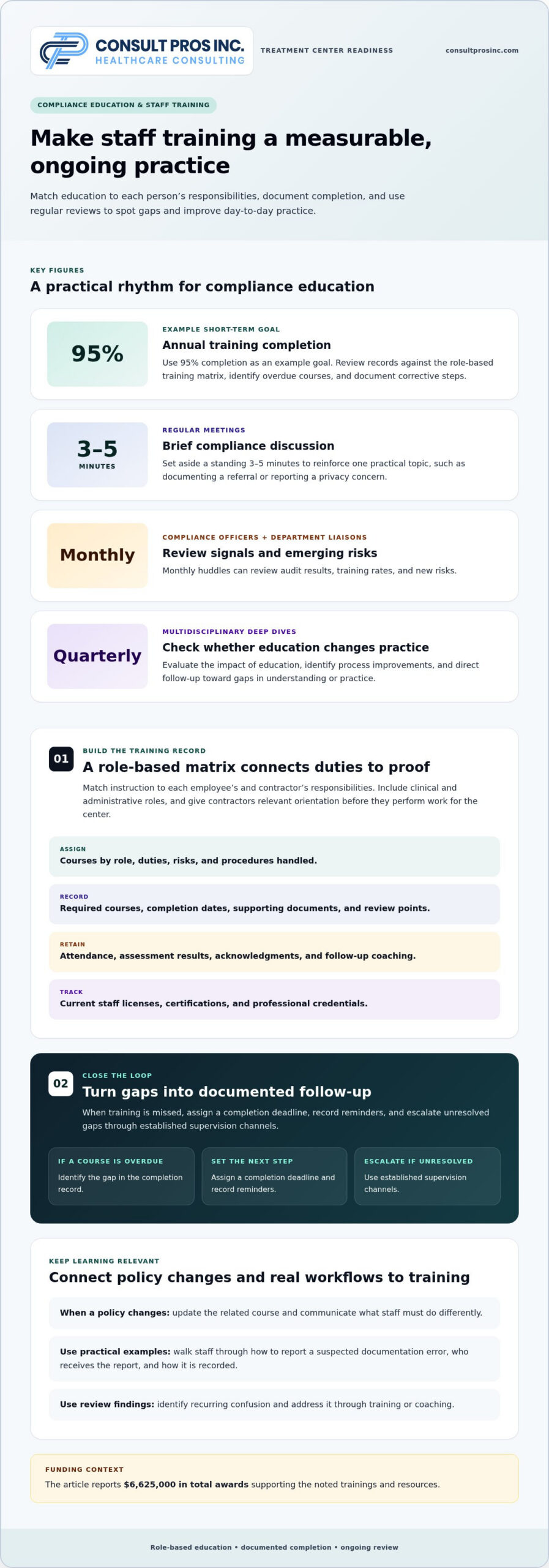
Match instruction to each employee’s and contractor’s responsibilities. Clinicians may need practice documenting services and protecting patient information, while billing staff may need guidance on accurate claims and escalation steps. Give contractors relevant orientation before they perform work for the center. Use a role-based training matrix to record required courses, completion dates, supporting documents, and review points.
- Assign courses by role. Connect each course to the duties, risks, and procedures the person handles.
- Document completion. Retain attendance, assessment results, acknowledgments, and follow-up coaching in an organized record.
- Track credentials. Maintain a current register of staff licenses, certifications, and professional credentials.
- Address missed training. Assign a completion deadline, record reminders, and escalate unresolved gaps through established supervision channels.
Make oversight measurable without reducing education to a checkbox. A 95% completion rate for annual training can serve as an example short-term compliance goal. Review completion records against the role-based matrix, identify overdue courses, and document corrective steps. If a policy changes, update the related course and communicate what staff must do differently. This creates a traceable connection between revised guidance and practice.
Embed brief discussion into existing routines. A standing 3-5 minutes of compliance at regular meetings can reinforce one practical topic, such as documenting a referral or reporting a privacy concern. Monthly huddles for compliance officers and department liaisons can review audit results, training rates, and new risks. Quarterly multidisciplinary deep dives can examine whether education changed practice and where processes need improvement.
Use examples from actual workflows while protecting sensitive information. For instance, walk staff through how to report a suspected documentation error, who receives the report, and how it is recorded. Supervisors can identify recurring confusion and address it through training or coaching. Training Services and Regulatory Compliance Programs help build this repeatable oversight structure instead of relying on informal reminders.
Keep training current, documented, and aligned with compliance obligations. Use completion records to identify where staff need further explanation or coaching. Treatment center compliance programs should also track staff licenses, certifications, and professional credentials. Reviewing training and credential records together gives you a clearer picture of staff readiness for their responsibilities.
Quarterly multidisciplinary deep dives can evaluate the impact of education and identify possible process improvements. The noted trainings and resources are supported by $6,625,000 in total awards. Use review findings to keep education practical and relevant, and to direct follow-up toward gaps in understanding or processes that need improvement.
CLIA certification and federal quality standards
Federal requirements, privacy protections, accreditation standards, and written operating policies address different parts of organizational readiness. Map each to the services, records, and workflows your treatment center will maintain.
Applicable Federal Laws and Regulations
In the United States, CLIA requirements for clinical laboratories are codified at 42 CFR Part 493, according to the Electronic Code of Federal Regulations. HIPAA addresses patient privacy rights and standards for electronic transmission of healthcare data. The compliance guide library also includes 42 CFR Part 2, which concerns confidentiality of substance use disorder patient records.
HIPAA and 42 CFR Part 2 are federal requirements relevant to treatment center privacy and records handling. Build procedures around how staff access, use, disclose, and safeguard information, then train personnel on those procedures. For CLIA, first map whether the organization performs clinical laboratory testing; if it does, determine the applicable requirements and organize the necessary certification work before operations begin.
Accreditation is distinct from federal law. CARF and The Joint Commission standards can inform behavioral health policies, procedures, and workflows. They help guide organizational readiness, while state licensing and federal obligations remain separate compliance considerations.
Clinical, Safety, and Patient-Rights Policies
A policy library should turn obligations into repeatable staff actions. Include procedures for clinical documentation, treatment planning, medication handling where applicable, incident reporting, privacy, records access, complaints, and emergency response. Define who acts, where staff record each action, and how supervisors review exceptions. For example, an incident procedure should explain reporting channels, documentation responsibilities, and escalation to leadership.
Patient-rights policies should explain how the center protects dignity, privacy, informed participation, and access to complaint processes. Patients retain civil rights and liberties except as provided by law; treatment alone cannot deprive a patient of a civil right. Translate that principle into guidance on respectful communication, grievance handling, and escalating concerns.
Align safety procedures with the facility’s services and operating environment. Assign an owner to each policy, set a review trigger for workflow changes, and make approved versions accessible to staff. During implementation, compare policies with CARF and The Joint Commission standards, then document gaps and corrective actions. This makes policies useful in daily practice, not just a static collection of files.
Organizations developing laboratory readiness can use CLIA certification support to structure certification work alongside broader compliance planning.
The Clinical Laboratory Improvement Amendments were enacted in 1988. CMS and CDC issued a request for information on July 16, 2026 (91 Fed. Reg. 32097); it does not change any requirement currently in effect.
Operational Site Visit preparation
An Operational Site Visit assesses whether a health center can demonstrate its processes with organized evidence. HRSA assesses health centers once during every project period through an Operational Site Visit. This requirement applies to Health Center Program participants, not automatically to every behavioral health treatment center. Other reviews depend on a facility’s programs, funding, and applicable oversight requirements.
Common compliance risks include incomplete records, inconsistent procedures, unsupported claims, and unresolved audit findings. Healthcare organizations should address identified overpayments promptly. The False Claims Act can impose civil fines of up to $11,000 for each false claim submitted to the U.S. government. These figures underscore why centers need reliable controls for claims, documentation, and issue escalation.
Begin with a structured assessment of the requirements relevant to your organization. Assign an owner to each requirement, identify evidence of compliance, and record gaps with a responsible person and corrective step. For example, if a procedure requires supervisors to review records, retain both the procedure and evidence that reviews occurred. A written policy without evidence of implementation may not show reviewers how the process works.
- Map requirements to evidence. Create an index that connects each requirement with its policy, record, and responsible department.
- Review samples. Select records from relevant workflows and check them for completeness, consistency, and required approvals.
- Track corrective actions. Document each gap, its owner, the remedy, and evidence that the change was put into practice.
- Prepare staff roles. Identify who can explain a process and where supporting materials are maintained.
Before an inspection, conduct a practice review using the same evidence index. Ask a department lead to explain a workflow, then locate the related policy and record. If the explanation and documents conflict, investigate and correct the process. Continue monitoring after the review: a one-time file cleanup won’t resolve a recurring operational weakness.
For Health Center Program participants, prepare for the Operational Site Visit in line with the project period and applicable program requirements. Organize evidence by function, such as governance, services, staffing, and quality processes, so reviewers can connect written expectations with actual practice. A clear index also helps the team respond consistently to requests for records.
Regulatory Compliance Programs and Facility Setup & Operational Structuring can help establish the documentation, workflows, and monitoring processes that support inspection readiness. Use the assessment to identify specific gaps, then assign and track corrective actions before an external review.
Treatment center startup planning
Build the startup plan around service scope, facility readiness, staffing, and documented procedures. A staged plan connects each decision with the actions and resources needed before opening. To launch a compliant treatment center, coordinate these workstreams from the outset.
Site and Building Requirements
Zoning, building, fire safety, and accessibility requirements depend on the site, facility, and planned services. Before committing to a location, identify relevant local requirements and compare them with the treatment model, room uses, occupancy, and patient access needs. Record the responsible authority, required evidence, and physical changes that could affect readiness.
Assess the facility against its intended operations. Map patient areas, staff workspaces, records handling, and emergency routes to the planned services. This early review can expose conflicts between the layout and workflows, giving the organization time to assign corrective actions before setup is complete.
Startup and Operating Costs
The cost to open and operate a treatment center depends on the project’s scope and is provided after a quote request. Key cost factors include facility setup, staffing, equipment, licensing, accreditation, training, and the systems needed to support ongoing operations. Build separate startup and operating budgets so one-time setup needs remain distinct from recurring expenses.
For each budget line, document its purpose, timing, and accountable owner. A staffing plan, for instance, should connect roles with the proposed service model and operating schedule. Making assumptions visible helps leaders revise resource plans when facility, staffing, or program decisions change.
Translate the service model into policies and procedures before opening. Define how intake, assessment, diagnosis, treatment planning, documentation, referrals, and discharge connect. Assign an owner to each workflow and specify the records that show it occurred. Procedures should reflect actual staff responsibilities, not an idealized process the organization cannot carry out.
Use a staged implementation plan with clear deliverables. Short-term compliance goals can cover a 0-to-6-month period, while long-term goals can cover 6-12 months. For example, completing internal claims audits within 3 months is a possible short-term goal. Assign an owner, evidence of completion, and review point to each action so progress remains visible.
- Define the program. Specify services, patient populations, and workflows before finalizing staffing and facility plans.
- Build the document set. Organize policies, procedures, forms, and approval records around actual operations.
- Coordinate readiness. Align facility setup, staff preparation, and administrative systems with planned opening activities.
- Review changes. Reassess procedures when service scope, staffing, or facility workflows change.
Test the operating design with practical scenarios. Walk through a sample intake, a documentation handoff, and an escalation requiring leadership action. If staff cannot identify the right procedure or record, revise the workflow before relying on it. For a team preparing to launch a compliant treatment center, this sequence connects site decisions, operational controls, and resource planning.
Treatment center licensing support
Licensing support organizes application steps, documentation, renewals, and state-specific requirements. Begin by defining the treatment setting and services, then map each requirement to an owner and record. To launch a compliant treatment center, connect licensing tasks to the operating model from the start.
Licensing by Treatment Setting
Inpatient, outpatient, residential, and detox programs may face different licensing requirements because their services, supervision, and facility operations differ. Define the care model first, then identify the state department responsible for the relevant license category. A detox program, for example, should map its planned services and clinical oversight to applicable state requirements before finalizing procedures.
Create a requirement tracker for each setting. Include application steps, required documents, submission status, renewals, and the department responsible for each item. If a center combines residential and outpatient services, map each service line separately rather than assuming one license covers every activity. This clarifies the application’s scope and connects policies with the operations they govern.
Staff Qualifications and Client Ratios
Staff qualifications and staff-to-client ratios depend on the state, license category, treatment setting, and services delivered. Build a staffing plan around those requirements, matching each role to its duties, credentials, supervision structure, and coverage needs. Distinguish clinical from administrative roles and identify which responsibilities require professional credentials.
Maintain a credential register linking each employee’s role to applicable licenses, certifications, and renewal records. Include contractors who perform duties within the center’s operations. Assign an owner to monitor expirations and retain documentation, then update the staffing plan when services or the treatment setting change. This keeps personnel records aligned with the licensed operating model.
Use a step-by-step licensing workflow to keep the application and operations aligned:
- Define scope. Record treatment settings, services, and planned operating activities.
- Map requirements. Connect each state-specific item to its documentation and responsible owner.
- Align policies. Ensure written procedures reflect the licensed services and staff responsibilities.
- Maintain records. Track application status, renewals, and supporting documents in one system.
CARF and The Joint Commission standards can inform policies and operational readiness, but licensing remains tied to applicable state requirements. Track these workstreams separately so accreditation preparation does not replace license-specific documentation. For operators preparing to launch a compliant treatment center, a setting-specific licensing plan helps coordinate the obligations.
Organize your state licensing plan with licensing support for treatment centers to structure applications, documentation, and renewals around your treatment setting.
Consult Pros: In-Network Contracting
Consult Pros Inc helps behavioral health operators coordinate In-Network Contracting with the foundational work of opening a treatment center. Turn to the firm when licensing, facility planning, or accreditation preparation needs to align with your operating model.
Through State Licensing & Certification, Facility Setup & Operational Structuring, and TJC & CARF Accreditation Support, Consult Pros Inc helps organize the administrative and operational work behind a launch. In-Network Contracting supports organizations planning payer participation as they establish their services and operational structure.
These services support infrastructure and organizational readiness, not clinical treatment delivery. If you’re ready to structure your center’s next steps, contact Consult Pros Inc about your launch to discuss your project.
Move Your Treatment Center From Plan to Readiness
A viable launch depends on keeping decisions aligned as the organization develops. Before implementation, establish who owns each workstream, how leadership will resolve competing priorities, and how changes to the operating model will be documented. This governance structure connects early planning to the center’s long-term direction.
Consult Pros Inc offers State Licensing & Certification, Facility Setup & Operational Structuring, and In-Network Contracting to support key organizational workstreams. These services help entrepreneurs and operators turn a treatment concept into an operational plan, with coordinated support across launch decisions. For leaders preparing to launch a compliant treatment center, the next step is to define immediate priorities and where structured assistance fits.
Contact Consult Pros about your launch to discuss the next stage of your treatment center plans. A clear starting point can help you move forward with purpose and build a durable foundation.
Frequently Asked Questions
What licenses and certifications are required to open a treatment center in the United States?
Requirements depend on the treatment setting, services, and activities the center will perform. A state license is central to authorization, while CLIA certification applies when the organization performs clinical laboratory testing. HIPAA and 42 CFR Part 2 concern privacy and records, rather than replacing facility licensing. CARF and The Joint Commission accreditation are separate from state licensure; operators may pursue them to align organizational practices with accreditation standards.
How do state licensing requirements for treatment centers vary by state?
States differ in license categories, application materials, oversight departments, and renewal procedures. The treatment model matters too: residential programs and outpatient services may fall under different state requirements. Define each service and setting, then map them to the relevant license categories. Keep separate records for applications, required documents, renewals, and policy changes, especially if the organization operates multiple service lines.
What are the steps to start a behavioral health or substance use treatment center?
Define the population served, treatment setting, and services first. Then map the relevant licensing and certification requirements, establish the facility and operating structure, and build policies around actual workflows. Prepare staffing and onboarding plans, including credential records, before opening. Finally, organize evidence showing how the center works in practice, such as sample intake documentation and staff procedures. This sequence connects the proposed care model with operational readiness.
How can a treatment center become eligible for Medicaid, Medicare, and private insurance reimbursement?
Insurance participation involves payer-specific enrollment and contracting, separate from establishing the center’s operating structure. Identify relevant payers, assemble the requested organizational and clinician information, and track each application or contract separately. Compare payer requirements with the center’s services and documentation practices before submitting materials. In-Network Contracting helps treatment organizations establish payer relationships as part of broader operational planning.