
The treatment model, not the name on the door, shapes the licensing path. State licensing for treatment centers varies by state and can depend on the services offered, the facility model, and how care is delivered. Start by defining those details and identifying the state authority responsible for your proposed program. This is a foundational planning decision, not an administrative detail to leave until later.
It’s understandable to be concerned that a program, building, or staffing plan could miss a requirement and create avoidable rework. State licensure is also distinct from accreditation and payer enrollment, so treating them as interchangeable can leave important readiness gaps. Each has a different purpose: licensure concerns state authorization, accreditation evaluates an organization against an accreditor’s standards, and payer participation concerns payment arrangements.
This guide explains how to identify the relevant state authority and license category, and how program design, facility planning, staffing, and operating procedures affect preparation. It also shows how accreditation and payer requirements fit alongside licensure. Use the steps to build a state-specific plan, organize connected workstreams, and identify open questions before submitting an application.
Key Takeaways
- Start with the treatment model: services, setting, and population served help determine the relevant state authority and license pathway.
- Use a state-specific review to map facility, capacity, staffing, and program factors that may shape application readiness.
- Distinguish state licensing for treatment centers from accreditation, certification, and payer participation, since each serves a different operational purpose.
- Build a sequenced preparation plan that connects jurisdiction research and program scope with facility plans, staffing, policies, and submission materials.
- Coordinate licensing preparation with facility setup and operational structuring, while recognizing that state agencies make licensing decisions.
What State Licensing for Treatment Centers Covers, and Why the Model Comes First
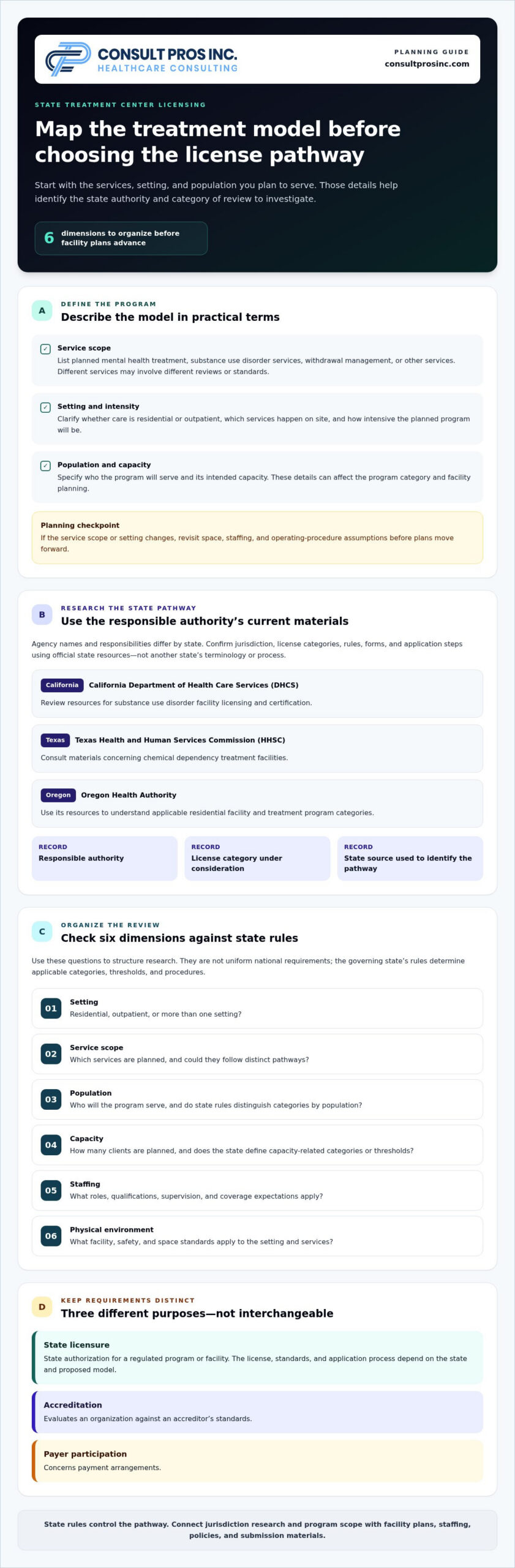
State licensure is authorization from the state authority responsible for regulating a treatment program or facility. To identify the right pathway, first describe the services you plan to offer, where care will take place, and the population the program intends to serve. These details help determine which agency and category of review may apply. State licensing for treatment centers is not a single national process; requirements must be checked against current rules in the state where services will operate.
Licensure generally means state authorization to operate a regulated program or facility. The specific license, standards, and application process depend on the state and the proposed model.
How a treatment center model influences licensing scope
A residential program provides care in a setting where clients stay, while an outpatient program delivers services without an overnight stay. These descriptions help frame the model, but they don’t create a universal classification system: states may define and regulate program types differently. A general overview of a Residential Treatment Center can provide context, while the state’s own rules determine the licensing pathway.
- Service scope: Mental health treatment, substance use disorder services, and withdrawal management may be subject to different reviews or standards.
- Setting and intensity: Describe whether care is residential or outpatient, which services will be delivered on site, and how intensive the planned program will be.
- Population and capacity: Specify who the program will serve and its intended capacity, since these details can affect the applicable program category and facility planning.
Write down these parameters before committing to a facility or finalizing design plans. If the service scope or setting changes, revisit the assumptions behind space, staffing, and operating procedures before those plans advance.
Which state authority oversees the proposed program?
Identify the state health or behavioral health authority responsible for the proposed services. Use its current materials to confirm jurisdiction, license categories, rules, forms, and application steps. Agency names and responsibilities differ by state, and some services may involve separate regulatory pathways. Base your plan on official state resources rather than another state’s terminology or application process.
- California: Review California Department of Health Care Services (DHCS) resources for substance use disorder facility licensing and certification.
- Texas: Consult Texas Health and Human Services Commission (HHSC) materials concerning chemical dependency treatment facilities.
- Oregon: Use Oregon Health Authority resources to understand applicable residential facility and treatment program categories.
Record the responsible authority, the license category under consideration, and the state source used to identify the pathway. This gives your team a reference point as it validates the proposed model and makes facility-planning decisions.
How State Licensing Requirements Change With Services and Facility Type
Once the proposed model is defined, translate it into regulatory questions instead of assuming a familiar program label means the same thing in every state. The state’s rules determine whether a service or facility category applies, whether separate approval is needed, and which standards accompany it. Use the comparison below to organize research, not as a list of uniform national requirements. Check current categories, thresholds, and procedures with the governing agency.
| Dimension | What to investigate |
|---|---|
| Setting | Does the program operate residentially, on an outpatient basis, or across more than one setting? |
| Service scope | Which mental health, substance use, withdrawal management, or other services are planned, and could they follow distinct pathways? |
| Population | Who will the program serve, and do state rules distinguish categories by population? |
| Capacity | How many clients are planned, and does the state set capacity-related categories or thresholds? |
| Staffing | What roles, qualifications, supervision, and coverage expectations apply to this program type? |
| Physical environment | What facility, safety, and space standards apply to the setting and services? |
Residential, outpatient, and withdrawal management models
Residential and outpatient programs have different operating environments, so facility planning may involve different considerations. Residential planning may include the setting where clients stay; outpatient planning may focus on spaces used for services and visits. Withdrawal management or detoxification may also have distinct state requirements. These distinctions help frame research, but they are not nationwide license labels or capacity limits. The target state’s rules control.
Services, staffing, and facility standards to map
Compare the actual program design with the state’s current rules. Prepare a concise service description, proposed staffing structure, client-record processes, safety procedures, and overview of the physical environment. Then use the agency’s materials to identify which items need supporting documents, review, or approval. These prompts organize the work but don’t replace state-specific requirements.
- Services: Describe what care the program will provide and in which setting.
- Staffing: Identify planned roles, qualifications, and supervision arrangements for agency review.
- Operations: Outline how client records and safety procedures will support the proposed model.
- Facility: Document the environment and capacity assumptions that inform space planning.
Texas illustrates why this mapping matters: Texas regulatory materials address topics such as organization, staffing, services, client protections, records, and the physical environment. Use these topics as planning prompts, not as requirements to apply automatically elsewhere. Confirm each applicable standard, threshold, and approval pathway with the authority overseeing the proposed program.
Aligning these workstreams early can help reveal mismatches between the service model and facility plans. Founders structuring that process can use treatment center licensing and facility planning support to organize regulatory and operational work around their proposed model.
State Licensure vs. Accreditation, Certification, and Payer Participation
Opening a treatment center can involve several approvals, each with a different purpose and decision-maker. State licensure is a jurisdiction-specific regulatory authorization for the facility or services covered by the applicable rules. Accreditation evaluates an organization against an accrediting body’s standards. Certification has a defined scope that depends on the program and issuing authority. Payer participation concerns enrollment or contracts that allow an organization to seek payment for covered services.
Each approval has its own scope and decision-maker, so one approval shouldn’t be treated as a substitute for another. CARF or The Joint Commission accreditation does not automatically replace required state authorization. Likewise, licensure alone doesn’t establish accreditation, secure payer contracts, or guarantee a particular reimbursement outcome.
| Category | Purpose | Decision-maker | Operational role |
|---|---|---|---|
| State licensure | Authorize a regulated facility or service within the state’s framework. | Applicable state licensing authority. | Establishes state regulatory authorization within the license’s scope. |
| Accreditation | Evaluate an organization against an accreditor’s standards. | An accrediting body, such as CARF or The Joint Commission. | Provides an external quality framework and may be relevant to organizational or payer expectations. |
| Certification | Recognize compliance with requirements for a specific program, activity, or standard. | The authority or organization responsible for that certification. | Applies to the certification’s defined scope; it doesn’t automatically authorize unrelated services. |
| Payer participation | Establish eligibility or contractual participation for payment under a health plan. | Public programs or individual health plans, as applicable. | Supports participation in a payer’s network or program, subject to its terms. |
What state licensure authorizes, and what it does not
A state license applies to the facility or services identified under that state’s rules. Its scope may depend on the treatment model and applicable regulatory categories, and additional approvals may apply to particular activities. Track each approval separately, noting its issuer, scope, status, and relationship to the proposed program. State licensing for treatment centers is one part of readiness, not a proxy for every other organizational requirement.
Where accreditation and certification fit
CARF and The Joint Commission are accreditation bodies, not state licensing authorities. Their standards and review processes are distinct from state authorization, even when accreditation supports broader quality or contracting objectives. Certification also requires careful interpretation because the term can refer to different programs and issuing bodies. Confirm what a specific certificate covers before treating it as relevant to a service or facility.
CLIA may be relevant if the center conducts laboratory testing; whether it applies depends on the testing activity and current requirements. Plan payer enrollment and contracting as separate workstreams, since neither follows automatically from accreditation or state licensure. Tracking each pathway separately helps operators sequence decisions and identify gaps without assuming one approval resolves another.
A Practical Roadmap for Preparing a State Treatment Center License Application
The sequence below is a general planning framework, not a universal agency process. Use it to coordinate decisions and supporting materials, then adapt each step to the responsible authority’s current rules and instructions. Application sequencing must follow the current instructions of the agency responsible for the proposed program.
- Confirm jurisdiction and scope. Identify the state authority and define the proposed services, setting, population, ownership structure, and intended facility capacity.
- Map applicable rules. Gather current agency forms, regulations, checklists, and written guidance that relate to the facility and program model.
- Identify approvals and dependencies. Record any related reviews or approvals that may apply, and note what must be completed before an application or inspection can proceed.
- Align facility plans. Compare proposed floor plans, space use, and capacity assumptions with the facility standards that apply to the program.
- Develop staffing and operating materials. Prepare staffing plans, governance documents, policies, and procedures that reflect the proposed services and applicable rules.
- Assemble and review the submission. Use the agency’s current checklist to organize required materials, confirm consistency across documents, and follow its filing instructions.
- Prepare for review and inspection. Treat inspection readiness as a distinct workstream, with timing and criteria determined by the state and the applicable process.
Before submission: establish scope and assemble evidence
Create a state-specific document matrix that names each requested item, its source, its owner, and its completion status. Use current agency forms and checklists rather than adapting another state’s application. Cross-reference floor plans, policies, staffing plans, and governance materials so service descriptions, capacity assumptions, and operating procedures present one coherent model. Before submission, check that document versions match and that each requested item has a clear owner.
After submission: manage review and operational readiness
Maintain one register for agency questions, requested corrections, inspection activities, and decision milestones. Assign responsibility for each response, track due dates set by the agency, and retain supporting records. Review progress regularly so open items remain visible and document changes are reflected across the application package.
In parallel, prepare the people and operations that may be reviewed. Depending on state procedures, this can include staff readiness, access to records, safety procedures, and the operating condition of the facility. Use current agency instructions to plan for inspection criteria and timing. Application completeness, agency workload, and state procedures vary, so avoid relying on a fixed timeline when planning launch activities.
Founders who want to coordinate licensing preparation with facility plans, staffing, and operating systems can structure a state-specific licensing plan with advisory support from Consult Pros. The state authority retains responsibility for application review and licensing decisions.
From State License Planning to Operational Readiness With Consult Pros
A licensing plan is most useful when it guides how the center will function, not just which documents it will submit. Facility decisions, governance, staffing, policies, and operating systems all need to support the proposed services and applicable state pathway. Consult Pros Inc advises behavioral health founders and operators by organizing these connected workstreams, while the state agency retains authority over application review and licensing determinations.
Coordinate licensing with facility and operational setup
Facility planning and operational structuring should reflect the same program model described in the licensing plan. Planned services and setting, for example, inform decisions about space, staffing roles, operating procedures, and supporting systems. Coordinating these decisions can help surface mismatches before they lead to revisions.
- Facility setup: Align space planning and facility decisions with the intended program and applicable state review.
- Governance and policies: Organize oversight responsibilities and operating procedures around how the center will deliver services.
- Staffing and onboarding: Connect planned roles, recruitment, onboarding, and training to the operating model.
- Operational systems: Structure the administrative systems and records processes needed to support day-to-day operations.
Accreditation preparation can be coordinated with broader readiness work, but it remains distinct from state licensure. CARF or The Joint Commission preparation addresses an accreditor’s standards; it doesn’t replace state authorization. Separate work plans can help teams manage both pathways while aligning shared policies and operational foundations.
Establish a state-specific advisory work plan
An advisory work plan should begin with the intended state, services, and facility model, alongside the governing agency’s current materials. Consult Pros Inc helps founders and operators organize licensing milestones, supporting documents, facility planning, staffing tasks, and operational preparation into coordinated workstreams. The plan reflects the proposed model, while licensing decisions remain with the state authority.
- Set the project baseline: Document the state, proposed services, setting, ownership structure, and facility assumptions.
- Map connected work: Link licensing milestones to facility plans, governance materials, staffing, policies, and operational systems.
- Track readiness: Assign owners and monitor open tasks, agency requests, and preparation for applicable reviews.
This structure gives leadership a clearer view of dependencies and outstanding decisions, while keeping regulatory requirements grounded in current state guidance. It also supports an orderly transition from planning documents to operating procedures without implying a guaranteed approval or timeline.
For support organizing a state-specific licensing and facility-readiness plan, discuss licensing and facility setup advisory with Consult Pros Inc.
Build Regulatory Readiness Into Your Next Decision
Before committing to a lease, finalizing a program design, or setting a launch date, establish a process for revisiting regulatory assumptions as the project develops. State guidance and application materials can change, and early decisions may affect later facility, staffing, and operating plans. A disciplined review of state licensing for treatment centers helps keep those decisions aligned with the intended model and the governing agency’s current direction.
Turn open questions into an organized work plan with clear owners, dependencies, and milestones. Consult Pros supports behavioral health operators with licensing and certification advisory, facility setup, operational structuring, accreditation preparation, and staffing support. State agencies retain licensing authority; advisory support helps coordinate preparation around your project.
Discuss your treatment center licensing and facility setup plan with Consult Pros. A state-specific plan and coordinated workstreams give your team a clearer path from preparation to operational readiness.
Frequently Asked Questions
How long does state licensing for a treatment center take?
There’s no reliable nationwide timeline because review steps and agency procedures vary by state, license category, facility model, and application readiness. The responsible agency’s current process is the best source for estimates. Allow time to prepare documents, respond to agency questions, complete facility review, and address any required inspection. Avoid tying an opening date to an assumed approval date; instead, track agency milestones and keep launch plans flexible.
Can a treatment center begin operating while its license application is pending?
Don’t assume that submitting an application authorizes the center to operate. Whether services can begin before approval depends on state rules and the specific license or registration pathway. Before accepting clients or describing the facility as licensed, confirm operating restrictions directly with the responsible state authority and obtain appropriate legal guidance. Include this decision in launch planning, since marketing, staffing, and intake activities may need to align with the permitted status.
Does a treatment center license transfer when ownership changes?
A license shouldn’t be assumed to transfer automatically when ownership changes. Depending on the license and transaction, a state may require advance notice, a new application, review of the incoming operator, or another agency process. Identify the applicable change-of-ownership requirements before closing, and coordinate regulatory planning with transaction and legal advisors. Build the agency’s requirements into the transaction schedule so responsibility for notices, submissions, and continuity planning is clear.
What documents are commonly requested in a treatment center license application?
Depending on the state and program, an application may request organizational, ownership, facility, service, staffing, policy, or safety information. The exact list varies, so use current agency forms and instructions for the intended license category. A document matrix can identify each item’s owner, review status, and state-specific source. Add version dates to working files and record revisions so reviewers and internal teams can identify the current materials.
Does providing treatment through telehealth remove state licensing obligations?
No. Telehealth doesn’t automatically eliminate licensing considerations. Applicable rules may depend on where the provider and client are located, which services are delivered, and the professional or facility structure involved. For example, a program serving clients across state lines may need to assess requirements connected to each service location. Map the planned telehealth model and confirm current requirements with relevant regulatory authorities and qualified legal counsel before expanding service delivery.
What should a center do if its license application is denied?
Start by reviewing the written agency decision for its specific grounds, deadlines, and available response or appeal procedures. The appropriate next step depends on state rules and the application record. Organize the submitted materials and agency correspondence, then distinguish correctable gaps from issues that require a formal response. Obtain qualified regulatory or legal advice before submitting an appeal, response, or revised application, and track all applicable deadlines carefully.
Does a change in treatment services require notice to the licensing agency?
It may. Adding a service, changing the facility model, or altering other approved program details can trigger notice, review, or approval requirements under state rules. Before implementing a material change, compare it with the license conditions and current agency instructions. For example, document how a proposed new service affects the program description, staffing plan, and facility operations, then determine whether a submission or agency response is required before the change begins.