
A completed payer application doesn’t make a treatment center ready for an in-network agreement. Effective treatment center insurance contracting starts with operational fit: the facility’s services, staffing, licensing, documentation, and administrative systems need to align with payer expectations. Credentialing and contracting are connected, but they serve different purposes. Credentialing reviews provider qualifications, while contracting establishes the terms for participating in a payer’s network.
A payer agreement is also different from insurance that protects the business against operational risks. Each addresses a separate need, and neither substitutes for the other. This guide explains the main stages of payer contracting, how to assess readiness before investing in applications, and which decisions can affect preparation. It also shows how facility structure, regulatory planning, and operational systems fit into a coordinated approach. Consult Pros Inc supports behavioral healthcare organizations with in-network contracting advisory alongside these broader operational foundations.
Key Takeaways
- Treatment center insurance contracting moves from defining services and assessing readiness to preparing materials and reviewing payer terms.
- Each payer sets its own participation criteria and process, so requirements and timelines can vary.
- Compare in-network participation, out-of-network arrangements, and commercial coverage in light of your facility’s goals and operational capacity.
- Review program definition, organizational structure, documentation, and administrative capacity before committing resources to payer applications.
- Coordinate contracting preparation with facility structure, licensing, staffing, and compliance planning.
What treatment center insurance contracting means for in-network access
Treatment center insurance contracting is the process of establishing an agreement that allows a provider or facility to participate in a health plan’s network. The agreement sets participation terms for covered services. Eligibility and requirements depend on the payer, the program, and applicable rules. In practical terms, the payer considers a treatment center’s services and operating structure in relation to a particular plan’s network and participation process.
In-network payer contracting is an agreement between a provider and a health plan that establishes the terms for participating in the plan’s network. The agreement can affect how covered services are accessed and reimbursed, but network participation alone doesn’t guarantee referrals, payment for every service, or a particular reimbursement level. Coverage and payment depend on plan terms and the circumstances of the service. A foundational explanation of how plans and networks relate is available in Health Insurance and Provider Networks.
In-network contracting versus treatment-center business insurance
The word “insurance” can refer to two separate operational matters. A payer agreement concerns a facility’s participation in a health plan’s network and the terms associated with covered services. Commercial insurance policies, by contrast, are intended to address organizational risks. Property coverage may address damage to a facility, while liability coverage may address certain claims involving the organization.
These arrangements aren’t interchangeable. A health plan contract doesn’t replace property or liability coverage, and a commercial policy doesn’t establish network participation. Plan for them independently: include payer relationships in service and financial planning, and consider business insurance as a separate risk-management responsibility.
Why payer relationships matter to facility planning
Payer participation decisions can shape how a treatment center defines its programs, organizes staffing, and plans administrative capacity. For example, a facility considering more than one level of care should assess how each program’s scope aligns with the participation criteria of the plans it intends to pursue. That assessment can inform planning before the organization commits resources to contracting.
Requirements and network availability can differ among payers, plans, programs, and applicable jurisdictions. A plan’s participation process may differ from another’s, and an agreement for one service or program shouldn’t be assumed to extend to another. Treat each prospective payer relationship as a distinct planning decision rather than assuming one agreement establishes access across plans.
Keep the distinction clear as plans develop: contracting is about network participation, not a promise of patient volume or a guaranteed financial result. Before proceeding, compare the payer’s requirements with your program scope, staffing plan, facility status, and administrative capacity. This groundwork helps identify which questions depend on a particular payer’s process and which are broader facility-planning considerations.
How treatment center payer contracting moves from readiness to agreement
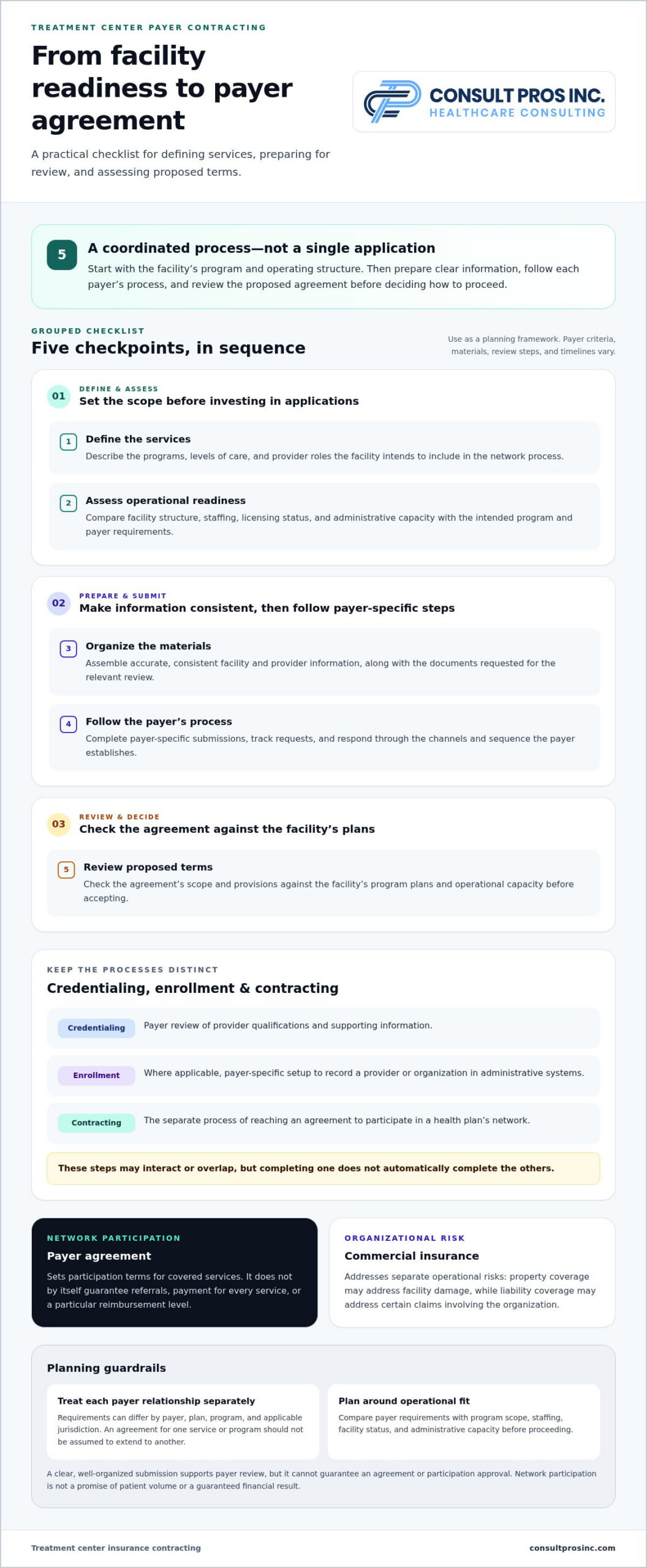
Treatment center insurance contracting is best approached as a coordinated process, not a single application. First clarify what the facility provides and how it is organized. Then assess whether its operations can support payer participation, prepare accurate information, follow each payer’s process, and review proposed terms before deciding how to proceed.
A practical sequence is:
- Define the services. Describe the programs, levels of care, and provider roles the facility intends to include in the network process.
- Assess readiness. Compare the facility’s structure, staffing, licensing status, and administrative capacity with the intended program and payer requirements.
- Organize materials. Assemble accurate, consistent facility and provider information, along with the documents requested for the relevant review.
- Follow payer processes. Complete payer-specific submissions, track requests, and respond through the channels and sequence the payer establishes.
- Review proposed terms. Check the agreement’s scope and provisions against the facility’s program plans and operational capacity before accepting.
This sequence is a planning framework, not a universal payer checklist. Each health plan controls its participation criteria, requested materials, review sequence, and timelines. Requirements can also depend on the facility’s circumstances and proposed programs. A well-organized submission helps the payer review clear, consistent information, but it can’t guarantee an agreement or approval for participation.
Credentialing, enrollment, and contracting are related but distinct
Credentialing generally involves a payer’s review of provider qualifications and supporting information. Enrollment, where applicable, refers to payer-specific setup that allows a provider or organization to be recorded in the payer’s administrative systems. Contracting is the separate process of reaching an agreement to participate in a network. The steps may interact or overlap, but completing one doesn’t automatically complete the others.
What happens when a payer reviews a facility
A payer may review program information, provider details, and requested documentation. It may ask for clarification or additional materials, and the review may involve different steps depending on the plan and facility. Keep information consistent across submissions, assign someone to track outstanding requests, and record decisions and follow-up. These practices help the team manage the process without assuming it will result in a contract.
Credentialing completion confirms a review step, not approval for a facility to join a payer’s network. That distinction helps leaders set realistic expectations, assign responsibility for each workstream, and avoid treating a provider’s credential status as proof that the organization has a signed payer agreement.
Facility structure, licensing, staffing, and compliance all inform contracting preparation, so behavioral healthcare operators benefit from coordinating these workstreams rather than managing them in isolation. Consult Pros’ in-network contracting support helps organize the work as part of broader operational planning, without promising payer acceptance or specific reimbursement outcomes.
Compare payer contracting with other insurance and network options
Choosing how to participate in payer networks is different from purchasing insurance to protect a treatment center’s operations. In-network and out-of-network arrangements describe a provider’s relationship with a health plan. Commercial coverage, in the comparison below, means business insurance for organizational risks. Keeping these categories separate helps leaders assess network strategy without mistaking it for a risk-management policy.
| Option | What it describes | Planning considerations |
|---|---|---|
| In-network agreement | A provider’s agreement to participate in a health plan’s network under specified terms. | Consider program fit, payer participation criteria, and the administrative capacity needed to meet the agreement’s requirements. |
| Out-of-network arrangement | A provider relationship in which the provider has no in-network agreement with that plan. | Access and payment depend on plan benefits, service circumstances, and applicable terms. Don’t assume every plan covers out-of-network services. |
| Commercial business coverage | Policies addressing organizational risks, such as property, liability, or workers’ compensation. | Assess these protections separately from payer participation. They don’t establish a relationship with a health plan’s network. |
In-network and out-of-network relationships
An in-network agreement establishes a formal participation relationship with a specific plan. An out-of-network arrangement means no such agreement is in place. Neither label alone determines whether a person can receive services or whether a claim will be paid. Benefits, coverage decisions, and payment depend on plan terms and the circumstances involved.
For facility leaders, compare more than network status. Consider whether the plan’s participation process and program criteria align with the services offered, and whether the organization can support the related administrative work. Assess payer availability and program eligibility for each plan and program. Don’t assume an option available for one applies to another.
Payer agreements and commercial coverage protect different interests
A payer agreement governs a provider’s participation in a health plan network. Commercial policies address distinct organizational risks: property coverage may relate to the facility, liability coverage to certain claims, and workers’ compensation to workplace injury risks. These policies don’t create provider status with a health plan, and a network contract doesn’t replace business insurance.
In practical planning, treat the two workstreams independently. Evaluate payer relationships in light of program goals and operational capacity, and assess business coverage as part of organizational risk management. The right network approach can vary by facility, payer availability, and program eligibility, so there isn’t one participation model that fits every treatment center. Keeping the categories separate helps operators compare options without assuming access, coverage, or payment outcomes.
Assess treatment center readiness before pursuing payer contracts
Before starting treatment center insurance contracting, assess whether the facility can clearly describe its programs and support them in practice. Readiness involves more than assembling application materials. Check that program scope, organizational structure, provider information, facility status, documentation, and administrative capacity tell a consistent story. Identifying gaps early helps operators focus preparation on the areas most relevant to their intended payer relationships.
Use a treatment center operational readiness review to examine:
- Program definition: Can the facility describe its services, levels of care, and intended operating model consistently?
- Organizational structure: Are facility and provider details accurate and aligned across internal records?
- Licensing and facility status: Do current approvals and the facility’s status align with the payer’s requirements for the relevant program?
- Documentation: Can the organization assemble the information a payer requests and keep it organized for review?
- Administrative capacity: Are responsibilities and workflows established to manage payer communication and ongoing follow-through?
Align program scope and organizational documentation
Review how service descriptions, facility operations, and provider information fit together. For example, a program description should reflect the services the facility is structured and staffed to deliver. Payers may request organizational, provider, program, or licensing information, but specific materials and criteria vary. Treat state and payer requirements as details to assess for the facility and program in question, not as universal prerequisites.
Document control matters. Assign responsibility for maintaining current versions, resolving inconsistencies, and recording outstanding items. If a facility is new, changing its structure, or adding a program, distinguish what is already established from what remains in development. This helps leaders assess readiness accurately and avoid presenting planned operations as if they were already in place.
Plan for ongoing administration after contracting
Readiness also includes the ability to manage organized communication after a payer relationship begins. Identify who will manage payer correspondence, maintain relevant records, route requests to the right staff, and track follow-through. Staffing plans, onboarding, and compliance processes support continuity by helping team members understand their responsibilities as operations evolve.
This administrative planning is distinct from day-to-day claims processing or medical billing. The focus is the organization’s capacity to manage the payer relationship and maintain the processes that support participation. If key duties depend on one person or haven’t been assigned, clarify ownership before adding new operational commitments.
For a new facility, a dedicated contracting checklist can turn this review into a structured preparation plan tailored to program scope, facility status, and the payer process being pursued. Consult Pros Inc’s in-network contracting support helps behavioral healthcare operators organize contracting preparation alongside facility structuring, licensing, staffing, and compliance considerations. Aligning these workstreams gives leaders a clearer basis for deciding when to proceed and what requires further preparation.
How Consult Pros supports treatment center insurance contracting
Treatment center insurance contracting works best when payer preparation reflects how the facility is structured and operated. Consult Pros Inc advises behavioral healthcare founders and operators on in-network contracting as part of broader operational planning, connecting contracting priorities with facility setup, licensing, staffing, and compliance. This coordinated perspective helps leaders organize the work around their program model and stage of development.
Consult Pros Inc’s advisory work focuses on structuring and preparing contracting activities, not guaranteeing a payer’s decision or a financial result. A payer controls its participation process and decisions, so support cannot guarantee acceptance, network placement, referrals, or reimbursement. The goal is to bring clarity to the facility’s priorities, readiness, and next steps.
Coordinate contracting with facility and compliance planning
Consider contracting plans alongside the operational foundations they depend on. Licensing status, facility structure, program design, and staffing plans may all inform how an organization prepares for payer review. Consult Pros Inc helps operators coordinate these advisory workstreams so contracting preparation is considered in context, rather than treated as an isolated administrative task.
The right areas of support depend on the facility’s needs. A new organization may be establishing its operating structure, while an existing operator may be addressing staffing, onboarding, or compliance processes as programs evolve. Connecting these priorities helps leaders identify dependencies and organize preparation. This work concerns operational and contracting advisory, not day-to-day claims administration or medical billing.
Define a practical next step for your organization
Before pursuing support, clarify a few points internally: the program model you intend to operate, the facility’s current stage, and the payer relationships you want to explore. Identify operational questions that could affect preparation, such as facility planning, licensing, staffing, or compliance. A concise overview gives the contracting discussion a practical starting point without presuming that a payer will offer an agreement.
A structured discussion can then establish which workstreams are most relevant and how they fit together. Some organizations may need to focus first on facility and regulatory foundations; others may be ready to organize a contracting strategy around established programs. The appropriate sequence depends on the organization’s circumstances and the payer processes it intends to pursue.
For behavioral healthcare leaders seeking a coordinated approach to payer preparation and operational priorities, Discuss in-network contracting support with Consult Pros Inc. A focused conversation can help frame the facility’s current needs and identify practical advisory priorities, while keeping payer decisions and outcomes in their proper context.
Set a Clear Course for Your Next Contracting Decision
Your next step doesn’t need to be a large-scale application effort. Start by identifying the decision that will most improve your organization’s position: clarifying a program model, strengthening operational foundations, or setting a focused payer strategy. A defined priority makes it easier to direct time and attention where they can support durable progress.
For treatment center insurance contracting, thoughtful preparation is valuable even when payer decisions remain outside your control. Consult Pros makes in-network contracting a priority and brings it into a broader advisory perspective that can include licensing, facility structuring, staffing, and regulatory compliance. This connects payer planning with the organization’s operational direction without promising network placement or reimbursement outcomes.
Whether your facility is establishing its operating model or refining its contracting priorities, a measured, coordinated approach can help you move forward with greater clarity. Discuss your treatment center’s in-network contracting needs and identify practical next steps for your organization.
Frequently Asked Questions
How long does treatment center insurance contracting take?
Treatment center insurance contracting has no universal timeline because each payer sets its own review and decision process. The duration can depend on whether facility information is complete, whether the payer requests clarification, and how contract discussions proceed. Build flexibility into operational planning, track submissions and responses, and keep a record of open questions so follow-up is focused rather than relying on an assumed deadline.
Can a new treatment center pursue payer contracts before opening?
A new treatment center may be able to begin payer discussions or parts of an application before opening, but whether it can pursue a particular contract depends on the payer’s process and the facility’s stage. Distinguish proposed services from operations already in place, and don’t present planned staffing, licensing, or facility arrangements as completed. A staged plan helps owners identify what can be prepared early and what depends on further development.
Does provider credentialing guarantee an in-network agreement?
No. Credentialing addresses a provider’s qualifications, while a payer makes a separate decision about network participation and whether to offer an agreement. For example, an individual clinician’s review may be complete even though the organization’s program or facility participation remains undecided. Track each provider’s credentialing status separately from the facility’s contracting status so internal planning reflects what has been reviewed and what still requires a payer decision.
What documents might a payer request from a treatment center?
Requested materials vary, but a payer may ask for information about the legal organization, facility, programs, licenses, and participating providers. Provider details could include qualifications or other information relevant to the payer’s review. Maintain a controlled set of current documents and note which payer requested each item. This makes it easier to respond accurately without assuming one plan’s document list will satisfy another plan’s requirements.
Is Medicaid managed care contracting different from commercial payer contracting?
Yes, the contracting context can differ. Medicaid managed care involves health plans operating within a state Medicaid program, while commercial contracting involves private health plans. Processes, criteria, and oversight can vary by state, payer, and program. Assess each prospective relationship on its own terms, including which organization handles participation decisions and what program-specific requirements apply, rather than transferring assumptions from one payer category to another.
What happens if a payer declines a treatment center’s application?
A decline means the facility should review the payer’s communication and determine what it says about the decision. If the payer identifies missing materials or a correctable issue, the organization can address the gap and organize a response. If the decision reflects a different participation criterion, the next step may differ. Any reconsideration or resubmission depends on the payer’s process, so document the outcome and use it to guide future planning.
Does in-network status guarantee patient referrals or payment?
No. An in-network agreement doesn’t promise a volume of referrals or payment for every service. Coverage and payment depend on the member’s plan, the service provided, and applicable agreement and plan terms. Before relying on a payer relationship in financial projections, distinguish network participation from actual utilization and claim outcomes. Treat in-network status as one element of planning, not a substitute for assessing operational capacity and payer-specific conditions.