
A treatment center’s operational risk often sits between systems, not within a single compliance task. Licensing records may be separate from staffing plans, while payroll procedures and compliance responsibilities develop on different tracks. Treatment center operational consulting helps founders and operators connect these moving parts. Readiness starts with a clear view of what exists, who owns it, and how work gets done.
When responsibilities are scattered across teams and documents, workflows can be difficult to repeat as a center prepares to launch or grow. This checklist helps you assess priority systems, assign accountable owners, and identify where documentation needs to support consistent execution.
Use it to review the operational foundations linking regulatory readiness, staffing, and financial processes. You’ll also find ways to spot gaps that may benefit from coordinated advisory support, so next steps reflect your facility’s needs and applicable requirements.
Key Takeaways
- Assess operational readiness across connected systems, not solely through a license, accreditation, or certification decision.
- Clarify governance, decision rights, escalation paths, and review routines so responsibilities are actionable and understood.
- Use the treatment center operational consulting checklist to document each priority area’s owner, current process, evidence, gaps, and next review.
- Compare formal approvals with day-to-day evidence, while accounting for requirements that vary by state, facility model, and services.
- Coordinate facility structuring, licensing, accreditation preparation, staffing, and administrative systems to turn identified gaps into sequenced work.
What treatment center operational consulting addresses across the organization
Treatment center operational consulting is structured support for designing and aligning the business systems, responsibilities, and workflows that help a behavioral health facility operate with clarity. It considers how functions work together instead of treating licensing, accreditation, staffing, or finance as isolated projects. By mapping the links between policies, owners, records, and routine tasks, leaders can see where handoffs need better structure.
Operational readiness is broader than receiving a license, accreditation, or certification. An approval addresses a defined requirement or review. Readiness also depends on whether the facility can carry out and document its processes consistently. A policy, for example, may be approved while onboarding materials still describe an older workflow. Or a staff member may be assigned a responsibility without a clear escalation path. These disconnects can leave ownership unclear and records incomplete even when the relevant documents appear to be in place.
A coordinated review maps how work moves between functions, including leadership decisions, staffing and training, financial administration, and compliance activities. This helps an operator distinguish a document that exists from a process that is assigned, understood, and used.
Which treatment center stages can benefit from operational review?
Review can begin during planning, as founders define the facility model and the systems it will require. Before launch, the focus shifts to operational handoffs, staff responsibilities, documentation, and whether core procedures are ready to use. As a facility grows, new services or roles can expose gaps in existing processes. Ongoing review helps leaders keep procedures aligned with actual operations.
The right scope depends on the facility model and its stage. A planned program may need foundational structures, while an operating center may need to clarify ownership or make workflows more repeatable. Requirements vary by state and facility, so determine applicable obligations using current, relevant primary sources.
How do consulting and internal operations work together?
Leaders retain accountability for the organization and its decisions. An advisor does not replace internal authority, clinical leadership, or regulatory bodies. Treatment center operational consulting can help leadership map responsibilities, identify process gaps, and develop practical procedures and documentation around the facility’s operating model.
For example, an advisor can help clarify how a policy update reaches the staff responsible for carrying it out, how completion is recorded, and who reviews the process over time. Internal teams then apply the workflow, share operational realities, and maintain their responsibilities. This keeps implementation grounded in day-to-day work while giving leaders a clearer basis for oversight.
Useful advisory support connects design with implementation by translating priorities into assigned work, usable records, and review routines. It does not replace formal approval, but it can help create a more coherent operating structure as the facility’s needs change.
The operating systems a behavioral health facility needs to connect
Operational systems work best when responsibilities and information move clearly between teams. Staff need to know which steps apply to their roles, managers need a way to see whether those steps are completed, and records need to support review. Treatment center operational consulting can help leaders map these connections, turning disconnected documents into a coordinated structure.
Start with governance. List recurring operational decisions, who can make or approve them, and how unresolved issues reach the appropriate leader. Set a review routine that fits the facility’s stage and operating model. Meeting notes should capture decisions, assigned actions, responsible owners, and follow-up dates. An action log makes it easier to track tasks between meetings.
Governance and responsibility mapping
A responsibility matrix can connect each key process to its owner, reviewer, and escalation contact. For example, a policy revision may need an operational owner to coordinate the update, a designated leader to review it, and a defined method for communicating the final procedure to affected staff. Document approval paths as well as decision rights, so routine questions do not stall or bypass established oversight.
Documented ownership supports continuity by making clear who acts, who reviews, and where unresolved issues go. Revisit the matrix when responsibilities change, new services are introduced, or a review shows that a handoff no longer works as intended.
Staffing, administrative, and compliance workflows
Connect role descriptions to the tasks staff actually perform, then align onboarding and training materials with current procedures. Where applicable, include credential verification and retain records of completed steps. When a workflow changes, decide who updates the relevant materials and how staff receive the revised instructions. This keeps written policy connected to daily practice instead of leaving teams to rely on informal direction.
Administrative systems need the same clarity. Behavioral health accounting systems and payroll processes should make responsibilities, approvals, and records understandable to the people who manage them. Consistent documentation gives leaders a more useful view of routine administrative activity and supports operational review. Keep internal financial administration distinct from day-to-day medical billing or claims processing.
Compliance monitoring should connect observations to a defined response. When a review identifies a gap, record the issue, assign an owner, set a follow-up point, and document whether the process was updated or the concern remains open. This does not determine which requirements apply to a particular facility. It provides a practical way to track findings through corrective work.
This connected-systems view helps identify where process design or documentation needs attention. Consult Pros Inc’s facility setup and operational structuring can help align responsibilities across staffing and administration.
How to assess operational gaps without mistaking one approval for readiness
A formal approval marks a specific milestone, but it does not show by itself whether the facility can sustain the processes behind its operations. A license, accreditation, certification, or payer-related credential may have a defined scope. Leaders still need to determine whether responsibilities are assigned, procedures are current, and records are maintained in practice.
Readiness is demonstrated through functioning, documented processes, not through an approval alone. For each relevant requirement, compare its status with evidence of how related work is carried out. Evidence may include a current procedure, a completed record, a named owner, or documentation of review and follow-up. Treatment center operational consulting can help organize this comparison and show how gaps connect. A checklist alone is not proof of compliance or a guarantee of approval.
Approval status versus operational evidence
Build a working register that separates the milestone from the operational evidence needed to maintain it. Use the table as a starting format, adapting each row to the facility’s model and applicable oversight. Check state and facility details, along with current payer, accreditor, or certification expectations, against relevant primary sources before treating them as requirements.
| Requirement | Accountable owner | Evidence | Follow-up date |
|---|---|---|---|
| Approval or credential milestone | Named lead | Current status record and supporting documents | Next review or renewal point |
| Related operating procedure | Process owner | Current procedure and applicable completed records | Scheduled procedure review |
| Staff implementation | Relevant supervisor | Role guidance and applicable onboarding or training records | Next staff or workflow review |
A blank owner or evidence field is a signal to investigate, not a compliance finding on its own. It identifies a question for leadership to resolve and document.
Prioritizing gaps and dependencies
Not every gap has the same operational importance. Start with matters tied to patient safety, essential workflows, or time-sensitive external requirements that apply to the facility. Then map dependencies. A procedure may rely on an approved decision, staff training may depend on a finalized procedure, and internal review may depend on completed, accessible records.
Unclear ownership can interrupt that sequence. If no one is responsible for updating a procedure, training materials may fall out of date. If no reviewer is assigned, a completed record may not lead to follow-up. Make dependencies visible before assigning target dates, so teams address prerequisites first and do not mark a task complete while the underlying process remains unfinished.
- Address first: gaps tied to patient-safety concerns, essential operating dependencies, or verified deadlines.
- Schedule next: process improvements that matter but do not block an essential workflow or applicable requirement.
- Reassess: open items when facility services, oversight, or internal responsibilities change.
Use this assessment to guide follow-through. When requirements depend on the state, facility model, services, or oversight involved, confirm their applicability and interpretation through current authoritative sources.
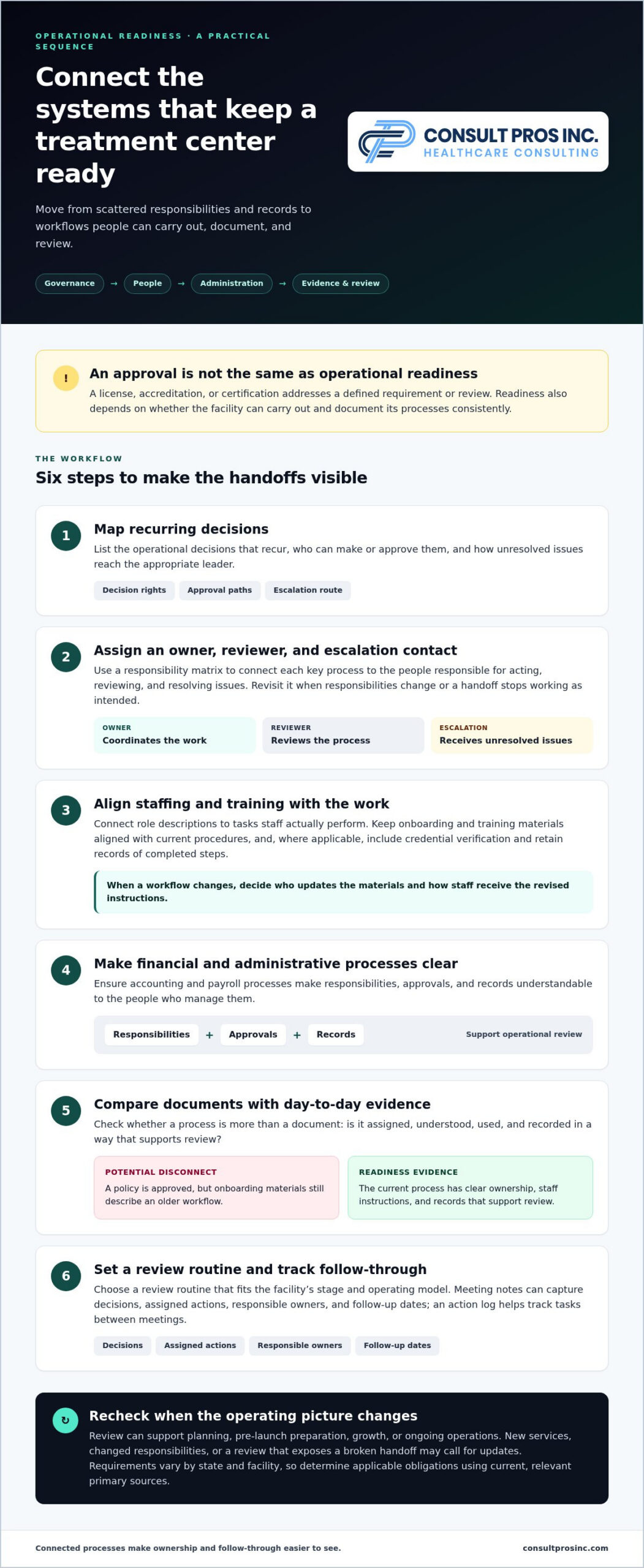
A practical treatment center operational consulting checklist
Use this sequence to assess how well the facility’s core processes work together, whether you’re preparing to launch or reviewing an established operation. Adapt the checkpoints to your facility model and applicable requirements. A checklist organizes a review, but does not establish compliance or guarantee approval.
For every checkpoint, record five things: the accountable owner, the current process, supporting evidence, the identified gap, and the next review date. If a field is unknown, flag it for follow-up instead of treating an assumption as a completed step. For more detail on launch planning, see the behavioral health facility setup guide.
Checklist checkpoints for people, process, and documentation
Review each area against actual practice, not just the presence of a policy or form. The treatment center operational consulting checklist below is a working tool. Tailor it to the services, roles, systems, and oversight relevant to your facility, then retain evidence of what was reviewed and what remains open.
- Clarify responsibility. Identify who owns key operational decisions and workflows, who reviews them, and where staff escalate unresolved issues. Record approval paths and the latest review date.
- Compare policies with practice. Select core written procedures and confirm that current staff roles and actual workflow steps align with them. Note outdated instructions, unclear handoffs, and who will address each gap.
- Review staffing records. Map role descriptions to onboarding steps, applicable credential verification, and training records. Confirm records show completion and staff can access current, role-specific guidance.
- Trace administrative processes. Document how accounting and payroll activities are handled, including responsible roles, approvals, retained records, and routine management review. Identify steps that depend on informal knowledge rather than a defined process.
- Check compliance follow-through. Review how monitoring findings are recorded, assigned, and tracked through corrective action. Capture the evidence used to close an item and set a date to revisit unresolved or recurring issues.
Turning findings into an accountable action plan
After the review, rank open items by urgency, dependencies, and owner. Address verified time-sensitive requirements and foundational steps first. Unresolved ownership or outdated procedures can delay training, documentation, and internal review. Schedule improvements that do not block essential work, while keeping their owners and review dates visible.
Define completion through evidence, not a verbal status update. Depending on the task, that may be an approved procedure, a completed training record, a reconciled administrative document, or a documented review. Keep licensing items at checklist level and verify state and facility details against current primary sources before acting on them.
Consult Pros Inc’s operational structuring support can help connect facility setup, staffing workflows, and administrative systems as you organize checklist findings into assigned work.
How coordinated operational support can sustain treatment center readiness
A checklist makes gaps visible. Coordinated advisory work can help leaders turn findings into a sequenced plan. Treatment center operational consulting connects facility structuring, licensing, accreditation preparation, staffing, and administrative systems, with each workstream tied to the facility’s priorities. A change in one area can affect others. Revised services, for example, may affect staffing needs, training, documentation, and the processes leaders use to monitor operations.
A scoped review can distinguish immediate dependencies from longer-term improvements. The advisor and leadership can organize findings into practical actions, identify the internal decision-maker for each item, and define what evidence will show progress. Leaders retain organizational accountability and authority, while internal teams contribute the operational knowledge needed to make procedures workable.
When an external operational review may be useful
An external review can be useful during launch planning, when a facility changes its operations, as it grows, or when process gaps keep recurring. Set the scope around the organization’s priorities, facility model, and applicable requirements rather than relying on a generic template. A focused review can clarify where coordination is needed without promising approval, accreditation, profitability, or a fixed implementation timeline.
Advisory work can be staged to match the organization’s readiness and capacity. Leaders may first resolve foundational ownership or documentation gaps, then address related staffing workflows and administrative routines. Accreditation and certification preparation can fit within this broader structure, but each remains tied to applicable standards and its own review process. Operational coordination does not replace decisions made by the relevant authority.
Coordinating advisory work with payer and compliance priorities
Operational foundations can support payer contracting readiness by helping a facility organize responsibilities, records, and workflows. They do not guarantee a contract or determine payer decisions. Contracting has its own requirements and processes, so treat it as a connected workstream rather than assuming operational preparation completes it.
Use this treatment center insurance contracting guide alongside your operational findings to understand the payer-facing process. This can help leaders distinguish contracting tasks from the internal systems that support consistent administration and follow-through. Assess current payer and compliance requirements in the context of the facility’s model and applicable oversight.
A scoped discussion can translate priority findings into coordinated work across facility structuring, licensing, staffing, accreditation preparation, and administrative systems. Discuss your operational priorities with Consult Pros Inc to explore an advisory approach aligned with your facility’s needs.
Make operational readiness an ongoing practice
Readiness is not a finish line. As a treatment center evolves, its responsibilities and systems need to keep pace with changes in staffing, services, and oversight. Choose one priority from your assessment, assign an internal owner, and establish how leadership will review progress. That turns planning into sustained operational attention.
Treatment center operational consulting can help founders and operators organize work around their facility’s priorities. Consult Pros Inc supports facility setup and operational structuring, staffing, onboarding, recruitment and training, accounting and payroll systems, and regulatory compliance programs. This coordinated advisory support helps leaders move from identified needs to organized next steps, while accountability remains with the organization.
Discuss your treatment center’s operational priorities and identify the next step that will best support your facility’s readiness. Clear ownership and a measured plan can help your team build a stronger foundation for what comes next.
Frequently Asked Questions
What does treatment center operational consulting include?
Treatment center operational consulting can include structured advice on how a facility’s business functions fit together, from decision workflows and staffing processes to administrative systems and compliance oversight. For example, an advisor may help clarify how a procedure update connects to staff guidance, training records, and management review. The scope depends on the facility’s needs and can cover planning, implementation support, or improvement of existing processes.
When should a treatment center engage an operational consultant?
A treatment center may engage an operational consultant during launch planning, before a major operational change, during growth, or when recurring process problems are difficult to resolve internally. For example, repeated delays in updating staff instructions after policy changes may point to a handoff that needs clearer ownership. A review can help leaders organize work before separate decisions create additional coordination demands.
Can operational consulting guarantee treatment center licensing or accreditation?
No. An operational consultant cannot guarantee licensing or accreditation because those decisions rest with the relevant authorities or accrediting organizations. Advisory support can help a facility organize documentation, assess operational gaps, and prepare work around applicable requirements, but it does not control the outcome. Treat consulting as structured preparation and implementation support, not a substitute for official review or approval.
How do you measure operational readiness at a treatment center?
Measure readiness by assessing whether critical processes can be carried out consistently and whether their records support oversight. For example, leaders can check whether assigned actions have evidence of completion, staff records reflect completed onboarding steps, and identified issues receive documented follow-up. A useful review also checks whether procedures match current responsibilities, rather than relying only on the existence of policies or approvals.
What is the difference between operational consulting and licensing consulting?
Licensing consulting focuses on the licensing process and related preparation for applicable state requirements. Operational consulting addresses a wider range of organizational systems, including how staffing, administrative processes, documentation, and internal oversight work together. The work can overlap: licensing preparation may depend on operational information, while broader process design helps leaders organize responsibilities around the facility’s model. The appropriate scope depends on the facility’s priorities.
Does operational consulting include treatment center billing?
Operational consulting does not mean day-to-day medical billing or revenue cycle processing. It may address related administrative foundations, such as accounting and payroll systems, role clarity, and management review routines. Those functions are distinct from processing claims or managing billing activity. Define the scope of an operational review clearly so internal financial administration and billing operations are not treated as interchangeable responsibilities.
How should a treatment center prioritize operational gaps?
Prioritize gaps by considering potential patient-safety relevance, verified time-sensitive requirements, and whether an unresolved task blocks other work. For example, a delay in assigning responsibility for a procedure may also delay staff preparation and documentation. Record the impact, dependencies, owner, evidence needed to close the gap, and next review date. Revisit priorities when the facility changes its services, staffing structure, or operating model.