
A clinician’s professional license, on its own, doesn’t establish that an organization has every authorization its services and setting may require. Behavioral health licensing requirements often involve two connected but distinct tracks: approval for the facility or organization, and individual licensure for the practitioners delivering care. Treating them as one checklist can leave gaps that surface during an application, expansion, or operational review.
It’s understandable to want a clear answer about which licenses and approvals apply, especially when requirements vary by state, service model, and care setting. This guide explains how facility authorization differs from clinician licensure, which operational details can shape each track, and how to build a state-specific requirements map before you apply or expand.
Telehealth, residential or outpatient services, and integrated mental health and substance use programs can affect the compliance picture. Interstate compacts may also influence clinician practice. Because rules change and state agencies define their own requirements, use this framework to organize your planning, then verify current details with the relevant licensing authority. A coordinated map can help align licensing with facility planning, staffing, and operational readiness.
Key Takeaways
- Use a planning inventory to distinguish organizational approvals, practitioner credentials, and service-specific authorizations without treating every item as a universal requirement.
- Behavioral health licensing requirements depend on the organization’s state, services, and care setting, so verify each item with the relevant official authority.
- Build a requirements matrix that records the source, accountable owner, status, and last verification date for each obligation.
- Coordinate licensing tasks with facility planning, staffing, onboarding, and operating protocols while tracking approval and operational readiness as separate milestones.
Behavioral Health Licensing Requirements: Facility Licenses and Clinician Licenses Are Different
Behavioral health licensing is not a single credential held by an organization or its workforce. It is a set of authorizations that may apply to the entity operating a program, the services it provides, the setting where care is delivered, and the professionals involved. States define their own licensing categories and oversight structures, so the same service model can be treated differently across jurisdictions. The term behavioral health licensing requirements describes a planning landscape, not one universal checklist.
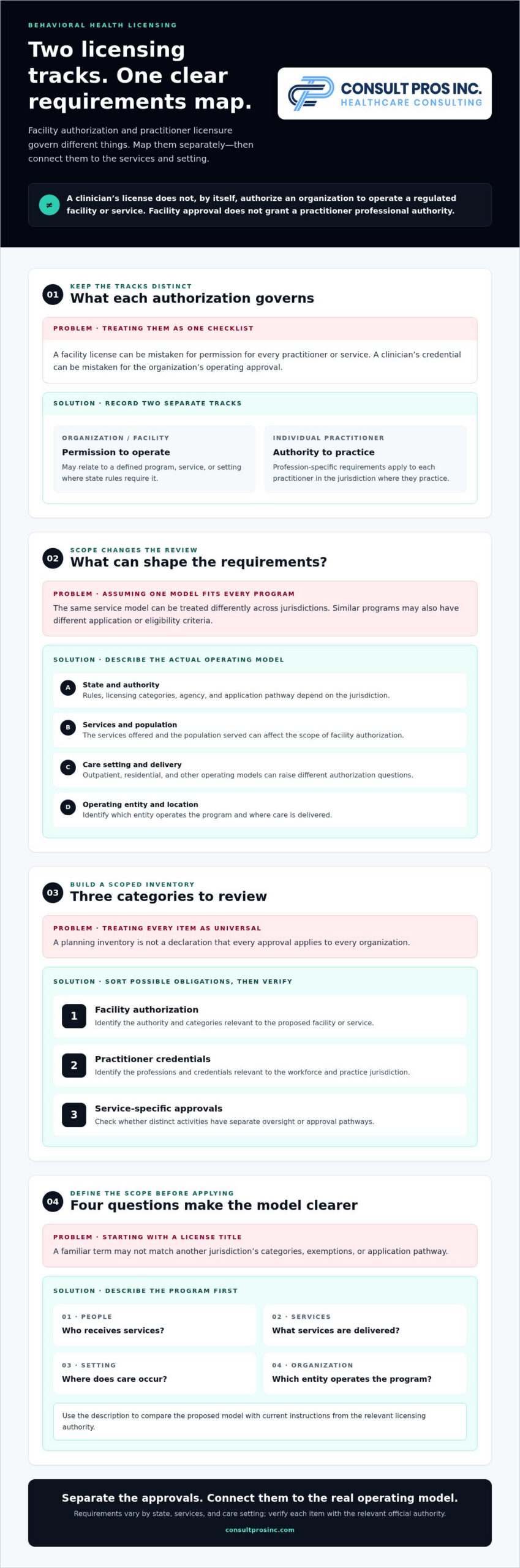
The key distinction is what an authorization governs. A facility or organization may need permission to operate a defined program where state rules require it. Separately, each practitioner must meet the applicable requirements for their profession and practice jurisdiction. Neither track replaces the other: facility approval does not grant a clinician professional authority, and a clinician’s license does not, by itself, authorize an organization to operate a regulated facility or service.
What does a behavioral health facility license generally authorize?
Where required, facility authorization generally relates to an organization’s operation of a defined service or setting. Its scope may depend on the services offered, the population served, whether care is outpatient or residential, and the organization’s operating model. For example, a program providing outpatient counseling may raise different authorization questions from a residential program, even if both address behavioral health needs. This is a planning distinction, not a claim that either example requires a particular license in every state.
Different oversight bodies or separate approvals may apply to distinct activities. The relevant agency, license title, exemptions, and application pathway depend on the jurisdiction, so don’t assume a familiar term applies nationally. Start by describing the actual model: who receives services, what services are delivered, where they occur, and which entity operates them. That description gives the licensing review a clear scope.
How is facility licensing different from a clinician’s license?
Practitioner credentials attach to individuals and are generally governed by profession-specific rules in the jurisdiction where they practice. A mental health counselor, for instance, may need an individual license or another recognized credential under that state’s framework. That credential addresses the practitioner’s authority, not the organization’s permission to operate a facility. This broad overview of Mental Health Professional Licensing describes the range of professional roles and licensing concepts.
One operating model can involve multiple practitioner credentials alongside one or more organizational approvals. A facility license does not automatically authorize every practitioner or every service delivered on site. Likewise, a clinician’s credential is not proof that the organization has satisfied its facility obligations.
Facility authorization governs the organization’s permitted operation; professional licensure governs an individual practitioner’s authority, so each must be mapped separately.
Keep those tracks distinct as you define the organization’s scope. Record the facility or service approvals that may apply, then identify the practitioner professions and credentials relevant to the workforce. This helps prevent an individual license from being mistaken for organizational approval, or a facility authorization from being treated as a substitute for each clinician’s professional requirements.
Behavioral Health Licensing Requirements for Facilities and Practitioners
Use a planning inventory to identify possible obligations, not as a declaration that every item applies to every organization. Behavioral health licensing requirements depend on the governing authority and the organization’s actual services, setting, and operating structure. Separate the inventory into facility authorization, practitioner credentials, and approvals tied to particular services, then compare each category with current official instructions.
Applications and eligibility criteria can differ even when two organizations appear similar. One program may need to document its organizational structure and service model, while another may also need to address a distinct setting or service category. The Ohio Behavioral Health Licensure and Certification resource illustrates how a state agency can organize oversight across facility and provider categories. Use it as an example of state-level structure, not as a template for other jurisdictions.
Facility-level requirements operators may need to map
Start with the authority responsible for the proposed facility or service, then identify the categories it oversees. Compare the proposed setting and scope with the authority’s definitions to see whether separate licensing or approval pathways may apply. Assess the following records against official application instructions rather than assuming every item is universally required:
- Ownership and organizational information, including governance records relevant to the application.
- Site and facility details requested by the authority for the proposed setting.
- Operational documentation describing services, populations served, and how the program will function.
Record the source for each item. This makes it easier to distinguish an authority’s actual application criteria from internal readiness materials your organization chooses to assemble.
Professional requirements for behavioral health clinicians
For each practitioner role, map the applicable profession, license level, and state pathway. Depending on the credential, official criteria may address education, supervised experience, examinations, and application materials. These categories are not universal. The responsible board and its current rules determine what applies, including any distinct routes for associate, provisional, or full licensure.
State counselor pathways show why a single national checklist is insufficient. Florida describes multiple routes, including examination, endorsement, provisional, and limited licensure. New York’s counselor materials address education, experience, examinations, and applications. Washington distinguishes counselor and associate credentials and provides examination information. These examples illustrate differences in pathway design; they don’t establish facility requirements or replace checking current state rules.
Build one inventory for the organization and another for its workforce, linking each item to its governing authority, evidence, owner, and verification date. For structured state-route planning, use this state licensing guide for treatment centers. Consult Pros Inc supports state licensing and certification advisory work, connecting requirements mapping with facility structuring and operational readiness. Explore licensing and operational structuring support as you organize the work across both tracks.
How Service Model, Setting, and State Change Licensing Requirements
A licensing review becomes more precise when it starts with the operating model rather than a generic list of credentials. Outpatient counseling, residential treatment, and other behavioral health services may follow different pathways, depending on state rules and program details. An organization may also need to consider more than one authority if its services or settings cross regulatory categories.
Use a comparison table to record what needs verification in each target state. The entries below are research prompts, not conclusions about what any state requires.
| State | Service | Setting or modality | Responsible authority to identify | Requirements to verify |
|---|---|---|---|---|
| State A, target jurisdiction | Outpatient counseling | Clinic or other outpatient setting | Agency or board overseeing the relevant program | Whether the service or organization requires authorization, and what scope it covers |
| State B, target jurisdiction | Residential behavioral health services | Residential facility | Agency responsible for the applicable facility category | Which facility pathway applies and what application materials are specified |
| State C, target jurisdiction | Telehealth services | Remote delivery across state lines | Relevant state licensing and program authorities | Practitioner jurisdiction, service authorization, and any requirements tied to the organization |
Which operational details can change the applicable requirements?
Document the proposed services, populations served, care setting, and delivery modality before assigning a licensing pathway. Adding residential care, serving a different population, or introducing telehealth across state lines may raise questions that were not part of the original review. Ownership structure and multiple locations can also affect which entities, sites, or operating arrangements an authority considers.
For each conclusion, record the official source and date reviewed. Mark it for confirmation against current guidance before acting. This helps distinguish verified requirements from assumptions that still need resolution.
How do licenses differ from accreditation and certification?
State licensure is a government authorization where required. Accreditation is a separate review conducted by an independent organization and may be relevant to organizational goals or payer arrangements. CARF and The Joint Commission are distinct accrediting bodies. Accreditation does not automatically replace state authorization, just as state licensure does not establish accreditation.
Certification is another category, and its purpose depends on the program and governing framework. CLIA or LegitScript may be relevant in particular operational contexts, but neither should be treated as a universal behavioral health requirement. Define the activity, identify the authority or program governing it, and verify the applicable scope before adding it to the organization’s requirements map. Keeping these categories separate helps operators coordinate obligations without mistaking one form of recognition for another.
Build a Behavioral Health Licensing Requirements Map Before Applying
A structured requirements map turns research into accountable work. It helps founders and operators separate verified obligations from open questions, organize evidence across facility and practitioner tracks, and see who owns each next step. Treat it as a working document and revise it when the service model changes or an authority updates its guidance.
Create a state-specific requirements inventory
Start with a precise description of the proposed operation. Record each service, location, population served, and delivery model, then identify the authority responsible for each area and its current official application guidance. Keep state-specific conclusions provisional until confirmed against that guidance, especially when an interpretation could affect the application pathway.
- Define the scope. Describe services, populations, locations, settings, and delivery methods, including planned telehealth or expansion activity.
- Identify authorities. List the agencies or professional boards that oversee the facility, services, and practitioner credentials in each state.
- Map requirements. For every potential obligation, record what the authority requires, the evidence it specifies, and the official source.
- Assign owners. Name one accountable person for each requirement, even when other team members contribute supporting materials.
- Track evidence. Record status, evidence location, verification date, and the next action needed to resolve gaps or submit materials.
This workflow keeps the behavioral health licensing requirements map tied to the organization’s actual scope rather than a generic checklist. Mark unclear interpretations as unresolved, identify the authority or guidance relevant to resolving them, and don’t treat an assumption as a settled requirement.
Organize application evidence and accountability
Use an authority-and-requirement matrix with fields for the requirement, source, responsible person, status, evidence location, and verification date. Add the application version, submission date, correspondence, and follow-up deadline where relevant. A clear record shows what is complete, what needs action, and whether a change to the program affects previously gathered evidence.
Keep organizational application evidence separate from workforce credentialing and employment records. Facility files may include materials requested about ownership, governance, site, or operations. Practitioner files may include the individual’s applicable education, experience, examination, application, and credential records. Employment and onboarding documents belong in a related but distinct record set. The authority’s current instructions determine the required evidence, so don’t assume one file type satisfies another.
A requirements matrix reduces avoidable omissions by giving every obligation a verified source, an accountable owner, and a traceable status. If site planning is part of the readiness work, the behavioral health facility setup guide can help connect planning decisions with application preparation. Consult Pros supports state licensing, facility structuring, and coordinated operational readiness. Build a licensing and readiness plan with Consult Pros.
Turn Licensing Requirements Into Operational Readiness
A completed application is one part of launch preparation, not a substitute for an operating organization. Licensing work is most useful when it informs facility planning, staffing, onboarding, and the procedures that guide daily operations. Translate each verified requirement into an owner, supporting document, or operational task so regulatory planning stays connected to implementation.
Coordinate licensing with facility and staffing preparation
Use requirements for the proposed service model to guide facility decisions and procedure development. Where site features or operating practices are relevant to an authority’s review, bring them into planning early enough to address gaps before they become last-minute application issues. Use current official guidance as the reference point for the expectations that apply to the state and program.
Apply the same discipline to staffing preparation. Coordinate practitioner credentialing records with recruitment and onboarding workflows so the organization can track each person’s role, required credentials, and supporting documentation in the appropriate record system. Keep employment materials distinct from the facility application file, while making relevant status and outstanding actions visible to the people responsible for licensing and staffing.
Accreditation preparation is another related workstream, but it remains distinct from state licensing. TJC or CARF preparation may affect operational policies, staff training, and documentation practices, so planning alongside licensing can help surface dependencies. Accreditation is not a substitute for state authorization, and state approval does not complete separate accreditation work.
When licensing advisory support can help
Coordination is especially valuable when an organization is translating requirements into multiple workstreams, such as facility structuring, staffing, onboarding, and ongoing compliance. A licensing advisor can help organize a state-specific requirements map, connect it to the proposed operating model, and separate tasks for facility readiness from practitioner credentialing. This structure supports deliberate decisions without treating unverified assumptions as confirmed rules.
Consult Pros Inc advises behavioral health founders and operators on state licensing and certification, facility structuring, staffing, and regulatory compliance. Coordinated planning helps leadership teams maintain a shared view of open requirements, evidence, and implementation responsibilities as the organization prepares to operate or expand.
Approval and operational readiness are related milestones, but they are not interchangeable. An authorization addresses the applicable regulatory permission; readiness also involves the people, procedures, facility plans, and records needed to carry out the organization’s model. Track these milestones separately to clarify what has been approved and what implementation work remains.
Use your behavioral health licensing requirements map as an active management tool. Revisit it as services, staffing, or locations change, and verify state-specific conclusions with the relevant authority. To discuss how licensing advisory and operational structuring can support your organization’s plan, connect with Consult Pros about your licensing and operational plan.
Move From Requirements Mapping to a Confident Next Step
Use your licensing map as a decision-making tool, not a document that sits untouched after an application is prepared. As your plans develop, revisit assumptions, record changes, and verify state-specific interpretations with the relevant authority. This ongoing discipline helps keep behavioral health licensing requirements aligned with the services and operations you intend to build.
Consult Pros supports behavioral health organizations with state licensing and certification advisory, facility structuring, staffing, onboarding, and regulatory compliance planning. Coordinating these workstreams can help leadership turn identified requirements into practical responsibilities while keeping regulatory review and organizational readiness distinct.
Discuss your behavioral health licensing and operational plan with Consult Pros to take the next step with a clear structure for the work ahead.
Frequently Asked Questions
Can a behavioral health facility open while its license application is pending?
Not automatically. A facility should begin operating before final licensure only if the governing authority permits it and any required interim authorization is in effect. Filing an application or receiving confirmation that it was submitted does not, by itself, establish permission to open. Before admitting clients or announcing an opening date, seek written guidance for the specific program and setting, document any conditions, and build contingency plans around unresolved requirements.
Does a behavioral health facility license cover every clinician who works there?
No. A facility authorization generally addresses the organization or program, not each clinician’s individual authority to practice. Employing a counselor does not mean the facility’s license verifies that counselor’s current credential or authorizes every professional activity. Establish a separate credentialing process that records each practitioner’s license type, issuing jurisdiction, status, and renewal date, then connect those records to role assignment and onboarding procedures.
Can a counselor provide telehealth services to a client in another state?
Possibly, but the counselor and organization must assess the rules tied to the client’s location and the service being delivered. A counselor’s home-state license may not, on its own, authorize practice with an out-of-state client; an applicable compact privilege or other state pathway may be relevant. Before scheduling cross-state telehealth, verify the counselor’s authority for that jurisdiction and whether the organization’s service model raises separate authorization questions.
Are provisional or associate behavioral health licenses available in every state?
No. States use different license categories, eligibility standards, and supervision arrangements, and some may not offer a comparable provisional or associate credential for a particular profession. Similar titles across jurisdictions can have different scopes or supervision conditions. For workforce planning, match each role to the exact credential recognized by the state board, confirm any practice limitations, and document the supervision structure before assigning clinical responsibilities.
Does CARF or Joint Commission accreditation replace a state facility license?
No. CARF and The Joint Commission conduct accreditation programs that are separate from state facility licensing. Accreditation may support organizational or payer objectives, but it should not be treated as permission to operate where state authorization is required. Likewise, a facility should not infer that state licensure satisfies a separate accreditation commitment. Track each process independently, including its own standards, evidence, responsible owner, and renewal or review requirements.
Does a behavioral health facility need a new license after a change of ownership?
It may, but the answer depends on the state, license type, and transaction structure. Some authorities may require advance notice, approval, a new application, or another ownership-related process; verify the applicable route for the specific facility. Before a transaction closes, identify the licensing authority’s change-of-ownership instructions and account for required filings or approvals in the transition plan. Don’t assume the existing authorization transfers automatically.
How often do behavioral health facility licenses need to be renewed?
There is no single renewal cycle for every behavioral health facility. The schedule depends on the state and the specific license or program category, and renewal conditions may also differ. Record the expiration date and renewal instructions from the issuing authority, then assign an owner to monitor notices and required submissions. Confirm the current cycle with the authority rather than relying on a prior operator’s calendar or another state’s rules.