
Completing a course alone doesn’t prepare a clinical team for complex behavioral health work. Effective behavioral health staff training builds cultural and linguistic competency, ethical practice, and trauma-informed care, and connects these principles to staff roles and organizational needs. The format matters too: online learning supports knowledge acquisition and self-paced study, while in-person training allows for skills practice and real-time coaching.
Teams need consistent foundations, but their learning priorities depend on the people they serve, the services they provide, and each role’s responsibilities. Training is most useful when it strengthens practical judgment and aligns with organizational policies and workflows.
This article covers core training areas, including cultural competency, confidentiality, ethical boundaries, and trauma-informed supervision. It also explains how to choose learning formats, assess whether training builds usable skills, and integrate learning into organizational practice.
Key Takeaways
- Build cultural and linguistic competency into everyday team practices so communication and care better reflect the people served.
- Clarify ethical boundaries and confidentiality procedures, including how 42 CFR Part 2 and HIPAA relate to ASAM-informed care coordination.
- Match learning formats and role-play opportunities to staff responsibilities, then connect training messages with organizational policies.
- Use trauma-informed principles to shape supervision and workplace procedures, creating more consistent support across the clinical team.
Cultural and linguistic competency in behavioral health
Effective learning connects clinicians’ self-awareness with practical ways to understand clients’ backgrounds and adapt care. A behavioral health staff training plan can use case discussions and continuing education to make cultural responsiveness part of everyday practice.
Clinician Cultural Self-Awareness
Clinicians should examine how their own cultural backgrounds shape assumptions about mental health, communication, family roles, and help-seeking. One useful exercise is to review a case, identify an assumption, and consider how it could affect an assessment or intervention. This reflection helps staff distinguish clinical evidence from personal expectations, especially when a client’s choices differ from their own experience.
Understanding Client Cultural Backgrounds
Staff should learn to ask how language, family relationships, community, faith, and past experiences influence clients’ care preferences. For example, a clinician can invite a client to describe whom they want involved in treatment rather than assume family participation is welcome. Agencies can also review intake questions and service materials to make sure clients can explain their needs without relying on stereotypes.
Cultural Humility and Cross-Cultural Competence
Cultural humility requires ongoing reflection and openness to correction, not mastery of every culture. Cross-cultural competence turns that stance into practical communication, such as checking whether a client understood a care plan and inviting clarification. The Principles of Cross-Cultural Competence module lasts 45 minutes; teams can pair learning with case review to connect concepts to clinical decisions.
Culturally responsive services adapt communication and interventions to each client’s stated needs. Staff can use plain-language explanations, ask about preferred communication methods, and discuss whether a proposed approach fits the client’s values. These steps help identify mismatches between standard procedures and individual needs.
Training in crisis intervention, de-escalation, and suicide prevention should combine recognition of warning signs with scenario practice. Staff can rehearse calm communication, immediate safety steps, and escalation through agency procedures, then review their actions with a supervisor.
Inadequate training can contribute to miscommunication, missed warning signs, biased assessments, and inconsistent crisis responses. Clear practice standards and case-based reviews help teams identify these risks before they affect clinical decisions or client trust.
Credentialing, ethics, and confidentiality
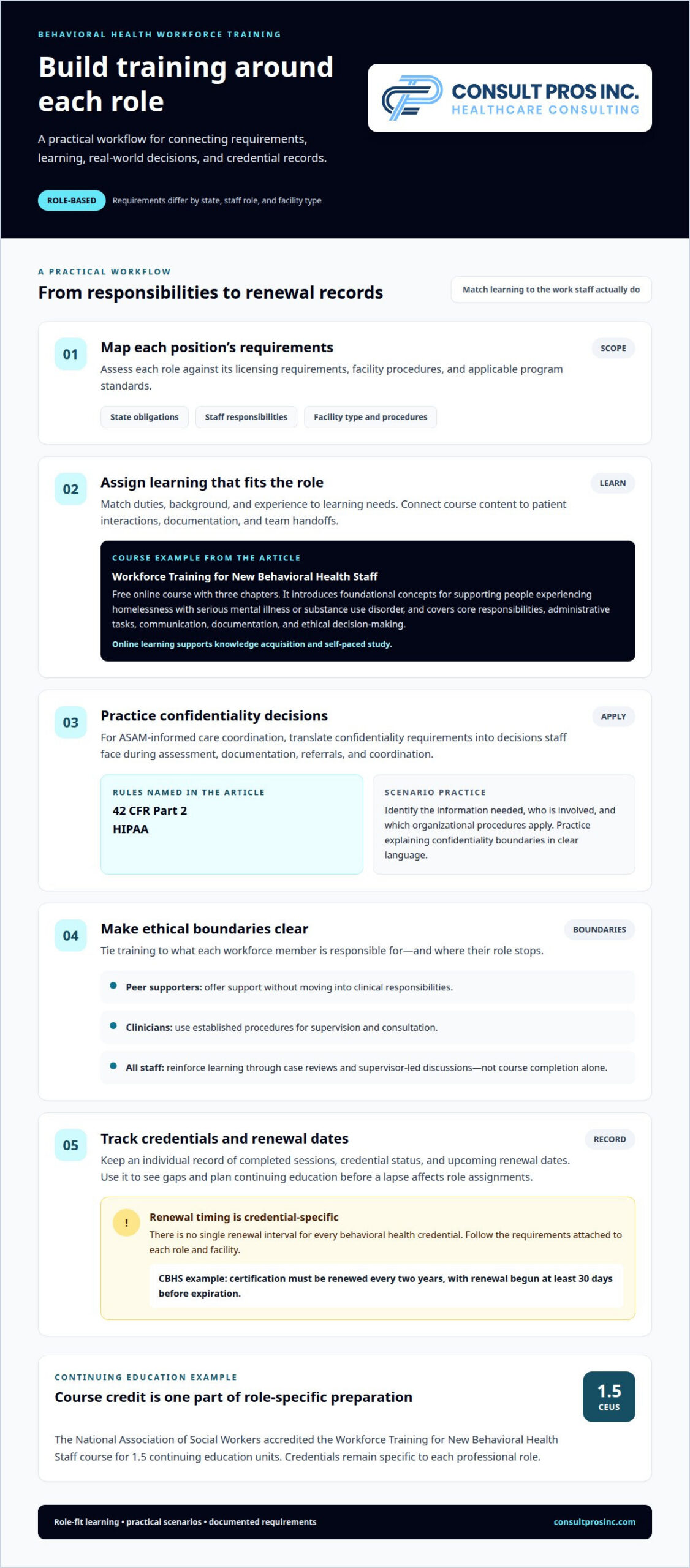
Credentialing and ethics training should connect each workforce member’s responsibilities with the information they handle. For ASAM-informed care coordination, federal confidentiality regulations include 42 CFR Part 2 and HIPAA, according to the U.S. Department of Health and Human Services. Courses should translate these requirements into decisions staff encounter during assessment, documentation, referrals, and care coordination.
For example, a team can use a referral scenario to practice identifying the information needed, who is involved, and which organizational procedures apply. Staff should also learn to explain confidentiality boundaries to patients in clear language. Reinforce the process through case reviews and supervisor-led discussions, not course completion alone.
Ethical practice also requires clear role boundaries. Peer supporters need training to offer support without moving into clinical responsibilities, while clinicians need procedures for supervision and consultation. The National Association of Social Workers accredited the Workforce Training for New Behavioral Health Staff course for 1.5 continuing education units (CEUs). That example illustrates how a course may support continuing education, while credentials remain specific to each professional role.
Training requirements differ by state, staff role, and behavioral health facility type. A practical assessment maps each position to its licensing requirements, facility procedures, and applicable program standards, then assigns courses that address those responsibilities.
There is no single renewal interval for every behavioral health credential. Staff training schedules and certification renewals follow the requirements attached to each role and facility; for example, CBHS certification must be renewed every two years, with renewal begun at least 30 days before expiration.
Maintain a record for each staff member showing completed sessions, credential status, and upcoming renewal dates. This gives managers a clear view of gaps and helps organize continuing education before a lapse affects role assignments. For facilities aligning workforce requirements with state obligations, state licensing and certification support can help structure the process.
Personalized learning and organizational integration
Build a learning plan by matching each role’s duties, background, and experience to its training needs. Then connect course content to the procedures staff use in patient interactions, documentation, and team handoffs.
The best online programs match staff roles and learning objectives. The free Workforce Training for New Behavioral Health Staff course has three chapters and introduces foundational concepts for supporting people experiencing homelessness with serious mental illness or substance use disorder. It covers core responsibilities, administrative tasks, communication, documentation, and ethical decision-making. Online education works well for knowledge acquisition and self-paced learning, letting participants start and stop at their own pace.
Choose the next step by identifying where staff need more practice. A new team member may need foundational instruction, while an experienced clinician may benefit from focused learning on assessment or care coordination. Use online courses to prepare staff, then schedule in-person sessions for skills practice and real-time coaching. Continuing education should reinforce role-specific knowledge, not repeat material without a clear purpose.
Evaluate learning through demonstrated skills, not course completion alone. Use a post-training assessment, case discussion, or role-play to see whether staff can apply the material. For example, have participants practice a handoff, then assess whether they communicate relevant details and follow agency procedures. Record the results to determine which topics need updating or additional coaching.
Integration also depends on consistent organizational messages. Align HR policies with training so supervisors reinforce the same practices during onboarding, performance conversations, and team meetings. Track monthly engagement indicators, quarterly performance measures, annual retention patterns, and bi-annual wellbeing surveys to identify areas for review. These measures give leaders a structured basis for adjusting education and workforce support.
Trauma-informed care
Trauma-informed practice shapes how staff structure encounters, not just how they respond to disclosures. Behavioral health teams can use consistent steps to explain procedures, preserve client choice, and reduce avoidable surprises during care.
Start with the environment and interaction. Before an assessment, explain what will happen, why information is being requested, and how the client can ask to pause. Staff might offer a choice of seating or explain a room transition before moving a client. These small procedural steps make care more predictable without assuming what a client has experienced.
Training should help staff recognize how trauma may affect communication, trust, and participation in mental health or substance use services. A client who becomes quiet during a discussion may need a slower pace or a clearer explanation, rather than pressure to continue. Staff can practice noticing changes in engagement, offering options, and documenting relevant observations without assuming their cause.
Supervision turns principles into shared practice. A trauma-informed supervision training lasts 1 hour. Supervisors can use a case review to examine whether staff explained choices, followed the care plan, and responded appropriately when distress emerged. Reviewing the sequence of actions gives the team practical evidence for refining procedures.
Keep protocols consistent across intake, treatment sessions, and transitions between staff. A handoff, for instance, can note communication preferences and agreed-upon approaches while maintaining appropriate confidentiality. Team discussions can help managers identify routine processes that create uncertainty or unnecessary distress.
Training is most useful when examples reflect the agency’s actual services and workforce roles. Clinical staff may rehearse adapting an interaction, while supervisors review how team procedures support that response. To establish this learning within an organization, develop trauma-informed staff training that connects instruction with day-to-day practice.
Consult Pros: Training
Consult Pros Inc helps behavioral health operators connect workforce readiness with broader facility requirements. When staff responsibilities intersect with licensing, accreditation, or established procedures, training needs should fit the organization’s structure and service model.
For operators establishing or refining a facility, State Licensing & Certification and Facility Setup & Operational Structuring can help align operational foundations with workforce responsibilities. TJC & CARF Accreditation Support is relevant when preparing an accreditation framework. These services address organizational readiness, while clinical teams remain responsible for applying professional judgment in care delivery.
Contact Consult Pros Inc to discuss how your facility’s operational priorities connect with workforce needs.
Make workforce learning part of operational planning
Training works best when built into how a facility develops, assigns, and supports its workforce. As services or staffing needs change, revisit learning priorities alongside operational plans so expectations remain clear for each role. This makes behavioral health staff training an ongoing part of organizational development rather than a one-time task.
Consult Pros supports behavioral health operators with In-Network Contracting, State Licensing & Certification, and Facility Setup & Operational Structuring. These services can help address related operational priorities as you plan how staff learning fits your facility’s next stage.
To discuss how training can fit your organization’s needs, contact Consult Pros. A clear next step can help turn learning priorities into a more structured plan for your team.
Frequently Asked Questions
What topics should behavioral health staff training cover?
Training should cover the competencies staff need to perform their assigned clinical and operational duties. Alongside communication, confidentiality, and trauma-informed practice, programs can address assessment and diagnosis, clinical supervision, telehealth practices, and substance use treatment approaches. For example, staff involved in assessments can practice recognizing potential errors, while supervisors can use case discussions to reinforce consistent decision-making and appropriate consultation.
What training is required for behavioral health staff in the United States?
Requirements depend on staff roles, facility services, and applicable state and federal rules. Organizations can map each position to its licensing requirements and responsibilities, then identify training relevant to those duties. For example, a program coordinating substance use care should include instruction on relevant confidentiality procedures, while an onboarding plan should cover the facility’s workflows and documentation practices.
What certifications and credentials are available for behavioral health staff?
Available credentials vary by profession and role, and may include state licensure for counselors, nurses, psychologists, psychiatrists, and social workers. Behavioral health specialists may pursue CBHS certification, which must be renewed every two years. Continuing education can also support professional development and credential maintenance. The relevant pathway depends on the worker’s qualifications, responsibilities, and applicable credentialing rules.
What are the best online behavioral health staff training programs?
The free, self-paced Workforce Training for New Behavioral Health Staff course covers core responsibilities, communication, documentation, and ethical decision-making. Online courses are best suited to knowledge acquisition; use in-person training for skills practice and coaching.
How do training requirements differ by state and type of behavioral health facility?
Requirements vary by state, staff role, and facility type. Map each position to its licensing requirements, facility procedures, and applicable program standards, then assign training accordingly.