
Advertising eligibility for addiction treatment providers depends on more than ad wording. Many advertising platforms, including Google and Facebook, require certification from businesses in regulated industries. LegitScript certification is one credential that can affect whether a provider is eligible to advertise.
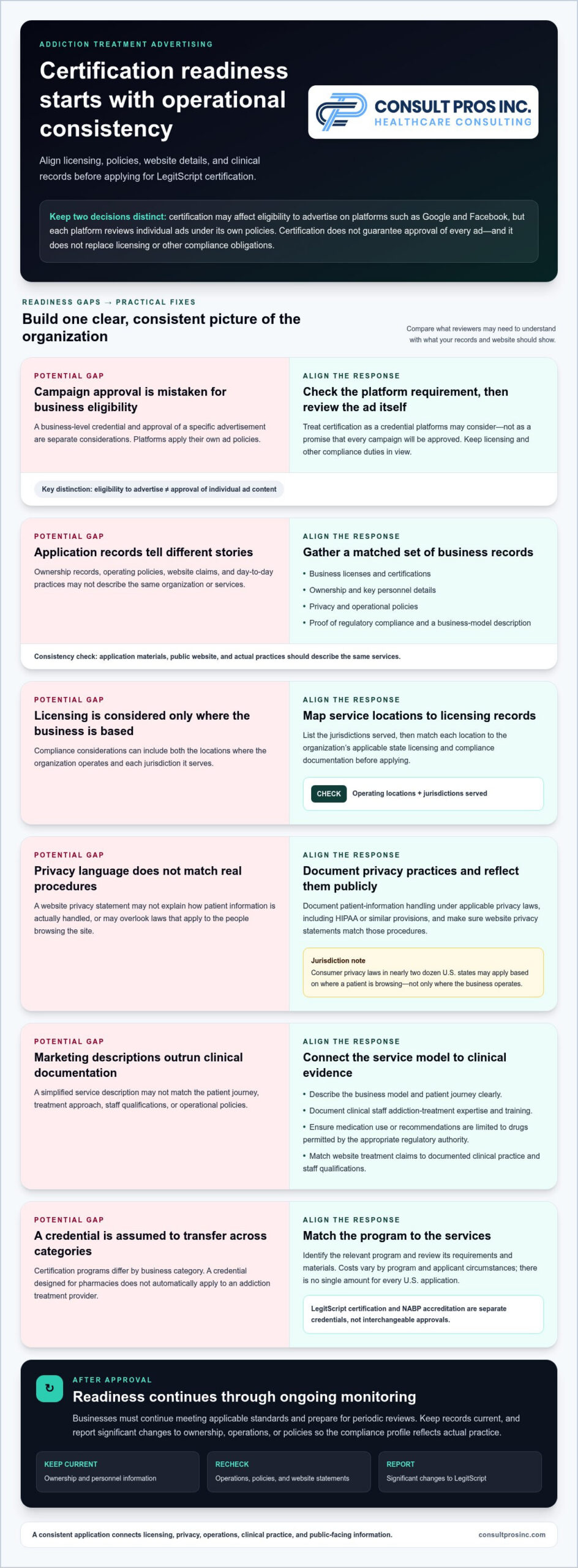
Meeting that requirement takes more than campaign planning. Licensing, policies, website information, and day-to-day business practices can all affect a LegitScript certification application. Aligning them helps present a clear, consistent picture of the organization.
This article explains how certification relates to healthcare compliance and advertising eligibility, what applicants may need to prepare, and how to check a website’s status. It also explains what the credential means and how to approach the next step.
Key Takeaways
- Check advertising platform requirements early, since certification may affect whether an addiction treatment provider is eligible to advertise.
- Prepare licensing, ownership, operational, and privacy documentation so the application reflects how the organization actually operates.
- Review clinical staffing expertise and treatment policies as part of compliance readiness, not just the application paperwork.
- Use LegitScript’s searchable classifications where available to assess a website’s status; certification also involves ongoing monitoring.
Advertising eligibility for addiction treatment providers
For addiction treatment providers, advertising eligibility can depend on regulatory compliance and campaign content. Platforms such as Google and Facebook require certification for businesses in regulated industries. LegitScript certification gives platforms a credential to consider when assessing a provider, but it does not replace licensing or other compliance obligations.
LegitScript certification can support access to advertising channels by showing that a business has undergone review. It does not guarantee approval of every advertisement: platforms assess individual campaigns under their own policies. Distinguish business-level eligibility from approval of specific ad content.
Before applying, organize records that describe the operation. Application materials typically include business licenses and certifications, ownership and key personnel details, privacy and operational policies, proof of regulatory compliance, and a description of the business model. Make sure the website clearly presents business details, contact information, privacy policies, and terms of service. All materials should describe the same organization and services.
LegitScript certification and NABP accreditation are separate credentials, not interchangeable approvals. LegitScript may classify a site as “Legitimate” if it holds accreditation or certification from a recognized entity, such as the National Association of Boards of Pharmacy (NABP), even without LegitScript certification. NABP also endorses LegitScript’s online pharmacy certification program.
Telehealth providers should account for their online service structure when preparing advertising materials. Clearly describe the business model, identify key personnel, and make privacy and operational policies accessible. Addiction treatment applicants must comply with applicable laws, including state licensing requirements, and document clinical staff expertise and training. Align these records with the services being promoted to keep the application and advertising descriptions consistent.
LegitScript certification as a compliance credential
LegitScript certification is a third-party credential that assesses whether certain healthcare businesses meet applicable compliance standards. For addiction treatment organizations, readiness involves legal, privacy, and operational practices, not just completing an application.
Legal and Licensing Compliance
Addiction treatment applicants must comply with applicable laws, including state laws and licensing requirements. LegitScript’s classification principle considers compliance both where a business operates and in each jurisdiction it serves. Map the locations served and match each one to the organization’s licensing records before applying.
Operational gaps can emerge when ownership records, policies, and actual practices don’t match. LegitScript certification also requires applicants to follow applicable privacy laws, including HIPAA or similar provisions. Document how patient information is handled and ensure the website’s privacy statements reflect those procedures. Consumer privacy laws in nearly two dozen U.S. states may apply based on where a patient is browsing, rather than where the business operates.
Certification Types and Costs
Certification programs vary by business category. LegitScript offers programs that include online pharmacy and CBD certification, along with reviews relevant to healthcare businesses. Identify the program that matches your services: a credential designed for pharmacies does not automatically apply to an addiction treatment provider.
Costs vary by program and applicant circumstances, so there is no single amount that applies to every U.S. application. Review the relevant program requirements and the scope of the materials needed, including licensing records, ownership information, and operational policies. Assess LegitScript certification costs for the specific program rather than assuming they match another business category.
Risks of Operating Without Certification
If an advertising platform requires certification, an uncertified provider may not meet its eligibility requirements. This can limit access to that platform’s advertising, even when the business otherwise operates lawfully. That is different from LegitScript’s “Rogue” or “Unapproved” classifications, which relate to specified illegal, unsafe, misleading, or regulatory-risk concerns.
After approval, businesses must continue meeting applicable standards and prepare for periodic reviews. Changes to ownership, operations, or policies can affect the information considered during review. Keep relevant records current and report significant changes to LegitScript so the organization’s compliance profile reflects its actual operations.
LegitScript certification for healthcare businesses
LegitScript certification is a third-party compliance credential used to assess certain healthcare businesses against applicable standards. Addiction treatment providers seeking access to advertising platforms may need it, depending on the platform’s requirements and their business category.
Business Prerequisites and Documentation
Build the application around the organization’s actual services, not a simplified marketing description. The business-model summary, website content, and operating policies should describe the same patient journey, from service information to treatment delivery. LegitScript evaluates whether addiction treatment applicants limit medication use or recommendations to drugs permitted by the appropriate regulatory authority. It also requires documentation that clinical staff have addiction-treatment expertise and training.
Before submitting, compare public claims with internal procedures. For example, the website’s description of treatment options should match the program’s documented clinical approach and staff qualifications. This consistency helps reviewers understand how the healthcare business operates.
Consumer Trust in Certified Businesses
Certification can indicate that a business has undergone a compliance review and is subject to ongoing monitoring. For patients and families considering an addiction treatment provider, that status offers a reference point about the organization’s review process, not proof of a particular clinical result or treatment quality.
Trust also depends on clear, accurate public information. Present the provider’s identity, services, and policies consistently so patients can compare the organization’s claims with the care it describes. Certification supports transparency, but it does not replace a patient’s assessment of whether a service suits their needs.
For treatment centers, operational practices must support advertising claims. Keep clinical training records aligned with staff responsibilities, and ensure medication recommendations follow the appropriate regulatory authority’s permissions. LegitScript reviews business legitimacy and compliance, so a well-organized program connects public messaging, clinical documentation, and actual operations. That alignment matters especially when a center changes services or expands into new markets, where compliance obligations may differ across jurisdictions.
Checking whether a website is LegitScript-certified
Start with the exact website domain and identify the business category before interpreting a result. LegitScript makes legitimacy classifications for internet pharmacies and other applicable healthcare websites searchable from its homepage. Match the result to the site’s domain and business identity, then compare those details with the organization’s current public materials.
Search access depends on the type of business. Classifications for internet pharmacies and applicable healthcare sites are searchable. For other merchant types, classifications are part of monitoring services for payment processors, e-commerce websites, and other platforms. A missing public search result therefore does not, by itself, establish a merchant’s certification status. Consider the business category and how its classification is made available.
A certified website has undergone LegitScript’s review processes and is monitored on an ongoing basis. Treat status as something that must stay aligned with current operations, not as a permanent record of past approval. If a recovery center changes ownership, services, or its website, compare those details with the information associated with its review. Changes can make earlier public descriptions less representative.
Use a practical review sequence: confirm the domain, examine the displayed classification, and check that the business name matches. Then review the website’s service descriptions, contact information, and policies. For example, a treatment provider’s public pages should identify the same organization shown in its business records. Distinguish certification status from other legitimacy classifications, as they do not all mean the same thing.
For healthcare businesses in regulated industries, this check supports due diligence but does not replace a review of the organization’s licensing, policies, and operational information. Record the date of your review and revisit the status when material business details change. This creates a clear reference point for internal compliance and advertising decisions.
Prepare your LegitScript certification application with structured support for the documentation and operational details under review.
Consult Pros: In-Network Contracting
Consult Pros helps behavioral health operators build the administrative foundations of a compliant facility. If your organization is preparing for LegitScript certification or coordinating certification with other operational priorities, Consult Pros’ State Licensing & Certification and Facility Setup & Operational Structuring services can support related readiness needs.
In-Network Contracting may also be relevant when a provider is building payer relationships as part of its operating model. For organizations pursuing external quality recognition, Consult Pros offers TJC & CARF Accreditation support. These services address distinct operational requirements; they do not replace LegitScript’s review or determine whether an advertising platform approves a campaign.
Contact Consult Pros to discuss your facility’s next administrative step, or visit consultprosinc.com.
Build compliance into your next operational step
Make certification readiness part of ongoing governance, rather than treating it as a one-time advertising requirement. Assign responsibility for keeping business records, public information, and operational practices aligned as the facility develops. This creates a practical foundation for pursuing LegitScript certification and adapting to organizational changes.
Consult Pros supports this broader operational work through In-Network Contracting, State Licensing & Certification, and Facility Setup & Operational Structuring. These services address connected administrative priorities, while LegitScript’s review focuses on its own certification standards. Keeping those responsibilities distinct helps operators plan without conflating different approvals.
When you’re ready to discuss certification and the operational steps around it, contact Consult Pros about certification. A structured next step can help your team move forward with clarity and confidence.
Frequently Asked Questions
What are the eligibility requirements for LegitScript certification?
Applicants must meet the requirements for their business category and comply with applicable laws where they operate and serve customers. Addiction treatment providers should be prepared to demonstrate state licensing compliance, appropriate medication practices, and qualified clinical staff. Their application and public-facing information should accurately reflect the services offered. Eligibility is assessed against the relevant program’s standards, so a pharmacy’s requirements may differ from a treatment provider’s.
How do you apply for LegitScript certification step by step?
Start by identifying the certification program that matches your business type. Gather the required licensing, ownership, operational, privacy, and business-model information. Submit the application through the appropriate program process, then address any requests for clarification during review. Before submission, compare the application with your website and internal policies. For example, ensure your service descriptions match the organization’s actual operating model.
How long does LegitScript certification take, and how long is it valid?
Application review time depends on the completeness and consistency of the submitted materials and any follow-up needed during review. Certification also involves ongoing monitoring and periodic reviews, rather than a one-time assessment that ends with approval. Keep business records, policies, and public information aligned as operations change. Report significant changes to ownership, operations, or policies to LegitScript.
What documents and information are required for a LegitScript application?
Applications typically include business licenses and certifications, proof of regulatory compliance, ownership and key personnel details, privacy and operational policies, and a business-model description. Addiction treatment applicants should also provide documentation of clinical staff expertise and training. A practical preparation step is to compare each document with the corresponding website information. For instance, confirm that the listed services and contact details reflect the same operating entity.
Which laws and compliance rules must applicants meet?
Applicants must comply with applicable laws and regulations in the jurisdictions where they operate and serve customers. Addiction treatment providers must meet relevant state licensing requirements and privacy rules, including HIPAA or similar provisions where applicable. LegitScript also evaluates medication use or recommendations against what the appropriate regulatory authority permits. Map the jurisdictions served, then align licensing records, patient privacy procedures, and clinical policies with those requirements.
What are common reasons LegitScript certification applications are denied?
Applications can run into difficulty when a business cannot demonstrate compliance with applicable standards or when its materials conflict. Examples include a licensing record that does not match the operating entity, unclear ownership information, privacy policies that fail to describe actual practices, or insufficient documentation of clinical staff expertise. Treatment providers should also ensure medication practices align with the applicable regulatory authority. These are readiness risks, not an exhaustive list of formal denial grounds.