
A complete file does not automatically mean a new hire is ready to work. Staff can upload compliance documents through a secure submission channel; if there is no such channel, the onboarding process should clearly assign responsibility for collecting and tracking each item. Effective treatment center staff onboarding also covers credentials, privacy training, and the role-specific preparation employees need before taking on their duties.
Document collection may feel like the most immediate task, but healthcare requirements shape onboarding from the start. The U.S. Department of Health and Human Services says HIPAA training should cover the Privacy, Security, and Breach Notification Rules. This guide explains how to organize document uploads, which licenses and certifications to gather, and how to build onboarding around HIPAA and behavioral health responsibilities. It also lays out a practical progression from pre-employment credential checks to supervised training and ongoing development, so the process supports compliance and gives each employee a clear, capable start.
Key Takeaways
- Set up a secure document-submission process and assign responsibility for reviewing each upload, so credentials and compliance records stay organized.
- Verify professional licenses with the issuing authority before making formal offers, and track certifications that need renewal.
- Train staff on HIPAA privacy, security, and breach notification before they access patient information or participate in care delivery.
- Build healthcare onboarding around role-specific requirements, supervised practice, and documented milestones rather than treating orientation as a single event.
1. Collecting new-hire licenses, certifications, and background checks
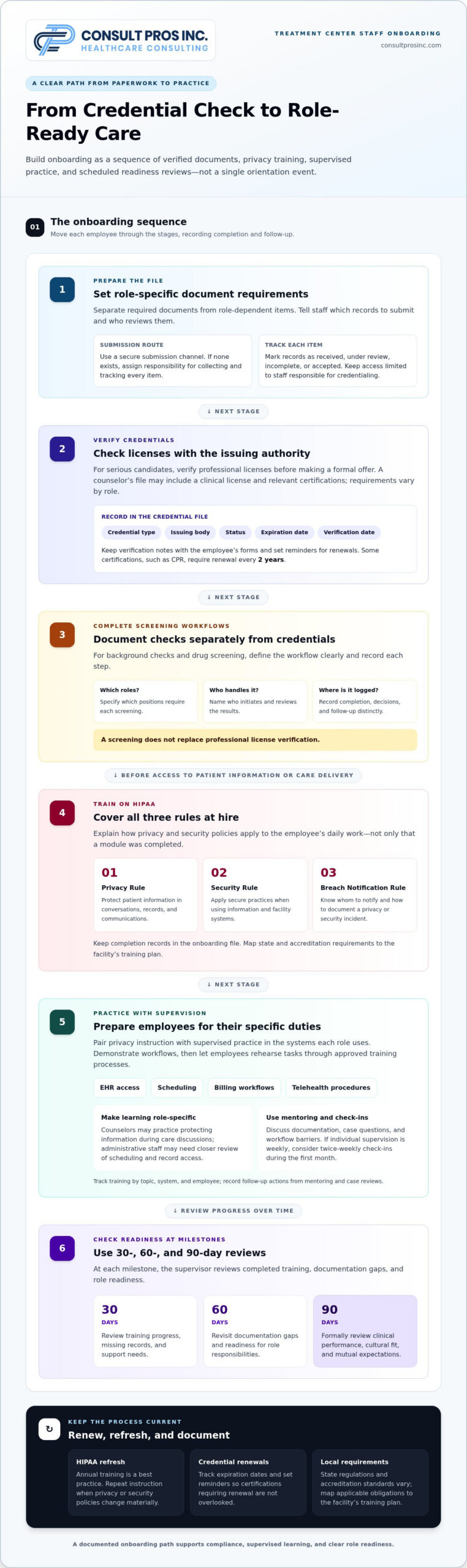
Build a role-specific credential file before the employee’s first shift. For serious candidates, verify professional licenses with the issuing authority before making a formal offer. Record the credential type, issuing body, status, expiration date, and verification date. A counselor’s file, for example, may include a clinical license and relevant certifications, while other roles require different documentation. This structure makes treatment center staff onboarding traceable and keeps missing records from blending into routine paperwork.
Use a checklist that separates required documents from role-dependent items. Collect license and certification copies, verify them against their issuing authorities, and set reminders for renewals. Some certifications, such as CPR, require renewal every 2 years. Keep the employee’s completed forms and verification notes together, with access limited to staff responsible for credentialing. A consistent boarding packet also helps the organization apply the same review steps across comparable positions.
Background checks and drug screening need clear, documented workflows. Specify which roles require each screening, who initiates it, how results are reviewed, and where completion is recorded. A screening does not replace professional license verification. Use a checklist to mark each step as pending, complete, or requiring follow-up, and keep decisions and records distinct.
Use milestones to carry credentialing into ongoing onboarding. A healthcare onboarding framework can set goals at 30, 60, and 90 days, with the supervisor reviewing completed training, documentation gaps, and role readiness at each point. At 90 days, formally review clinical performance, cultural fit, and mutual expectations. These scheduled discussions help identify support needs early and strengthen retention through clearer feedback.
Pair each new clinician with an approachable mentor who understands the organization’s technology and processes. If regular individual supervision is weekly, consider twice-weekly check-ins during the first month. Use these meetings to discuss documentation, case questions, and workflow barriers, then record follow-up actions. Mentoring gives staff practical guidance and feedback, while case reviews help translate knowledge into consistent, supervised practice.
2. HIPAA privacy, security, and breach notification training
Schedule HIPAA instruction at hire, before staff access patient information or participate in care delivery. The U.S. Department of Health and Human Services identifies three areas for mental health provider training: the Privacy Rule, Security Rule, and Breach Notification Rule. A structured orientation should explain how each applies to daily work, not simply record that a module was completed.
Use practical examples drawn from the facility’s workflows. Staff should understand how to handle patient information in conversations, electronic records, and communications, as well as how to follow internal procedures when a privacy or security concern arises. Explain the organization’s breach response process, including whom to notify and how to document an incident. Keep completion records in the employee’s onboarding file.
Set annual HIPAA training as a best practice, and repeat instruction whenever privacy or security policies change materially. Many state regulations and accreditation standards also require annual training. Since requirements vary by state and accreditation framework, map the facility’s obligations to its location and applicable standards, then include those topics in the training plan.
Make instruction comprehensive without assuming every new hire has the same knowledge gaps. Ask staff to apply policies to role-specific situations, then provide guidance where their responses show uncertainty. A counselor may need practice protecting information during care discussions, while administrative staff may need a closer review of scheduling and record-access procedures.
Pair privacy instruction with supervised practice in the systems each role uses. Demonstrate EHR access, scheduling steps, billing workflows, and telehealth procedures, then let employees rehearse tasks using approved training processes. Track completion by topic, system, and employee, so supervisors can identify unfinished training before access or responsibilities expand. For facilities developing a structured learning process, staff training support can help align onboarding with operational needs.
3. Can staff upload compliance documents directly?
Yes, staff can upload compliance documents directly when the facility provides a secure submission channel. The onboarding process should explain which records to submit, who reviews them, and how to correct missing items. A new counselor might upload a license copy and completed training acknowledgments through the organization’s designated system. Assign one reviewer to prevent files from being overlooked across email, paper, and electronic folders.
Track each requirement by employee and status, such as received, under review, incomplete, or accepted. If a document is missing, tell the employee exactly what is needed and what to do next. If a file is unreadable or contains inconsistent details, record the issue and request a corrected version. Keep training records with other onboarding documents so supervisors can confirm completion before assigning related duties.
Electronic signatures can simplify form completion when the facility’s process supports them. Identify which forms need signatures, retain the completed versions, and record who signed and when. Staff also need guidance on ethical decision-making and clinical documentation. Teach employees to record relevant facts accurately, distinguish observations from assumptions, and follow the organization’s procedures for correcting an entry.
Pre-admission paperwork offers another useful practice scenario for new staff. Explain how the admissions team handles intake forms, consent documents, and patient information, then show employees where each record belongs. A mentor can demonstrate the workflow and review a practice example before the employee handles documentation independently. Connect these steps to the facility’s mission, while aligning each employee’s access with their assigned responsibilities.
Common mistakes include relying on scattered email attachments, failing to follow up on incomplete files, and treating a signature as proof that training was understood. These gaps can leave supervisors without clear documentation and staff uncertain about clinical procedures. A defined review process, clear correction steps, and mentor check-ins help reduce those risks during onboarding.
4. Healthcare-specific onboarding requirements
Clinical, nursing, peer support, and administrative employees need a shared orientation as well as role-specific practice. Clinicians focus on assessments, documentation, and supervised care; nurses learn facility procedures and medical workflows. Peer staff need clear role boundaries and communication practices, while administrative employees learn intake, scheduling, and records workflows. A structured plan connects each role’s skills with the program’s culture.
Behavioral health and addiction treatment staff need training matched to their services and duties. Treatment centers providing substance use disorder services must train staff on 42 CFR Part 2 confidentiality requirements, including the 2024 rule changes. Regular training in patient safety and quality improvement can help staff support safe, effective care. CARF requirements list annual ethics and professional conduct training, plus rights-of-persons-served training at hire and an annual refresher.
A practical program combines facility orientation, compliance learning, system practice, shadowing, and supervisor feedback. Use the first week for high-touch orientation, then devote the first 30 days to clinical culture, compliance competency, and EHR proficiency rather than a full caseload. During days 31-60, new clinicians can begin with 50-60% of a full caseload. Increase responsibilities gradually across the first 90 days, with ongoing training and mentor check-ins.
Train employees in safety, de-escalation, and emergency response through clear protocols and supervised practice. Use role-playing and simulations to rehearse crisis intervention, assessments, and communication in difficult situations. After each exercise, discuss what worked, where staff need support, and how to document the event. Interdisciplinary practice can help counselors understand medical interventions and medical staff recognize psychological considerations.
Build the onboarding program around role-specific assessments, documented milestones, and continuing support. A formal review at 90 days can address clinical performance, cultural fit, and mutual expectations. This structure gives employees a clear progression from orientation to supervised practice, while helping leaders identify training gaps before responsibilities expand.
Consult Pros: In-Network Contracting
Consult Pros Inc supports behavioral health operators with In-Network Contracting, helping align payer contracting with facility operations. Turn to this support when preparing to establish or expand network relationships and coordinating contracting with broader readiness work.
Staff onboarding and credentialing are part of a larger operating structure. Consult Pros Inc also provides State Licensing & Certification, Facility Setup & Operational Structuring, and TJC & CARF Accreditation. These services address distinct operational needs, from establishing licensing foundations to structuring facility operations and pursuing accreditation. They can support an organization as it builds the systems and governance needed for staff readiness.
When coordinating contracting with licensing, facility structure, or accreditation priorities, Consult Pros Inc can help organize the work around your facility’s needs. Contact Consult Pros Inc to discuss your organization’s next steps.
Build a repeatable onboarding foundation
Treat onboarding as part of the facility’s operating infrastructure, not a task that ends after orientation. As roles, programs, and workflows change, a clear process helps leaders keep staff expectations aligned with the organization’s standards and mission. It also gives new employees a consistent path from initial readiness to confident participation in daily operations.
For operators building that broader foundation, Consult Pros supports In-Network Contracting, State Licensing & Certification, and Facility Setup & Operational Structuring. These services can be coordinated as an organization develops its operating model and prepares for ongoing work. The next step depends on where your facility is in that process and which operational priorities need attention first.
Use the approach that best fits your facility’s next stage, then establish ownership for maintaining it as the organization grows. To discuss how these operational priorities fit together, contact Consult Pros. A well-structured treatment center staff onboarding process gives your team a sound foundation for consistent, responsible work.
Frequently Asked Questions
How is Healthcare Onboarding Different?
Healthcare onboarding connects workplace orientation with patient safety, confidentiality, and role-specific clinical workflows. New employees need to understand not only their duties, but also how those duties fit into coordinated care. A peer support worker and a nurse, for example, need different role boundaries and procedures, even when they share facility policies. The onboarding plan should reflect each position’s patient contact, system access, and supervisory structure.
How long should clinical onboarding take?
Plan structured clinical onboarding across 90 days, rather than treating orientation as a single event. The broader healthcare onboarding process may extend three to six months, with role-specific training and milestones continuing beyond initial supervision. During the first 30 days, focus on clinical culture, compliance competency, and EHR proficiency before expanding responsibilities. Use regular supervisor discussions to address readiness, documentation habits, and skills that need further development.
What’s the cost of poor onboarding in turnover dollars?
Replacing a clinician at a behavioral health treatment center is estimated to cost 50-200% of the clinician’s annual salary per turnover event. These estimates reflect turnover costs, not onboarding service fees. The actual operational impact also includes lost continuity, recruitment demands, and the time supervisors redirect from existing responsibilities.
What are the steps for onboarding new treatment center staff?
Start by defining role duties and required records, then verify credentials and complete the facility’s screening process. Next, provide policy orientation, privacy instruction, and practice with role-specific systems. Assign a supervisor or mentor to guide early work, then schedule reviews at 30, 60, and 90 days. At each milestone, document progress, identify unresolved training needs, and adjust responsibilities to the employee’s demonstrated readiness.
What background checks and credential verification are required for treatment center employees?
Requirements depend on the employee’s role, facility policies, and applicable state or accreditation standards. Establish a written process for background checks and drug screening that identifies who initiates each step, reviews results, and records completion. For licensed roles, verify credentials with the issuing authority before making a formal offer. Keep verification notes separate from screening records, and track expiration dates so renewals are addressed before credentials lapse.
What HIPAA, patient privacy, and confidentiality training must staff complete?
HIPAA training should cover the Privacy Rule, Security Rule, and Breach Notification Rule, as described by the U.S. Department of Health and Human Services. Staff should complete training before accessing patient information or participating in care delivery. Annual instruction is a best practice, with additional training when privacy or security policies change materially. Staff at substance use disorder treatment centers also need training on 42 CFR Part 2 confidentiality requirements.