
A healthcare compliance program is more than a binder of policies. It is the operating structure that helps an organization follow applicable laws, identify concerns, and respond consistently. It brings together expectations, staff responsibilities, reporting channels, monitoring, and corrective action to address fraud, abuse, and waste. The HHS Office of Inspector General’s General Compliance Program Guidance is voluntary and nonbinding; applicable federal and state requirements still govern healthcare operations.
That distinction matters: a compliance program can support more than regulatory readiness. When integrated into daily operations, it clarifies accountability, helps surface issues early, and guides a measured response to prevent problems from recurring. Effective compliance is an ongoing organizational practice, not a one-time document.
This article explains what healthcare compliance means, whether a program is legally mandated, and how investigations, reporting, and corrective actions fit together. It also covers the practical benefits of a structured program, showing how policies, training, oversight, and follow-through support more stable healthcare operations.
Key Takeaways
- Distinguish voluntary federal program guidance from the laws and regulations that still apply to healthcare operations.
- Build written standards, clear responsibilities, training, and reporting channels into everyday operations so concerns can be identified and addressed.
- Federal law requires healthcare providers to report and return Medicare overpayments within 60 days of identification, according to the Centers for Medicare & Medicaid Services.
- Covered entities and business associates may submit an annual breach report to HHS’ Office for Civil Rights for breaches affecting fewer than 500 individuals, according to the U.S. Department of Health and Human Services, Office for Civil Rights.
- See how consistent oversight and corrective action can support accountability, reduce operational risk, and strengthen organizational readiness.
What is healthcare compliance?
Healthcare compliance is an organization’s practice of following applicable laws, regulations, and ethical standards. A healthcare compliance program turns those obligations into policies, staff responsibilities, oversight, and corrective action.
Healthcare Compliance Program Elements
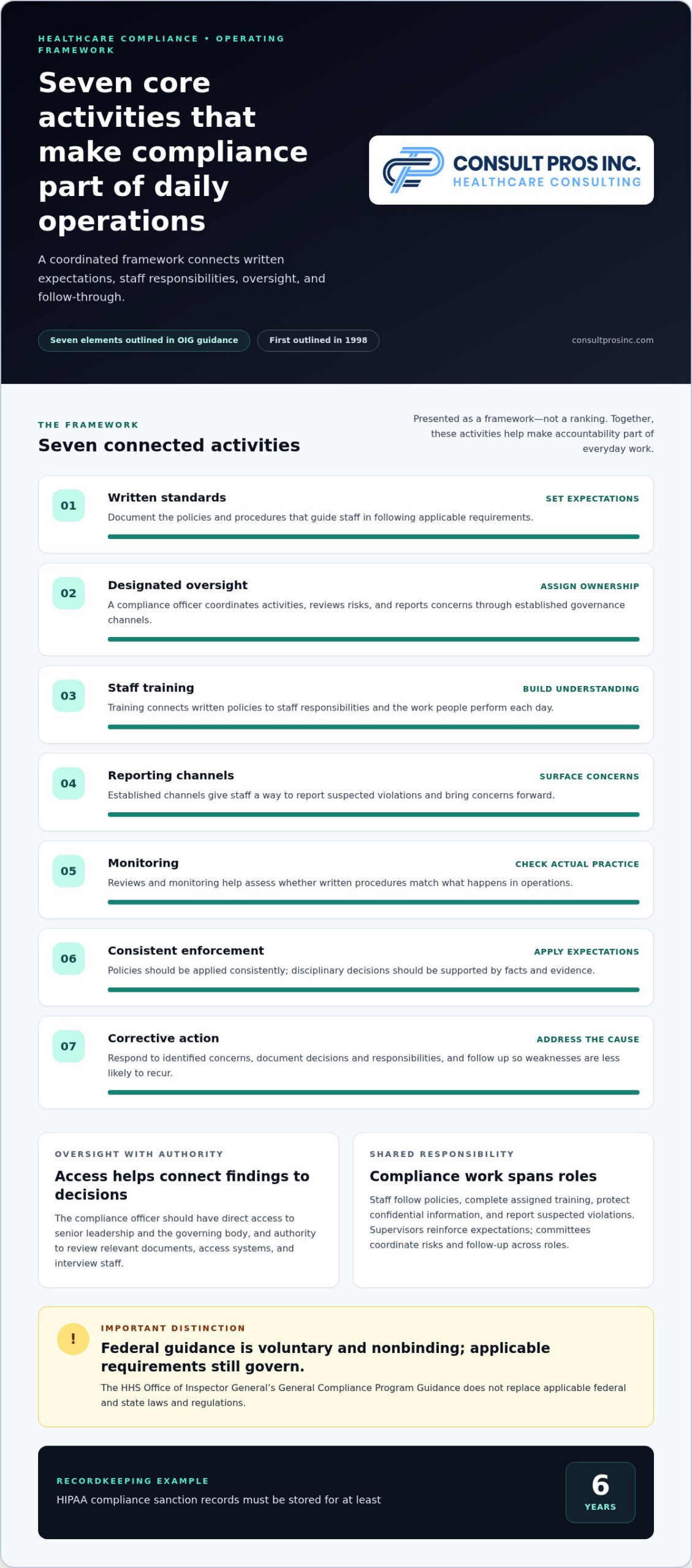
A healthcare compliance program is a coordinated framework for identifying obligations, preventing violations, and responding to concerns. The Office of Inspector General first outlined seven fundamental elements in its 1998 guidance; core activities include written standards, designated oversight, staff training, reporting channels, monitoring, consistent enforcement, and corrective action. Together, these elements make accountability part of daily operations rather than a policy kept apart from service delivery.
For example, a behavioral health organization can connect a written privacy policy to workforce training, incident reporting, and documented follow-up. HIPAA compliance sanction records must be stored for at least 6 years, according to the U.S. Department of Health and Human Services, Office for Civil Rights. Retained records help show how the organization addressed identified conduct and applied its policies.
Compliance Officer Authority and Oversight
A compliance officer coordinates the organization’s compliance activities and reports concerns through established governance channels. The officer should have direct access to senior leadership and the governing body, along with authority to review relevant documents, access systems, and interview staff. This access helps the officer assess whether written procedures match actual practice, including how staff handle patient information and billing records.
Effective oversight connects findings to decisions. The officer can coordinate monitoring, document emerging risks, and bring unresolved issues to leadership for direction. For example, if a review identifies inconsistent record handling, the officer can establish the facts, identify the relevant policy, and recommend a response. Clear reporting lines help leaders assign responsibility and track corrective actions through completion.
Staff and Committee Responsibilities
Compliance is everyone’s responsibility, while a compliance committee helps coordinate work across roles. Staff follow applicable policies, complete assigned training, protect confidential information, and report suspected violations through established channels. Supervisors reinforce expectations in daily work, and the committee brings operational leaders together to review risks, monitoring results, and unresolved concerns.
A committee can turn separate observations into an organization-wide response. For example, clinical, human resources, and finance representatives may identify different aspects of a documentation problem and coordinate a consistent review. The compliance officer records decisions, assigns follow-up responsibilities, and reports progress to leadership. This structure makes accountability visible without placing every compliance duty on one person.
Federal and State Requirements
U.S. organizations must address applicable federal and state requirements, with the specific obligations depending on their services, operations, and jurisdictions. Federal rules can include HIPAA privacy and security requirements, OSHA workplace safety requirements, and CMS program requirements. The Joint Commission also accredits and certifies healthcare organizations. The Anti-Kickback Statute prohibits financial incentives for referrals when the federal government may be charged, according to the U.S. Department of Health and Human Services, Office of Inspector General.
A state-specific review should account for where an organization operates and which services it provides. Licensing and certification obligations, workforce rules, reporting duties, and behavioral health requirements may vary by jurisdiction. Organizations can map each applicable requirement to a policy owner, training responsibility, and monitoring process. This structured review helps leaders identify which obligations apply to each facility and service line.
Investigations, reporting, and corrective actions
A documented response takes an organization from a reported concern to verified facts, appropriate action, and follow-up. Billing reviews, medical records, and staff reports can each reveal issues that need careful assessment.
Investigations and Corrective Actions
An investigation establishes what happened, which requirements apply, and whether a process or individual contributed to the concern. Review relevant records, interview appropriate personnel, document findings, and protect confidential information throughout. Corrective action should address the underlying cause, not just the immediate error, to make the same weakness less likely to recur.
For example, if a billing review finds repeated documentation gaps, the organization can examine how records are prepared, identify where procedures break down, and assign targeted training or process changes. The compliance team should document the decision, responsible lead, and follow-up review. Disciplinary action may be appropriate when supported by the facts, but decisions should be consistent and evidence-based.
Reporting Channels and Non-Retaliation
Reporting channels give workforce members a defined way to raise suspected violations, including concerns about billing, privacy, or patient safety. Organizations can offer access to a supervisor, compliance officer, or confidential reporting option, and explain how reports are received and assessed. Anonymous reporting can help surface problems early, particularly when staff fear workplace consequences.
A written non-retaliation commitment supports good-faith reporting and clarifies that raising concerns is part of staff responsibilities. The organization should document each report, limit access to sensitive details, and communicate next steps where appropriate. Clear procedures should also explain that knowingly failing to report a suspected violation may lead to employee discipline.
Communication About Reporting
Reporting works best when staff know where concerns go, who reviews them, and how urgent issues are escalated. The Patient Safety Rule, identified as 42 CFR Part 3, requires applicable organizations to include communication lines in their compliance programs. Written instructions and staff training can explain how to submit a report and what information helps investigators assess it.
Communication also supports consistent follow-through. A compliance officer can acknowledge receipt when appropriate, protect confidentiality, and share process updates without disclosing restricted details. For example, staff can be told that a policy review is underway, while patient and personnel information remains limited to authorized reviewers.
Billing oversight provides another practical reason for structured review. CMS conducts Comprehensive Error Rate Testing each year to assess providers’ billing, coding, and documentation for services rendered to Medicare beneficiaries; CMS CERT reports go back to 2011. Organizations can use internal reviews to identify patterns such as unsupported services, coding discrepancies, or missing records, then correct the underlying workflow.
Federal law requires healthcare providers to report and return Medicare overpayments within 60 days of identification, according to the Centers for Medicare & Medicaid Services. A response process should route potential overpayments promptly to responsible compliance and finance personnel, preserve supporting records, and track required reporting and repayment actions. Serious concerns involving federal healthcare programs may also fit the OIG Self-Disclosure Protocol or CMS Self-Referral Disclosure Protocol.
Organizations structuring these reporting, investigation, and follow-up processes can use regulatory compliance program support to align oversight with operational requirements.
Is Compliance Mandated?
No single federal rule requires every healthcare organization to adopt the same compliance program. However, organizations must follow applicable laws, and certain federal programs impose specific compliance duties.
Compliance Risk Assessments
A behavioral health compliance checklist can help identify where an organization’s operations may fall short of applicable requirements. It helps leaders focus monitoring and audits on the areas most relevant to their services and patient data.
Start by mapping operations, then compare written policies and actual practices with applicable requirements. Review incidents, audit results, billing processes, workforce practices, and access to patient information. Assess each issue for its potential impact and likelihood, then assign an owner and document planned monitoring or corrective action.
For example, a behavioral health provider can assess how staff access records, how billing documentation is reviewed, and how concerns reach leadership. Revisit the assessment as services, systems, staffing, or regulations change. A risk-based approach focuses review on exposed processes rather than treating every operational area as equally risky.
HIPAA Breach Risk Assessment
A HIPAA breach risk assessment evaluates whether an impermissible use or disclosure of protected health information requires breach notification. It provides a documented basis for the organization’s response and helps distinguish reportable events from situations that meet an exclusion.
Review what information was involved, who received it, whether it was actually acquired or viewed, and what mitigation occurred. HIPAA breach notification exclusions are set out in §164.402. Record the facts, decision, and actions taken, and route the assessment to personnel responsible for privacy and security.
Covered entities and business associates may submit an annual breach report to HHS’ Office for Civil Rights for breaches affecting fewer than 500 individuals, according to the U.S. Department of Health and Human Services, Office for Civil Rights.
Program guidance and legal obligations are distinct. The HHS Office of Inspector General’s General Compliance Program Guidance is voluntary and nonbinding; its use of “should” signals recommendations rather than universal legal duties. Specific federal and state laws still create enforceable responsibilities, including HIPAA requirements for covered entities and business associates. Organizations participating in Medicare, Medicaid, or other federal healthcare programs may also face audits or investigations.
Routine monitoring tests whether written controls work in practice. An organization might sample billing records, review access logs, or compare staff conduct with documented procedures. CMS conducts Comprehensive Error Rate Testing each year, assessing providers’ billing, coding, and documentation for services to Medicare beneficiaries. Internal reviews can help identify patterns and prompt corrective action before weaknesses persist.
Assess effectiveness by examining evidence, not policy documents alone. Leadership can review audit findings, reports, response times, training records, and completion of corrective actions. The U.S. Department of Justice’s Evaluation of Corporate Compliance Programs, updated in September 2024, is a starting point for assessing effectiveness. Reassess emerging risks annually and adjust monitoring when operational changes or findings indicate new exposure.
Need Help Building or Enhancing Your Compliance Program?
A behavioral health organization can make compliance expectations practical by translating them into written policies, staff training, reporting procedures, and oversight. The HHS Office of Inspector General identifies seven elements: written standards, a compliance officer and committee, training, communication channels, auditing and monitoring, consistent enforcement, and corrective action.
These elements work together; a policy without training or follow-through may not guide daily conduct. For example, a privacy procedure should clarify staff responsibilities, explain how to raise concerns, and describe how leadership reviews reported problems.
Policies, Procedures, and Standards of Conduct
Written policies define expected conduct, while procedures explain how staff perform specific duties. Standards of conduct set out the organization’s ethical commitments, including integrity, confidentiality, and honest documentation. Together, these documents clarify responsibilities and give supervisors a consistent reference for decisions.
In a behavioral health setting, a policy might address access to patient information, while its procedure explains how staff request access and report an error. Assign an owner to each document, identify the roles it affects, and revise it when operational practices or applicable requirements change. Clear version control helps staff use current guidance.
Sanctions for Policy Violations
Sanctions are consistent disciplinary responses to substantiated violations of organizational policies or procedures. They make expectations enforceable and reinforce that job title or seniority does not exempt anyone from accountability.
Define the review process and the factors that guide a response, such as the conduct, its impact, and whether the person received relevant training. For example, a supervisor might document a repeated failure to follow a records-access procedure and refer it for review under the organization’s disciplinary policy. Apply standards consistently, preserve decision records, and distinguish intentional misconduct from a process failure that requires correction.
Elements of an Effective Compliance Program
The seven elements organize compliance responsibilities from prevention through response. Written standards guide conduct; an officer and committee oversee implementation; training explains duties; communication channels receive concerns; audits and monitoring test practices; consistent enforcement addresses violations; and corrective action responds to identified weaknesses.
For practical implementation, connect each element to a responsible role and evidence of completion. A training record, monitoring report, or documented corrective action can show how a policy operates beyond the page. The HIPAA Privacy Rule requires covered entities to train workforce members on applicable privacy and breach-notification policies under §164.530. Annual refresher training can help keep those responsibilities visible as staff roles and procedures change.
Review the framework as operations evolve. A new service, revised workflow, or audit finding may call for updated procedures, targeted training, or additional monitoring. A structured healthcare compliance program keeps these parts connected, helping leadership assess whether written standards are understood, followed, and reinforced through accountable action.
Benefits of healthcare compliance programs
An integrated compliance framework makes regulatory duties part of routine operations, rather than separate administrative work. For behavioral health organizations, a healthcare compliance program connects staff education, internal reviews, and leadership oversight. Teams can see which procedures apply to their roles and where to raise concerns. This structure supports clearer accountability and more informed operational decisions.
More Consistent Operations
Written procedures help staff handle recurring tasks consistently across shifts and service locations. For example, a behavioral health team can follow a defined process for granting access to health information, documenting decisions, and escalating an error. Managers can compare actual practice with the approved procedure and address gaps. This supports continuity when staffing changes or workflows are updated.
Stronger Protection of Patient Information
HIPAA-focused education helps employees understand how their actions affect patient privacy and security. Staff who can recognize misdirected records, report access concerns, and follow internal safeguards can help detect issues earlier. A breach response process helps the organization gather relevant facts, assess the event, and determine next steps, supporting responsible handling of sensitive health information.
Earlier Visibility Into Operational Risks
Internal audits and monitoring give leaders a structured view of how policies work in practice. A documentation review, for instance, may reveal recurring omissions or inconsistent approval practices. Leaders can trace the issue to workflow, training, or supervision, then assign corrective actions and track completion. Findings can inform operational decisions, rather than merely record past problems.
Greater Readiness and Accountability
Organized records help an organization explain its processes during an audit, accreditation review, or government inquiry. Current policies, training records, audit results, and documented follow-up show how responsibilities are assigned and handled. Evidence does not replace sound practice, but it can help leadership demonstrate how issues are identified and addressed. Defined roles also clarify ownership of corrective tasks.
Trust depends on dependable conduct, not policy statements alone. When staff follow privacy procedures, raise concerns, and document their actions, patients and families encounter a more consistent organization. Leadership can reinforce that culture by reviewing patterns, addressing recurring weaknesses, and keeping education relevant to actual duties. A healthcare compliance program connects regulatory integrity with day-to-day organizational reliability.
To strengthen the framework behind these benefits, build a more structured compliance framework for your organization’s operational needs.
Consult Pros: In-Network Contracting
Consult Pros Inc supports behavioral health organizations with In-Network Contracting as they establish payer relationships within a broader operational plan. This work can be coordinated with State Licensing & Certification, Facility Setup & Operational Structuring, and TJC & CARF Accreditation, depending on the organization’s stage and priorities.
For operators launching a facility, these services can connect foundational setup with licensing, accreditation, and contracting needs. For established organizations, they can support planned changes to operational structure or payer contracting. Coordinating these areas within a comprehensive healthcare compliance program helps leaders clarify responsibilities and sequence decisions.
Contact Consult Pros Inc to discuss how In-Network Contracting can fit your behavioral health organization’s plans.
Build Compliance Into Your Next Stage
A healthcare compliance program is most useful when it develops with your organization and adapts as services, staffing, and operating structures change. Start by identifying which part of that infrastructure needs attention, then align the work with your broader readiness priorities.
Consult Pros Inc supports behavioral health operators with In-Network Contracting, State Licensing & Certification, and Facility Setup & Operational Structuring. These services connect operational planning with the requirements involved in establishing or developing a facility. A focused discussion can clarify where support fits your organization’s plans.
Contact Consult Pros Inc for compliance support, and move forward with a clearer foundation for your next stage of operations.
Frequently Asked Questions
What are the steps to create and implement a healthcare compliance program?
Begin by identifying the laws and operational obligations relevant to your services, locations, and payer relationships. Assign accountable owners, assess risks, and prioritize written controls for high-risk activities. Translate each control into staff guidance, training, and monitoring evidence. For example, connect a patient-record access policy to role-based permissions and a process for reporting inappropriate access. Review findings with leadership and update controls when services or workflows change.
What are the compliance officer and compliance committee’s roles and responsibilities?
The compliance officer coordinates oversight, while the committee connects that work to operational decisions across departments. For example, the officer can bring a recurring documentation concern to committee members responsible for clinical operations, finance, and workforce training. The group can determine whether the issue reflects unclear procedures, inadequate supervision, or a system weakness, then assign follow-up responsibilities. Senior leaders and the governing body retain oversight, including review of significant risks and unresolved findings.
What healthcare compliance training and reporting systems are required?
Covered entities must train workforce members on policies and procedures for complying with the HIPAA Privacy and Breach Notification Rules under §164.530. Training should reflect each employee’s duties, such as handling records, using approved communication channels, or escalating a suspected disclosure. A reporting system should clearly explain how to raise a concern, protect confidentiality, and prohibit retaliation for good-faith reports. Anonymous channels can help staff report concerns when they are uncomfortable identifying themselves.
How should healthcare organizations investigate, document, and correct compliance violations?
Preserve relevant records, establish who will review the concern, and document findings in a restricted case file. Record the report’s source, evidence reviewed, interviews conducted, conclusions, and decisions while protecting patient information. Examine the underlying cause, such as an unclear handoff or inconsistent documentation practice, and assign corrective actions to responsible staff. Track completion and assess whether the change works. Root cause analysis helps organizations address weaknesses instead of merely closing individual cases.
What are the penalties for healthcare compliance violations, including False Claims Act and HIPAA violations?
Consequences depend on the conduct and applicable law, and may include fines, legal action, reputational harm, or loss of stakeholder trust. Under the civil False Claims Act, liability can apply when someone knowingly submits or causes a false federal claim, including through deliberate ignorance or reckless disregard. The government may recover damages, and the law provides for fines. HIPAA violations can also trigger enforcement; the response depends on the facts and applicable requirements.
How do compliance program requirements differ for hospitals, physician practices, and small healthcare providers?
Applicable laws depend on services, operations, and participation in federal programs, while oversight structures can be scaled to organizational size and complexity. A hospital may coordinate compliance across departments and facilities; a physician practice may assign responsibilities through a smaller leadership structure. One resource describes small practices as having 1-10 providers, medium groups as having 10-50 providers, and large organizations as having 50+ providers. These labels describe scale, not separate universal legal standards.