
A behavioral health vacancy is more than an unfilled shift. Behavioral health staffing services match candidates’ credentials and experience to the organization’s care setting, patient population, and role responsibilities. That context is what makes specialized recruitment different from filling a position based on availability alone.
Organizations need qualified professionals, but they also need people whose skills align with the work and the communities they serve. This article explains how recruiters assess role requirements and match organizations with counselors, nurses, psychiatrists, psychologists, and social workers. It also outlines how the staffing process works, what can affect recruitment costs, and how staffing support connects with broader operational readiness, so you can make decisions with a clearer view of both workforce needs and organizational demands.
Key Takeaways
- Assess recruitment by how well it aligns a placement type with your staffing need, whether temporary, contract, or direct hire.
- Define the role, care setting, population served, and required qualifications before matching candidates to your organization.
- Compare the responsibilities of counselors, nurses, psychiatrists, psychologists, and social workers with the needs of your care model.
- Consider how recruitment, onboarding, and organizational readiness work together to support a stable behavioral health workforce.
What makes a behavioral health recruiter different?
Behavioral health recruitment aligns employment terms and specialty experience with the care setting. The right arrangement depends on the urgency of the vacancy, continuity needs, and the role’s responsibilities.
Temporary, Contract, and Permanent Hiring
Temporary placements can address short coverage gaps, while contract roles cover a defined period or need. Permanent direct-hire recruitment supports an ongoing position within a clinic or hospital. Temp-to-hire and contract-to-hire arrangements begin with a time-limited placement, giving the organization a chance to assess fit before making a longer-term commitment. Each option differs in duration, continuity, and hiring structure.
Travel contracts can bring clinicians from beyond their usual area, while local contracts draw on nearby recruiting markets. Compare options by specialty, schedule, patient population, and expected continuity. A psychiatric nurse role requiring sustained team coordination, for example, may call for a different arrangement than temporary coverage for an open shift.
Agency Selection Criteria
Clinics and hospitals can choose a recruiting agency by matching its focus to their roles, setting, and staffing model. First define the required specialty, responsibilities, schedule, and work location. Then assess how the agency recruits for that profile, evaluates experience with the relevant patient population, and coordinates screening and onboarding. State-level credentialing processes also matter when a role requires practitioners prepared to work in that state.
Local and travel coverage draw on different recruiting pools. A clinic seeking nearby candidates should prioritize agencies that recruit in its area, while a hospital open to travel contracts can consider a broader pool. Candidate availability depends on the role, setting, work location, and willingness to travel. Specify the location and contract type in the staffing plan.
U.S. These are listed job rates, not a national average or agency service fee. Staffing costs depend on the role, schedule, location, and contract duration; service pricing is provided after a quote request.
Matching candidates with suitable organizations
A strong match aligns a candidate’s qualifications with the organization’s care model, patient population, and position requirements. Screening should also reflect the work environment and onboarding needs.
Candidate Screening and Verification
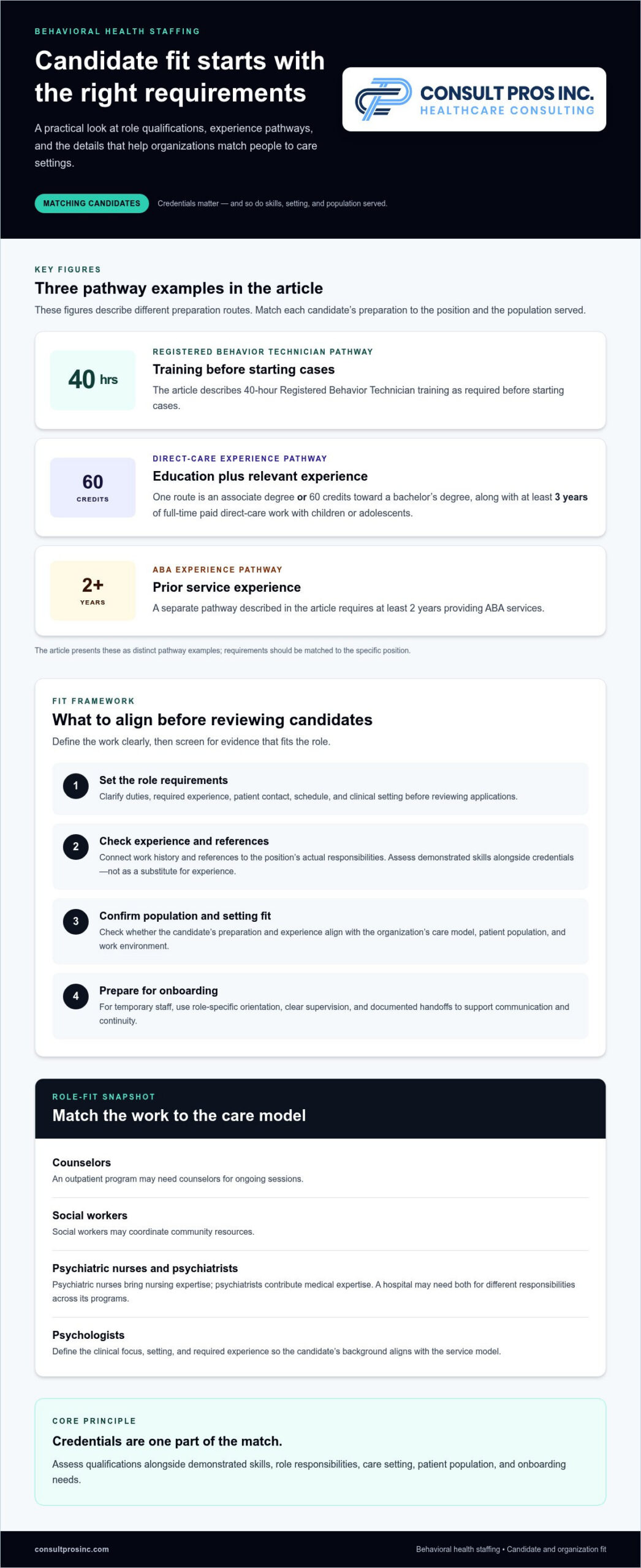
Screening connects a candidate’s work history and references to the position’s duties. Before reviewing applications, outline the required experience, patient contact, schedule, and clinical setting. For temporary staff, reduce continuity and communication risks through role-specific orientation, clear supervision, and documented handoffs. These steps help staff understand local procedures before taking on assigned responsibilities.
Credentials and Role Fit
Evaluate credentials alongside demonstrated skills, not as a substitute for experience. A behavioral health technician pathway requires 40-hour Registered Behavior Technician training before starting cases. Another pathway requires an associate degree or 60 credits toward a bachelor’s degree and at least 3 years of full-time paid direct-care work with children or adolescents. A separate pathway requires at least 2 years providing ABA services. Match the candidate’s preparation to the position and population served.
Client and Candidate Services
Recruitment support can clarify job requirements, identify suitable candidate profiles, and coordinate onboarding. Candidates also need a clear account of duties, schedule, work setting, and expectations before accepting a position. Specify, for example, whether the role involves direct patient interaction, a particular clinical environment, or physical tasks. Clear details help both sides assess fit and avoid preventable mismatches.
Licensing, Credentialing, and Compliance
In the United States, licensing and credentialing requirements depend on the role, state, and care setting. Organizations should align the position’s duties with the candidate’s applicable credentials, scope of practice, and internal compliance procedures. A staffing agency can organize this review, while employers remain responsible for setting role expectations and onboarding requirements. Structured state licensing and certification support can help align workforce planning with facility requirements.
Roles filled, including counselors, nurses, psychiatrists, psychologists, and social workers
Behavioral health teams combine clinical and paraprofessional roles, each contributing different skills. Match candidates to the organization’s services, patient needs, and day-to-day responsibilities.
Counselors, Psychiatrists, Psychologists, and Social Workers
Counselors, psychologists, psychiatrists, and social workers bring distinct professional perspectives to mental health programs. Organize recruitment around each role’s clinical focus, setting, and required experience. An outpatient program may need counselors for ongoing sessions, for example, while social workers coordinate community resources. Define the core duties before comparing candidates so their experience aligns with the service model.
Psychiatric nurses bring nursing expertise to behavioral health settings, while psychiatrists contribute medical expertise to care teams. A hospital may need both roles for different responsibilities across its programs. Candidates should understand the patient population, team structure, and work setting before accepting a position. Clear expectations help employers assess fit and candidates understand how their work relates to other team members.
Technician and Paraprofessional Roles
Behavioral health technicians and paraprofessionals provide practical support in structured programs. Duties vary by organization, so specify supervision, patient interaction, and routine responsibilities. A youth program, for example, may need a technician experienced in working with children and adolescents. Compare candidates’ preparation and relevant experience with the actual tasks, not just the job title.
Another pathway requires at least 2 years providing ABA services. These criteria illustrate why each position should state its pathway and duties clearly. A dedicated recruiter can then connect opportunities with candidates whose background fits the organization’s needs.
To build a balanced behavioral health team, map each service to its required roles, then identify gaps in clinical, nursing, social work, and paraprofessional coverage. An organization expanding outpatient counseling may prioritize counselors and social workers, while a program adding structured behavioral support may recruit technicians. This role-by-role plan focuses the search and supports stronger working relationships across the team.
Behavioral health staffing services
Healthcare organizations can use behavioral health staffing services to recruit, place, and onboard professionals for open roles. Depending on the staffing plan, support may cover temporary roles, defined contracts, or direct-hire recruitment. A clear profile also helps candidates understand the work, setting, and expectations before accepting a position.
Recruitment is only one part of the process. A practical staffing plan connects workforce needs with onboarding and operational readiness. Before recruiting a therapist, for example, define the role’s responsibilities, patient population, schedule, and relationships with the team. These details help identify relevant experience and show the new hire how the position fits the service model. For a practical guide to treatment center staff onboarding, from document uploads to credentials, consider how credential checks, privacy training, and role-specific preparation fit into the process.
A structured process can include:
- Define the gap: Identify the role, setting, schedule, and coverage need.
- Set candidate criteria: Describe required experience, credentials, and patient-facing duties.
- Coordinate onboarding: Prepare role expectations, internal procedures, and team introductions.
- Review fit: Track how the placement aligns with facility needs and responsibilities.
Retention deserves attention, too. Demanding work, compassion fatigue, emotionally taxing duties, perceived opportunities elsewhere, and mismatched hires can contribute to turnover. Give candidates an accurate picture of the duties and work conditions, then provide structured onboarding and clear supervision. A mental health program, for example, should explain whether a therapist works independently or coordinates care with a wider team.
Organizations looking to establish or expand services can connect recruiting with facility setup and operational structuring. This helps align staffing plans with how the facility will deliver care, rather than treating recruitment as an isolated task. Plan staffing and onboarding for your facility as part of building a workable operating structure.
Consult Pros: In-Network Contracting
Consult Pros Inc supports behavioral health organizations with In-Network Contracting, which can form part of a facility’s operational and payer-related planning. As you develop staffing plans, align workforce planning with licensing, facility structure, and accreditation objectives.
Consult Pros Inc also provides State Licensing & Certification, Facility Setup & Operational Structuring, and TJC & CARF Accreditation. These services support the administrative foundations around recruitment and onboarding, rather than treating each operational requirement in isolation. An organization preparing to launch a care program, for example, can plan its staffing model alongside licensing and facility setup.
Contact Consult Pros Inc to discuss how In-Network Contracting and related operational support fit your organization’s plans.
Build your next staffing decision into the operating plan
A workforce plan is strongest when developed alongside the facility it will support. Before opening a program or changing existing services, define how each position fits the care model, organizational structure, and readiness priorities. This forward-looking approach connects recruitment decisions with the operational foundations needed to sustain them.
Consult Pros supports this planning through In-Network Contracting, State Licensing & Certification, and Facility Setup & Operational Structuring. These services address related organizational needs as you establish or develop a behavioral health workforce. Identify where staffing plans intersect with your facility’s operational priorities, then discuss the support that fits.
Contact Consult Pros about staffing to discuss your organization’s plans for behavioral health staffing services. A deliberate plan can help your team move forward with greater operational clarity.
Frequently Asked Questions
Do you offer temporary and permanent staffing options?
Consult Pros supports staffing, onboarding, and recruitment, including direct-placement recruiting. Temporary coverage and permanent hiring serve different workforce needs: temporary roles address defined short-term gaps, while permanent placements fill ongoing positions. Before recruiting, identify the expected duration, core duties, schedule, and onboarding requirements. A clear brief helps recruiters and the organization choose a staffing structure aligned with the operating plan.
How quickly can you fill a licensed therapist role?
A therapist’s hiring timeline depends on specialty, applicable state licensing requirements, schedule, and candidate availability. A complete role description can help focus recruitment: specify the care setting, population served, responsibilities, and required credentials. Consult Pros provides recruitment and credential verification support, while State Licensing & Certification support helps organizations plan for licensing processes relevant to their operations.
Which behavioral health roles can staffing agencies fill, including therapists, psychiatrists, nurses, and counselors?
Recruitment can cover therapists, counselors, psychiatrists, psychologists, social workers, behavioral health nurses, and technicians. The right mix depends on the facility’s programs and each position’s contribution to care. An organization developing outpatient services may recruit therapists and counselors, while a residential program may also need nursing and paraprofessional roles. Define responsibilities and team relationships for each opening before recruitment begins.
How do behavioral health staffing agencies screen and credential clinicians?
Screening can include reviewing work history, references, credentials, and background checks against the position’s requirements. Consult Pros’ recruitment support includes credential verification, background checks, personnel file setup, and onboarding workflow development. Document role-specific requirements and ensure candidate records follow internal procedures. For example, distinguish required credentials from preferred experience in the job profile.
How quickly can behavioral health staffing agencies fill urgent vacancies?
The time needed to fill an urgent vacancy depends on the role, required qualifications, schedule, location, and candidate availability. Give recruiters a precise brief covering essential duties, required credentials, working hours, and how the vacancy affects operations. Separate responsibilities needing immediate coverage from those that can wait for a permanent hire. This prioritization clarifies the search without compromising role fit.