
The fastest way to delay a treatment-center launch is to treat licensing, facility planning, staffing, and operations as separate projects. Learning how to open a treatment center means seeing how decisions connect: the care model defines the services, those services shape state requirements, and licensing and facility criteria influence staffing and site plans.
Regulatory approvals can be a major hurdle, particularly because requirements vary by state and treatment model. A coordinated plan helps manage these dependencies and reduce avoidable rework. This guide lays out a staged roadmap, from defining your treatment model and service scope to aligning licensing, facility readiness, staffing, finances, and operating systems.
You’ll also learn which requirements depend on jurisdiction and why they should be assessed early, before facility and hiring decisions become difficult to change. The goal is a clear path from initial concept to a compliant, operationally prepared center designed to support sustainable care.
Key Takeaways
- Start by defining who the center will serve, what care it will provide, and how the program will operate.
- Use the intended service scope and setting to map state-dependent licensing, application, inspection, and readiness work.
- Assess facility and business-structure options against the care model, while verifying local zoning, occupancy, life-safety, and physical-plant requirements.
- Build staffing, policies, and operating systems around the planned services, with accountable owners and review dates for key readiness evidence.
- Use this staged roadmap for how to open a treatment center, advancing to launch only when applicable approvals, facility readiness, staffing, policies, and systems are in place.
How to Open a Treatment Center: Define the Care Model Before the Build
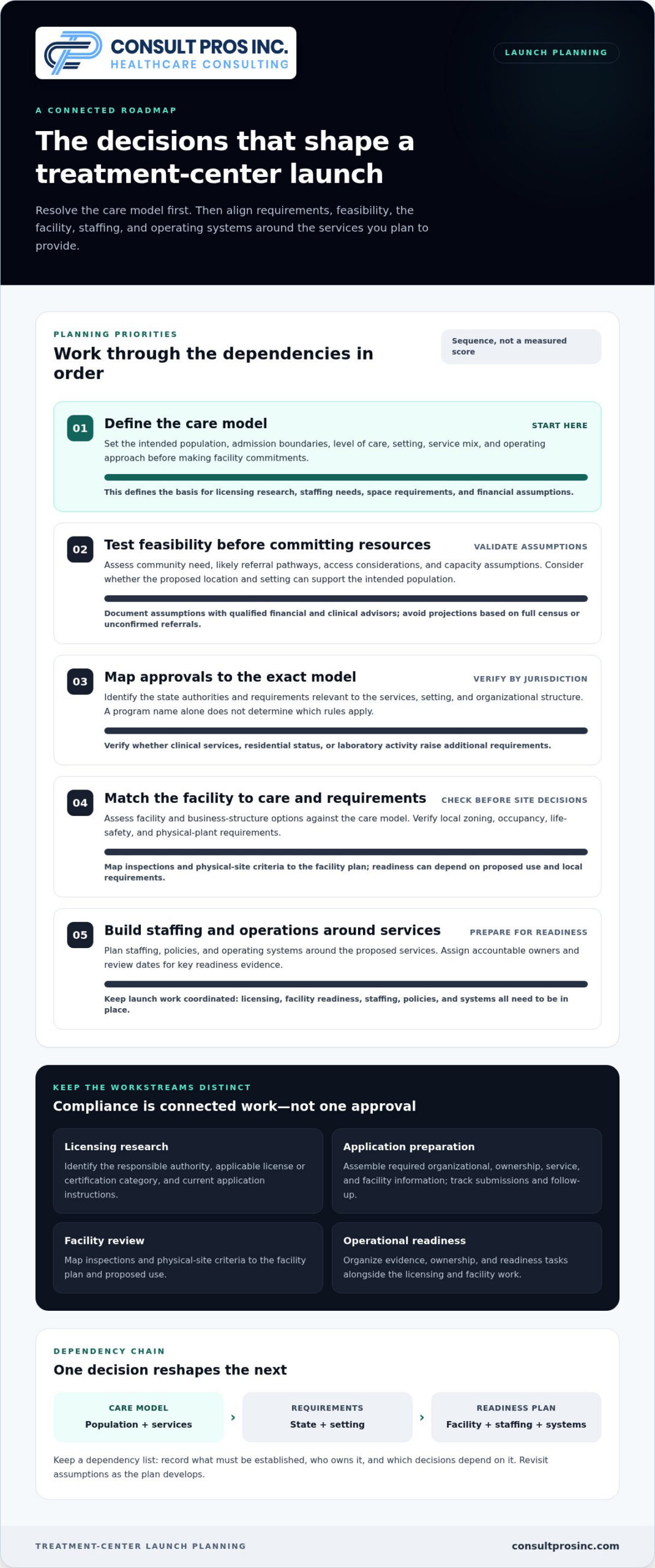
Start with the care model, not the building. Define whom the center will serve, what care it will provide, and how services will operate before making facility commitments. These decisions provide a working basis for evaluating licensing pathways, staffing needs, space requirements, and financial assumptions. They also help prevent a common planning mistake: choosing a site or capacity before confirming that the proposed program can operate there.
A treatment-center concept has several dimensions. Level of care, such as outpatient or residential services, is only one. The setting, intended population, admission criteria, service mix, and operating approach also shape the model. Each can affect the center’s regulatory classification and operating requirements, which vary by state and service scope. Verify those distinctions for the relevant jurisdiction rather than assuming one national license category applies to every program.
Choose the population, services, and level of care
Describe the intended population and presenting needs in practical terms. Set admission boundaries by stating which needs the program is designed to address and which require another level or type of care. Define the proposed services and setting alongside those boundaries. For example, a program designed for scheduled outpatient services has different space, staffing, and operating assumptions from a residential model, even if both serve people with overlapping needs.
Clinical leadership should shape the service mix and care pathways before the organization commits to a facility. The clinical plan should explain how people enter care, how services are coordinated, and how transitions are managed within the proposed scope. Founders can use rehabilitation counseling principles as a broad starting point for considering counselors’ roles and ethical practice, then align the actual model with applicable professional standards and state requirements. Document these decisions so licensing research and facility planning have a defined operational basis.
Build a feasibility case before committing resources
A viable concept must be supportable as well as clinically coherent. Assess community need, likely referral pathways, access considerations, and capacity assumptions before committing significant resources. Consider whether the proposed location and setting can support the people the program intends to serve, and whether referral relationships could reasonably connect those individuals with the center. Treat these as planning questions, then validate the demand and operating assumptions behind them.
Model the implications with qualified financial and clinical advisors. Consider how service scope affects staffing, facility requirements, program capacity, and the resources needed to sustain operations. Avoid basing projections on a full census or unconfirmed referrals. Instead, document the assumptions and revisit them as the plan develops.
Maintain a dependency list. State licensing and certification categories, facility criteria, staffing availability, payer strategy, and organizational structure may affect one another, and the order in which they are resolved can influence launch feasibility. For each item, record what must be established, who owns it, and which decisions depend on it. This foundation makes how to open a treatment center a sequence of informed scope decisions, rather than a premature commitment to a particular building or program.
How Treatment Center Licensing and Compliance Shape the Launch Plan
Once the proposed care model is documented, translate it into a map of approvals and readiness tasks. Applicable requirements depend on the state, services, setting, and organization’s structure. A program’s name alone won’t establish which rules apply. For example, residential services, clinical services, and laboratory activity can each raise different questions to verify against current state and federal guidance.
For founders learning how to open a treatment center, this distinction matters because compliance is not one application or approval. Licensing research, application preparation, facility inspections, and evidence of operational readiness are related but separate workstreams. Each needs an owner, records, and a place in the launch sequence.
Identify the authorities and approvals relevant to the proposed model
Identify the state agencies responsible for the proposed services and the rules that govern the specific setting. Then create a requirements register covering application materials, ownership disclosures, facility criteria, review steps, and inspection preparation. Flag items that may depend on clinical services, residential status, or laboratory activity for verification. The state licensing planning guide can help organize this research without treating one state’s process as a national standard.
Keep the workstreams distinct in the launch plan:
- Licensing research: Identify the responsible authority, applicable license or certification category, and current application instructions.
- Application preparation: Assemble required organizational, ownership, service, and facility information, while tracking submissions and follow-up.
- Facility review: Map inspections and physical-site criteria to the facility plan, since readiness may depend on the proposed use and local requirements.
- Operational readiness: Organize policies, staffing records, training evidence, and other documentation needed to demonstrate the center can operate as described.
For each requirement, record its source and date, accountable owner, status, and any decisions that depend on it. This makes changes visible early, before they disrupt facility work or launch sequencing.
Treat licensing, accreditation, and certification as distinct workstreams
A state license or certification authorizes activity under the applicable state framework. Third-party accreditation, such as review through CARF or The Joint Commission, is a separate process and is not a universal licensing mandate. Certification may refer to other program-specific credentials, while payer participation involves its own enrollment or contracting steps. The purpose and applicability of each depend on the center’s model and operating goals.
Assess each workstream separately. Determine whether accreditation is required by the applicable authority, supports organizational or contracting objectives, or is not relevant to the proposed scope. Evaluate payer participation against the intended payment model, and review advertising-related certification needs against planned services and communications. Keep the decisions connected in one launch plan, but don’t assume that completing one substitutes for another.
Consult Pros Inc coordinates licensing, facility planning, accreditation preparation, and operating systems as requirements take shape. Treatment-center launch planning support brings these workstreams into a single implementation structure.
Choose a Treatment Center Facility and Business Structure That Fit the Model
A facility should support the program’s defined services, not dictate them. Before comparing sites, translate the care model into practical requirements: setting, anticipated capacity, service areas, privacy needs, accessibility considerations, and the spaces staff need to deliver and coordinate care. Then assess potential facilities against applicable licensing criteria and local requirements. This prevents a promising property from becoming an expensive mismatch.
Evaluate facility options against service and licensing needs
Residential and outpatient programs can have different space-use and operating needs, but there is no single site standard for every treatment center. A residential model may require spaces that support its proposed living and care arrangements, while an outpatient program may prioritize areas for scheduled services and private conversations. Exact criteria depend on the services, state rules, and local approvals relevant to the project.
Review floor plans against the intended workflow, not just total square footage. Consider how people enter and move through the facility, where private services take place, how staff coordinate work, and whether shared spaces can serve their intended functions without compromising privacy or safety. Assess accessibility and physical-plant needs against applicable criteria, and document open questions for review with relevant authorities and qualified professionals.
Local verification is essential. Zoning, occupancy, life-safety, and physical-plant requirements can affect whether a property supports the proposed use and what changes may be needed. Before signing a lease or purchase commitment, align the site review with licensing research, facility planning, and a realistic assessment of required modifications. A broader treatment center facility planning guide for care and compliance can help organize these connected considerations.
Establish governance and a realistic operating plan
The site is only one part of the launch structure. Entity formation, ownership responsibilities, and governance influence decision-making, authority, and financial and operational oversight. Work with qualified legal counsel on entity and ownership matters, then document governance roles so accountability is clear during planning and after operations begin.
Build a project-specific budget instead of relying on generic startup figures. Develop assumptions for facility commitments and modifications, staffing, operating systems, and the resources needed to support the proposed capacity. Qualified financial and clinical advisors can help test whether the assumptions fit the service model and operating plan.
Stress-test the model by connecting cash flow, staffing, capacity, and referral assumptions. For instance, a plan that depends on filling every available appointment or bed immediately may not reflect a measured launch. Model how operations would function at different levels of utilization, and identify which expenses or staffing decisions change as capacity grows. This clarifies what the organization must fund and which dependencies could alter the launch sequence.
These decisions form a practical foundation for how to open a treatment center: match the facility and governance structure to the program, verify local requirements before making commitments, and test whether operating assumptions support sustainable care. Consult Pros Inc provides facility setup and operational structuring to help align these planning workstreams.
Prepare Treatment Center Staffing, Policies, and Systems for Opening
A launch plan becomes operational when people, procedures, and information workflows are ready to support the services described in the care model. Build a readiness record for each area with a named owner, required evidence, current status, and review date. This turns broad expectations into manageable tasks and helps leaders identify unresolved gaps before the center accepts admissions or delivers services.
Build staffing and onboarding around the care model
Map clinical, administrative, and leadership roles to the proposed services and applicable requirements. For each position, document responsibilities, reporting relationships, qualifications, and how the role supports the operating model. Establish a consistent process for credential verification, onboarding, supervision, and training. Retain records that demonstrate completion and show when follow-up is due. Requirements can depend on the services and jurisdiction, so align the process with current guidance instead of relying on a generic staffing template.
Plan for vacancies before they occur. Identify which roles are essential to the planned scope, who has authority to adjust operations if a position is unfilled, and which decisions require leadership review. A contingency plan should protect service continuity without assuming staff can take on duties outside their qualifications or assigned responsibilities. Review staffing readiness as hiring progresses, not only when the opening date approaches.
Create operating policies and information workflows
Policies should translate the care model and applicable obligations into clear procedures staff can follow. Work with qualified clinical and operational leaders to establish documentation, record access, privacy practices, and escalation or review workflows appropriate to the services. Define how information moves from intake through ongoing service and record completion, assigning responsibility at each handoff. The goal is a usable system, not a policy binder staff have not practiced.
Configure core administrative processes before routine operations begin. Assign owners and review procedures to accounting and payroll workflows, and test documentation and reporting processes using the systems and forms staff will actually use. Keep policies, forms, training materials, and system access aligned. A change to one may require updates to the others.
Before opening, conduct an internal gap analysis or mock review. Use a checklist that tracks evidence and accountability, such as:
- Staff roles, qualifications, credential checks, onboarding, and training records are organized.
- Policies reflect the planned services, and staff can locate and explain the procedures relevant to their roles.
- Documentation, privacy, accounting, payroll, and reporting workflows have been tested and have assigned owners.
- Open findings have a responsible owner, corrective action, and review date.
Record each review outcome and resolve material gaps before accepting admissions or delivering services. This disciplined preparation makes how to open a treatment center an operational readiness process, rather than a decision based only on a target date.
Consult Pros Inc supports staffing, onboarding, training, and operating-system planning. Coordinate treatment-center readiness support to align these workstreams with your launch plan.
Open a Treatment Center Through Staged Readiness and Coordinated Support
A treatment center is ready to open when its critical requirements have been met and documented, not simply because a target date has arrived. The sequence and duration depend on the state, facility, and service model, so use readiness gates instead of a universal timeline. Give each gate written criteria, an accountable owner, supporting evidence, and a clear process for resolving gaps.
Use readiness gates to control launch risk
Set criteria across regulatory approvals, facility readiness, staffing, policies, and operating systems. Keep evidence with each requirement, such as approval records, inspection outcomes, completed training documentation, or tested workflows, as applicable to the program. Assign an owner to confirm status and record the review date so leadership can see what is complete, what remains open, and which decisions depend on outstanding work.
Reassess the gates whenever a key dependency changes. A revised service scope, delayed facility work, a hiring gap, or an approval still under review may affect other launch decisions. Document the impact and determine whether the opening plan or scope needs to change. This makes launch readiness a managed decision, rather than an assumption based on progress in one workstream.
Coordinate expert support across connected workstreams
Licensing, facility planning, accreditation preparation, and operational setup often rely on shared information and sequencing. Consult Pros Inc coordinates these workstreams and supports staffing, onboarding, training, accounting, and payroll planning around the center’s proposed operations. Clinical decisions, including care pathways and clinical oversight, remain with qualified clinicians; implementation support structures the systems that enable the organization to operate as planned.
Before launch, leadership should review open items together and make a documented go or no-go decision against the established criteria. After opening, readiness work continues. Assign compliance ownership, schedule quality reviews, define incident escalation and follow-up procedures, and monitor whether actual operations remain consistent with the approved scope and internal policies. Use findings to assign corrective actions, owners, and review dates, then update procedures or training where needed.
This staged method provides a practical answer to how to open a treatment center: establish requirements, document readiness, and advance only when the relevant gate is satisfied. Consult Pros Inc coordinates guidance across state licensing, facility setup, accreditation preparation, staffing, and operational systems, connecting implementation tasks from planning through operational readiness.
Discuss treatment-center launch planning to structure the connected workstreams around your proposed model.
Move Your Treatment-Center Concept Into a Launch Plan
Turn your concept into a working plan with clear priorities, decision owners, and dependencies. Set out which decisions need to be resolved first, what evidence will demonstrate progress, and how changes in scope or readiness will be reviewed. This gives your team a practical way to maintain alignment as the project advances, rather than allowing early assumptions to shape later commitments.
Understanding how to open a treatment center is only the starting point. The work becomes more manageable when the implementation plan connects regulatory preparation with the people, space, and systems needed to support the organization. Consult Pros Inc provides guidance from facility floor planning through operational readiness, including state licensing, accreditation preparation, staffing, and operational systems.
Build the next stage with a coordinated plan tailored to your proposed center. Discuss a coordinated treatment-center launch plan and take a deliberate step toward establishing an organization prepared for sustainable operations.
Frequently Asked Questions
Can you open a treatment center without being a clinician?
Yes, ownership and clinical leadership are distinct, but requirements depend on the services and applicable state rules. A founder may focus on business or operations while qualified clinicians oversee clinical care. Before forming the organization or marketing services, define who holds authority for clinical decisions, supervision, and accountability. For example, clarify who approves clinical protocols and who is responsible for administrative decisions, then review the proposed structure with qualified legal and clinical advisors.
How long does it take to open a treatment center?
There is no dependable nationwide timeline. The duration depends on the service model, state review processes, facility readiness, construction needs, hiring, and other approvals. As you plan how to open a treatment center, build a schedule from verified project requirements rather than a generic estimate. Track application review, site work, hiring, and system preparation separately, and revise the schedule when a dependency changes, such as a facility modification affecting an inspection.
Do treatment centers need accreditation to open?
Not universally. Accreditation is distinct from state authorization, and whether it applies depends on the center’s operating goals, payer arrangements, and relevant rules. Some organizations pursue review by an accrediting body to support quality frameworks or business relationships, while others may face different expectations. Before selecting an accreditation path, identify the standards relevant to the planned services and payer strategy, then verify current criteria with the organization and qualified advisors.
Is a business plan necessary before applying for a treatment-center license?
A documented operating plan is useful, but it may not replace official application forms or supporting documents. Use the plan to show how services, staffing, facilities, governance, and financial assumptions fit together. For instance, if planned capacity changes, assess whether staffing projections and facility information need revision before submission. Since required materials vary by jurisdiction and service type, map the plan to the current licensing process and update it as requirements become clear.
Can a treatment center provide both residential and outpatient services?
Potentially, but each service setting may bring separate operational, facility, staffing, and regulatory considerations. Don’t assume one approval covers every program or location. A founder considering both settings should document which services operate in each space, how staff responsibilities are assigned, and how records and policies apply across programs. Then determine which authorities and approvals relate to each component, including whether shared resources can support the combined model responsibly.
What should be ready before a treatment center accepts its first client?
Before accepting a client, confirm that the center is authorized to provide the planned services and that staff can carry out the relevant procedures. A practical final check can include verifying that intake forms route to the right staff, records can be accessed by authorized personnel, and an identified leader receives incident escalations. Maintain evidence of completed readiness reviews, document unresolved items, and ensure quality oversight and compliance responsibilities are assigned before operations begin.
When should a founder bring in treatment-center launch consultants?
Early planning is often useful, while the service model and facility assumptions can still be adjusted. A launch consultant can help organize licensing, facility planning, accreditation preparation, staffing, and operational-system work into connected tasks. For example, a proposed change in services can be assessed for its effect on floor planning and staffing plans. Consultants support implementation coordination; legal advisors address legal matters, and qualified clinicians retain responsibility for clinical decisions.