
A behavioral health facility can be built and still be unready to deliver care. When the care model, facility design, licensing plan, staffing structure, and administrative systems develop separately, gaps can lead to rework and delay opening. Effective behavioral health facility setup starts by aligning these pieces around the services and patient population the organization intends to support.
The planning process can feel complex because facility, regulatory, workforce, and operational decisions depend on one another. A change in the intended level of care, for example, can affect space planning, staffing workflows, and readiness requirements. A deliberate sequence helps teams manage these connections instead of treating each task in isolation.
This guide explains how to build a practical launch plan, from defining the care model and planning the environment to preparing for state licensing, accreditation, staffing, and core administrative operations. It also shows how coordinated advisory support can bring these workstreams together, creating a clearer path from initial planning to operational readiness.
Key Takeaways
- Define the services and care model first, since inpatient, residential, and outpatient settings can have different planning and oversight needs.
- Use patient needs, staff workflows, safety priorities, privacy, and observation to guide facility layout and shared spaces.
- Distinguish licensing, accreditation, facility design, and internal policies, then map applicable requirements to the facility and services.
- Build a setup sequence with clear ownership across leadership, facility planning, compliance, and administration.
- Coordinated support for facility planning, state licensing, accreditation preparation, and staffing can connect key launch workstreams.
Behavioral Health Facility Setup Starts With the Care Model
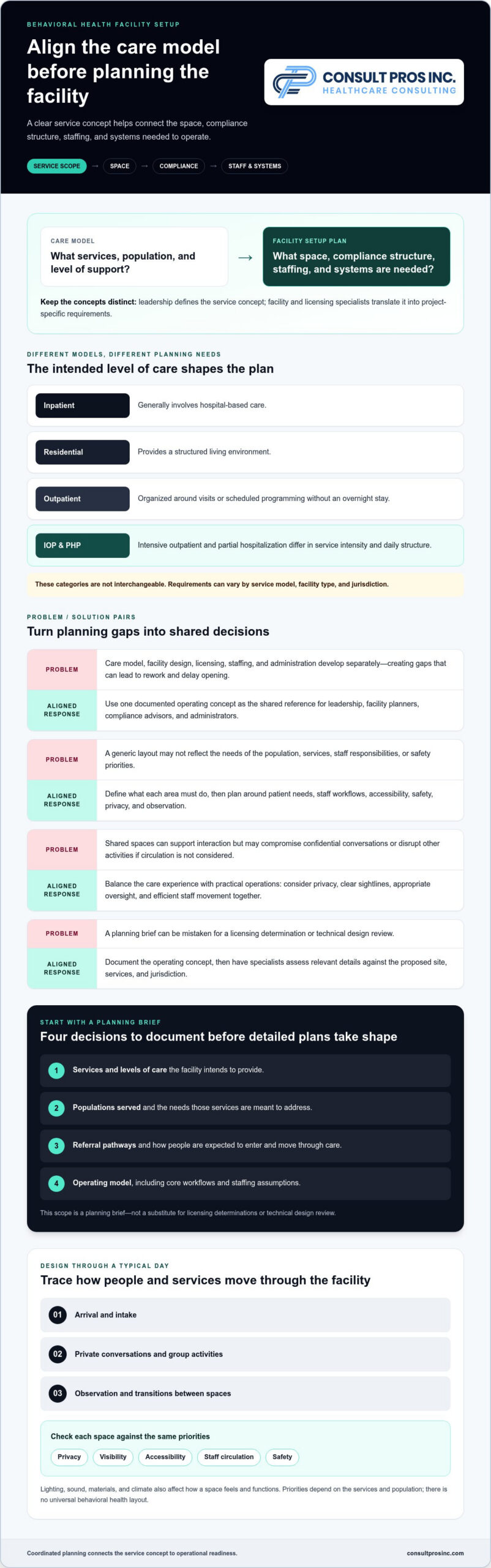
A behavioral health facility setup is more than a floor plan, license application, or staffing chart. It is the coordinated plan for aligning the services an organization intends to provide with its site, compliance foundations, workforce, and operating systems. Start with the care model because every later decision depends on what the facility is designed to do and whom it is intended to serve.
A care model defines the services, population, and level of support an organization intends to provide; a facility setup plan translates that model into the space, compliance structure, staffing, and systems needed to operate. Keeping the two concepts distinct gives early planning a clear focus: leaders establish the service concept, and facility and licensing specialists translate it into project-specific requirements. A general overview of the history and types of psychiatric hospitals offers useful context, but it does not replace planning for a facility’s own scope.
Inpatient care, residential programs, outpatient services, and other models serve different operational purposes. Inpatient settings generally involve hospital-based care, residential programs provide a structured living environment, and outpatient services are organized around visits or scheduled programming without an overnight stay. Intensive outpatient and partial hospitalization services also differ in service intensity and daily structure. These categories are not interchangeable, and requirements can vary by service model, facility type, and jurisdiction.
How the intended level of care shapes facility planning
Start with the needs the program is designed to address. Then map how patients, staff, and services will move through a typical day. A program built around scheduled groups may need different room use and transitions than a program with overnight stays or more intensive observation needs. These assumptions inform space planning, staffing, privacy, and workflow, so test them together rather than treating them as separate design questions.
There is no universal behavioral health layout. Patient population, service intensity, staff responsibilities, and applicable oversight all shape the plan. Early concepts should establish functional needs; design and compliance specialists can then assess how those needs translate to the specific site and governing requirements.
Which early decisions define the setup scope?
Before detailed plans take shape, leadership should document the operating concept. Clarify:
- The services and levels of care the facility intends to provide.
- The populations it plans to serve and the needs those services are meant to address.
- Referral pathways and how people are expected to enter and move through care.
- The intended operating model, including core workflows and staffing assumptions.
This scope is a planning brief, not a substitute for licensing determinations or technical design review. Specialists can use it to assess relevant details against the proposed site, services, and jurisdiction. Keeping those roles distinct helps leaders make foundational decisions without presuming regulatory conclusions.
A documented scope gives the project team a shared reference point. When leadership, facility planners, compliance advisors, and administrators work from the same service assumptions, they can spot conflicts earlier, clarify ownership, and reduce avoidable revisions. That shared foundation makes the detailed planning that follows more coherent.
Design a Behavioral Health Facility Around Safety and Patient Needs
Physical planning should translate the care model into a workable environment, not impose one standard layout on every program. Begin with the needs of the intended patient population, the services delivered, staff responsibilities, and the safety priorities those services require. Then trace a typical day through the facility, from arrival and intake to private conversations, group activities, observation, and transitions between spaces. This exercise helps identify where design must support privacy, visibility, accessibility, and efficient staff movement at the same time.
Patient-centered design works best when each environmental choice supports both the experience of care and the practical work required to provide it. A welcoming shared area, for example, can encourage interaction, but its location and circulation should also protect confidential conversations and avoid disrupting other activities. In a behavioral health facility setup, design is an operational decision as well as a construction decision.
Translate patient and staff needs into design priorities
Assess what each area needs to do before selecting finishes or furnishings. Consider how patients enter and move through the space, where staff need clear sightlines, and how people can access private conversations while maintaining appropriate oversight. Plan for accessibility and staff circulation alongside safety, rather than treating them as late-stage corrections. The right priorities depend on the services provided and the population served.
Lighting, sound, materials, and climate also shape how a space feels and functions. Glare or inconsistent lighting may affect comfort; noise from shared areas may interfere with conversation; and temperature or material choices can influence how usable a room feels throughout the day. Preferences depend on context, so avoid assuming one color palette, sensory approach, or room arrangement will suit everyone. Design measures can support safety, but no product or layout eliminates all risk.
Coordinate facility planning with applicable guidance
Use a clear review sequence: establish functional needs, develop a preliminary layout, and assess it against current guidance and requirements that apply to the facility. Design references can inform planning, but they do not automatically have the force of a binding requirement. Applicability depends on the project, and the relevant authorities determine which requirements govern. Before relying on Facility Guidelines Institute materials, verify the current edition and whether its scope covers the facility type and services being planned.
Coordinate early. A proposed room arrangement can affect staff workflows, privacy, and the ability to observe shared areas, so facility planners and operational leaders should review plans together before details are fixed. This helps prevent a design issue from surfacing only after it has affected other project decisions. A structured facility planning and operational setup review connects floor-planning assumptions with broader readiness needs. Explore treatment center facility planning for care and compliance for more guidance on coordinating space, patient needs, and applicable requirements.
Keep a written record of design priorities and the reasons behind them. Documenting patient needs, staff workflows, safety considerations, and applicable guidance together gives the project team a practical basis for reviewing changes and maintaining alignment as planning advances.
Coordinate Compliance, Governance, and Financial Foundations
A thoughtful design and defined care model do not make a facility ready to operate if approvals, policies, and administrative systems are treated as one task. Each serves a different purpose. Licensing addresses authorization under applicable jurisdictional rules; accreditation involves a separate set of standards and preparation; facility design concerns the built environment; and internal policies establish how the organization will carry out its work.
Requirements vary by state, facility type, services, and applicable oversight. Map them against the proposed operating scope, then verify state-specific requirements with the relevant authority. This helps prevent assumptions about one service or facility category from being applied to another without review.
Separate licensing, accreditation, and operational readiness
State licensing is jurisdiction-specific and tied to the services and facility model subject to that state’s oversight. State licensing for treatment centers is a foundational planning decision, distinct from accreditation and payer enrollment. TJC and CARF accreditation are distinct preparation workstreams, not substitutes for licensing. Design references have a separate role: they can inform planning but do not replace applicable requirements. Operational readiness brings these strands together with the people, policies, and systems needed to put the organization’s approved operating model into practice.
Keep the workstreams visible in one planning record, with an owner, status, and next action for each. State licensing and the differences between CARF and TJC require their own detailed planning; at setup, the priority is to avoid treating one approval or review as proof that every other foundation is complete.
| Workstream | Primary function | Setup focus |
|---|---|---|
| State licensing | Addresses jurisdiction-specific authorization for applicable services. | Identify the relevant authority and track requirements for the proposed scope. |
| TJC or CARF accreditation | Addresses preparation for the selected accrediting framework. | Organize standards-related documentation, processes, and assigned responsibilities. |
| Internal operational readiness | Establishes how the organization governs and carries out its work. | Assign ownership for policies, records, staffing administration, and financial systems. |
Establish ownership for core administrative systems
Readiness requires more than writing policies. Someone must be accountable for maintaining them, controlling records, coordinating compliance tasks, and keeping administrative processes usable as operations develop. A responsibility matrix can name a primary owner and supporting roles, and show where records are kept. This prevents important tasks from depending on informal knowledge held by one person.
- Governance and policies: assign responsibility for approval, review, and controlled updates.
- Records and compliance: identify who maintains documentation and tracks assigned obligations.
- Accounting and payroll: establish accountable owners for financial administration and payroll systems.
Documented ownership supports continuity as staffing and operations change. Coordinated advisory support can connect licensing preparation, accreditation planning, facility setup, and administrative foundations. Legal questions and formal regulatory determinations remain with qualified counsel and the relevant authorities.
Build a Behavioral Health Facility Setup Sequence Before Opening
A useful launch plan shows what must happen and what each decision depends on. Space plans, staffing assumptions, compliance preparation, and administrative systems should advance in coordination, with leadership resolving conflicts before they become late-stage revisions. For a behavioral health facility setup, assign a lead to each workstream and establish decision gates where the team confirms that foundational assumptions are clear enough to proceed.
Sequence decisions from scope through facility readiness
Use an ordered sequence to move from the service concept toward launch preparation. Steps may overlap, but later decisions should build on documented work from earlier stages.
- Define service scope. Leadership documents intended services, populations, referral pathways, and operating assumptions. This is the first gate: significant uncertainty about the model can undermine space, staffing, and compliance planning.
- Establish project ownership. Name accountable leads for leadership decisions, facility planning, compliance, and administration. Record who can approve scope changes and how unresolved cross-team issues will be escalated.
- Translate scope into facility needs. Facility planners use the agreed service assumptions to develop functional plans. Before a layout advances, review how proposed spaces support anticipated workflows, patient needs, and staff responsibilities.
- Coordinate design and compliance review. Assess plans against applicable licensing and safety requirements for the proposed services and jurisdiction. Treat unresolved questions as decision gates, not details to defer until the facility is nearly complete.
- Prepare people and operating systems. Develop role definitions, staffing assumptions, credential-verification processes, onboarding, and training workflows alongside accounting, payroll, records, and compliance responsibilities.
- Conduct a readiness review. Review open items across workstreams, assign owners and next actions, and determine whether the organization has addressed prerequisites for its planned operations before moving into launch preparation.
Prepare staffing and operating systems alongside the facility
Staffing is a dependency, not a final checklist item. Role definitions inform hiring and onboarding, while credential-verification and training workflows help prepare staff for their assigned responsibilities. Leadership should assign an owner and tracking method to each personnel process, then coordinate those plans with the operating model and facility workflows. Detailed personnel procedures can be developed in a dedicated staffing and onboarding plan.
Administrative foundations need the same discipline. Assign responsibility for accounting, payroll, records, policy maintenance, and compliance tasks before launch preparation is complete. Document where records are maintained, who updates them, and how outstanding issues are escalated. This makes continuity less dependent on informal knowledge or a single individual.
Readiness is coordinated evidence that essential facility, compliance, staffing, and administrative workstreams align with the organization’s planned operations. A review should make gaps visible, not simply confirm that tasks appear on separate checklists. Consult Pros Inc helps coordinate facility setup and operational structuring across connected launch workstreams. Plan your facility setup with Consult Pros Inc.
How Consult Pros Supports Behavioral Health Facility Setup
Bringing a behavioral health facility from concept to operational readiness requires connected decisions across facility planning, licensing, accreditation, staffing, and administration. Consult Pros Inc advises behavioral healthcare founders and operators on facility setup and operational structuring, organizing these workstreams around the intended services and launch priorities. This coordinated approach considers how a decision in one area may affect the others, rather than treating each requirement as a separate project.
For example, a change to the proposed service scope may affect facility planning, licensing preparation, staffing assumptions, and the systems needed to administer the organization. Coordinated oversight helps leaders see these dependencies, clarify ownership, and keep planning discussions anchored to a shared operating concept. Consult Pros Inc supports the organization’s foundations and operations, not the delivery of direct clinical treatment.
Coordinate setup workstreams under one launch plan
Facility planning, state licensing, and accreditation preparation have distinct purposes, but draw on overlapping information about services, space, staffing, and organizational processes. Consult Pros Inc structures these activities within a project plan, organizing tasks around decisions and milestones so leaders can identify dependencies and track open items. Support spans initial facility floor planning through operational readiness, while licensing and accreditation preparation proceed as related but separate workstreams.
This structure is useful when decisions move between leadership, facility planners, compliance leads, and administrative owners. A shared plan makes it easier to see what has been decided, what still requires review, and which next steps depend on further input. The organization retains responsibility for its decisions, while advisory support brings setup activities into a coordinated sequence.
Continue building operational readiness beyond the opening
Opening is a transition, not the end of operational structuring. Staffing workflows, onboarding, and training need to connect with defined roles and organizational processes, while accounting and payroll systems support routine administration. Documented responsibility for records and compliance tasks helps teams maintain continuity as the organization develops and its operating needs evolve.
Consult Pros Inc supports staffing and onboarding, accounting and payroll systems, and ongoing regulatory compliance programs, alongside facility planning, state licensing, and TJC or CARF accreditation preparation. This connected approach helps founders address launch requirements and the administrative structure needed to sustain organized operations. Leaders can use project milestones to review progress, assign unresolved items, and keep foundational systems aligned with the organization’s scope.
For behavioral health facility setup, coordinated advisory support offers a practical way to connect facility, compliance, staffing, and administrative workstreams. Discuss your facility setup plan.
Set Your Facility Launch in Motion
Turn your intended opening into a sequence of decisions, owners, and readiness milestones. Identify what needs to be resolved first, where teams depend on one another, and which open questions require specialist review. A clear starting plan helps leadership focus on the work that shapes a responsible launch instead of allowing disconnected tasks to set the pace.
Consult Pros Inc provides end-to-end guidance from facility floor planning to operational readiness, with support spanning state licensing, TJC and CARF preparation, staffing, and administrative systems. This coordinated perspective connects foundational workstreams while keeping decisions grounded in your organization’s planned services. The right behavioral health facility setup plan gives your team a practical framework to move forward with discipline and adapt as project needs become clearer.
Map your facility launch priorities with Consult Pros and take the next step toward a well-structured opening.
Frequently Asked Questions
How long does it take to set up a behavioral health facility?
There is no single timeline for opening a behavioral health facility. The schedule depends on project scope, facility model, state processes, and readiness dependencies, including how quickly decisions, reviews, staffing, and administrative systems are coordinated. If service assumptions remain unresolved, plans may need to be revisited before the project advances. Build a working schedule around required decisions and review points, then update it as authorities and project teams clarify their respective processes.
What licenses are needed to open a behavioral health facility?
Required licenses depend on the state, facility type, and services the organization plans to provide. Start by documenting the operating model, then identify the state agency or other applicable authority responsible for oversight of that facility and service category. Confirm requirements with the relevant authority, since a license for one program model may not cover another. Track any separate approvals or certifications that apply to the proposed operations as well.
Does a behavioral health facility need CARF or TJC accreditation before opening?
CARF or TJC accreditation is distinct from state licensing. Whether accreditation is needed before opening depends on applicable requirements and the organization’s business arrangements. Payer participation, contracts, or other organizational goals may influence which accreditation pathway to pursue and when to begin preparation. Map accreditation milestones separately from licensing tasks, and set timing based on the facility’s intended operations, payer strategy, and relevant oversight requirements.
What should a behavioral health facility business plan include?
A useful business plan connects the proposed services to the people, space, and systems needed to operate them. Define the target population, referral assumptions, and operating model; then address facility needs, staffing roles, and administrative responsibilities. Include financial administration, such as accounting and payroll processes, alongside the resources needed to support planned operations. Make key assumptions visible so leaders can evaluate changes coherently.
Can one behavioral health facility provide both outpatient and residential services?
A facility may be planned to provide more than one service model, but outpatient and residential operations have distinct space, workflow, staffing, and oversight considerations. For example, a program involving overnight stays raises different planning questions from one organized around scheduled visits. Before combining services, define how each will operate and how spaces and responsibilities will be organized. Applicable requirements depend on the jurisdiction, facility type, and services, so review the model with the relevant authority.
When should staffing and onboarding planning begin for a new treatment facility?
Begin staffing and onboarding planning while the operating model and facility plans are taking shape, rather than waiting until the space is ready. Early role definitions clarify which responsibilities must be covered and inform recruitment sequencing. Credential-verification procedures, onboarding materials, and training plans also need to be organized around assigned duties. A change in planned services, for example, may affect role descriptions, so revisit staffing assumptions when the operating scope changes.
What is the difference between behavioral health facility setup and facility design?
Facility design is the physical planning work: organizing spaces, circulation, and the built environment around intended use. Behavioral health facility setup is broader. It also includes the organizational work needed to prepare for operations, such as service planning, licensing preparation, staffing, accreditation preparation, and administrative systems. Design is one important workstream within that larger effort. Treating them as connected but distinct helps teams coordinate facility decisions with operational and compliance planning.